Anthropic to Implement Invisible Watermarks on Claude Starting 2026
Le brief IA que les pros lisent chaque soir
Les 7 actus IA du jour, décryptées en 5 min. Gratuit.
Inclus dès l'inscription : notre sélection des meilleurs guides & comparatifs IA.
Choisis ton rythme
Gratuit · Pas de spam · Désabonnement en 1 clic
Anthropic to Implement Invisible Watermarks on Claude Starting in 2026
Anthropic will apply invisible watermarks to all outputs from Claude globally, with marks that "can persist through certain modifications."
Anthropic has signed the Code of Practice under the EU AI Act and will equip all new Claude models with machine-readable labels starting in August 2026. This requirement will apply globally.
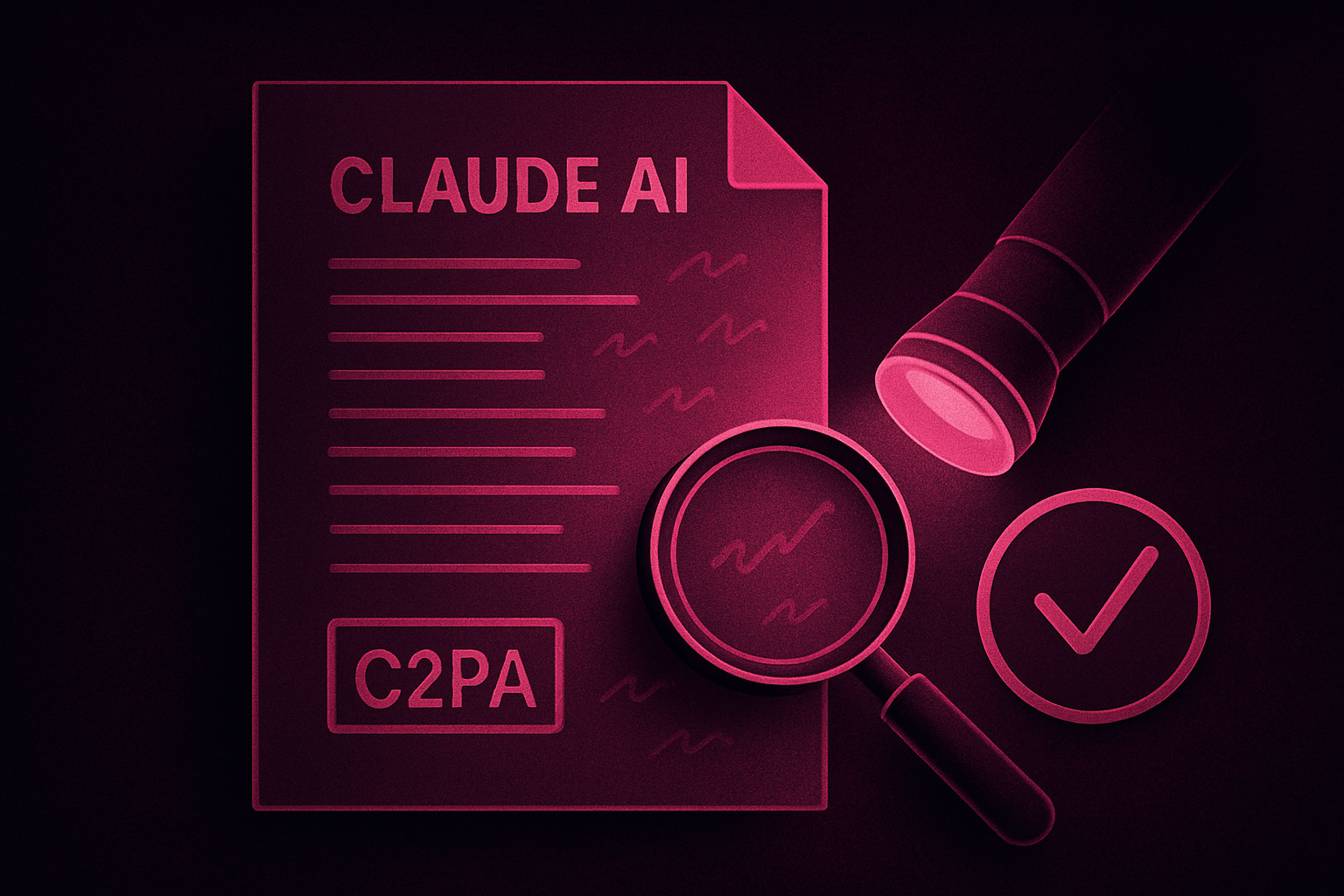
Text will receive invisible watermarks that persist when copied. Files, such as images, will obtain signed provenance metadata following the C2PA standard.
Anthropic acknowledges limitations: a watermark does not prove that Claude authored the content, as users often employ AI to modify or translate their own text. Significant modifications or changes in format may also completely remove the watermarks; however, they "can persist through certain modifications."
Anthropic has signed the Code of Practice under the EU AI Act concerning transparency for AI-generated content. Starting in August 2026, new Claude models will incorporate watermarks in the text and attach signed provenance metadata to files.
Claude models launched in the EU from August 2, 2026, will come with this label integrated. The requirement will not stop at the EU borders. It will apply globally to all Claude products, including the API, Claude, Claude Code, Claude Cowork, and Claude Tag.
Generated text will carry embedded watermarks, while generated files will receive digitally signed provenance metadata. Existing models will benefit from a transition period under the law, but Anthropic claims it is already working on their upgrade.
The company also plans to release verification tools so that users and third parties can check the labels, although it has not specified a date.
Two Methods to Make AI Content Identifiable
Anthropic plans to use two types of labels. Text generated by Claude will carry an invisible watermark that does not affect its meaning, quality, or readability, according to the company. The watermark survives copy-pasting and "can persist through certain modifications." It is applied at the model level, so it does not matter which Claude product you are using.
Supported files, including .svg, .png, and .jpg images, will carry signed provenance metadata based on the open standard C2PA, developed by the Coalition for Content Provenance and Authenticity. The signature indicates that Claude processed the file and can reveal subsequent modifications. Text watermarks should also work through cloud partners such as AWS, Google Cloud, and Microsoft Foundry, although these platforms may not support signed metadata.
Detection Has Certain Limitations
Anthropic is transparent about the limitations. A detected watermark does not mean that Claude actually wrote the content. Users often utilize Claude for proofreading, translation, or summarization, so the output may carry a watermark even if the ideas originated from a human.
The absence of a watermark does not clarify the situation either. The model could have been shipped before the deployment of watermarks, the text could have been heavily modified or translated, the passage could be too short for reliable detection, or the metadata could have been removed during a format conversion or screenshot capture.
The real test is how these watermarks survive editing, reformatting, and translation. If they hold up, verifying a known watermark should be more reliable than tools like Pangram, whose proprietary detection methods do not reveal what triggered a result. Third-party detectors could add support for Anthropic's watermark, providing them with a more reliable signal.
AI Text Detection Remains a Sensitive Topic in Society
Anthropic is not alone in this field. Google DeepMind has open-sourced its SynthID watermarking system, integrating it into the Gemini models. SynthID slightly adjusts probability values when predicting tokens to create a watermark without degrading text quality. It works in multiple languages but struggles with texts that have been modified after generation.
OpenAI has held a text detector with 99.9% accuracy for about two years and has yet to release it. Reasons include the ease with which users can circumvent it through translation or rewriting, the risk of stigmatizing certain groups, and concerns that a public detector could harm OpenAI's business.
This risk is particularly serious in the education sector, where unreliable detectors can lead to false accusations of cheating. At the same time, there are good reasons to want to know when and to what extent AI has been used. Studies show that heavy reliance on AI tools can weaken critical thinking and writing skills, especially among students who view them as shortcuts rather than learning tools. The issue extends beyond academia, with scammers now enrolling fake students in U.S. universities and using AI to navigate courses and collect financial aid.
Anthropic's decision could also impact its business. Claude is popular for knowledge work, particularly among students, as even older models produce relatively natural prose. With schools and universities already grappling with the use of AI in academic work, more reliable detection could make Claude less appealing to these users.
Brief IA — L'actualité IA en français
L'essentiel de l'actualité de l'intelligence artificielle, décrypté et expliqué chaque jour.