Anthropic: Kristen Swanson Advocates for Responsible AI
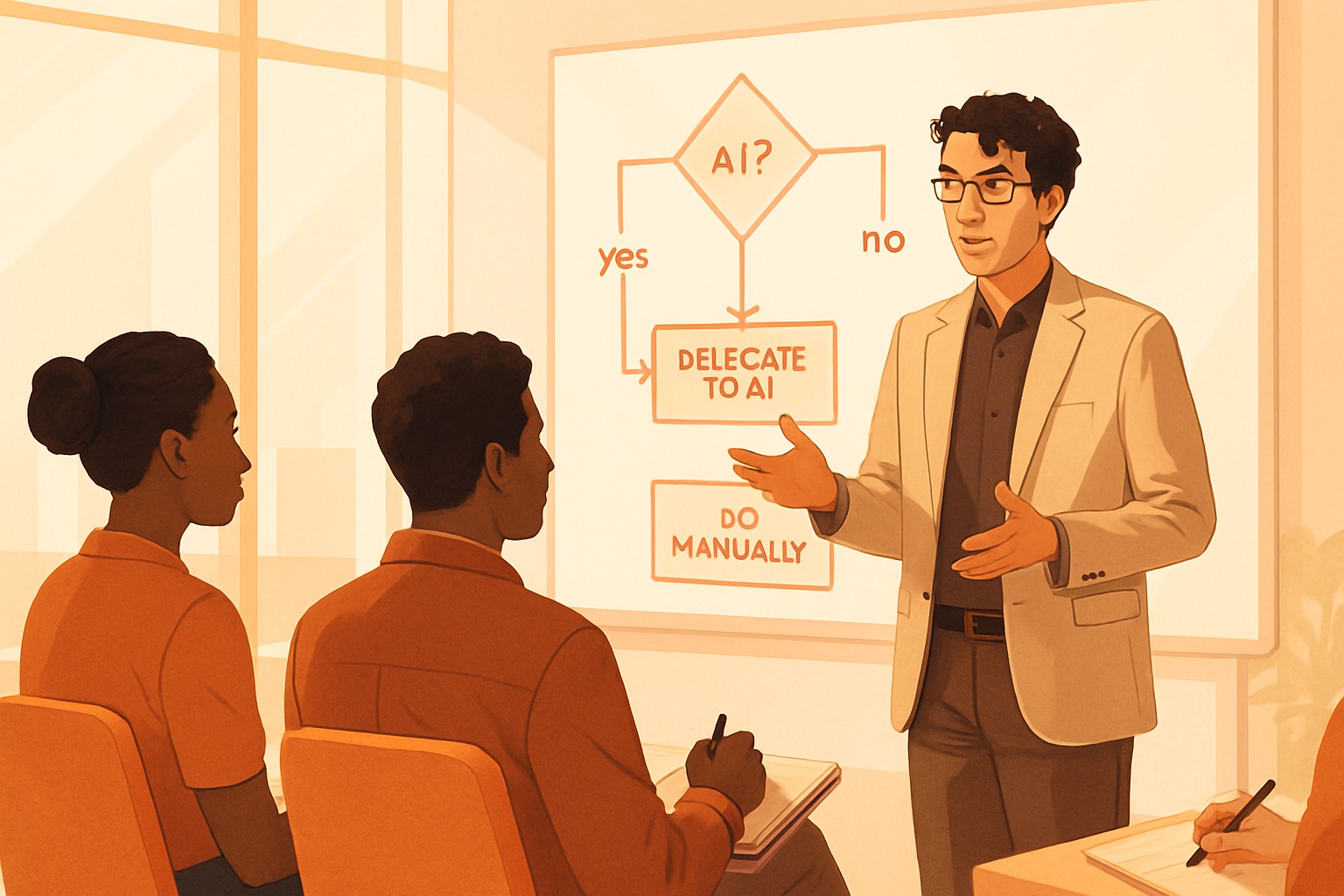
The head of AI fluidity at Anthropic, Kristen Swanson, advocates for a selective approach to automation. She describes a dynamic balance that needs to be reassessed as model advancements occur, warns of a "discernment tax," and reminds us that "more AI is not always better." Executives are also setting safeguards to preserve human thought.
Kristen Swanson urges adjustment of AI usage according to its advancements
For Kristen Swanson, the boundary between what can be entrusted to AI and what should remain under human control evolves with model advancements. She oversees Claude Academy, which offers educational resources on AI, and emphasizes that a task that seems today to require personal execution might be better suited for AI in six months. Experienced users regularly reassess the technology's capabilities to avoid "capability overhang," which refers to a fixed understanding of AI's possibilities based on past experiences. Claude Academy encourages users to document some of their most challenging tasks and then retest them with the arrival of new models to observe progress. According to Swanson, the latest generations of models may excel at certain tasks while struggling with others, and these retests help clarify what is possible. She promotes a continuous experimentation approach, where trial and error take precedence over seeking the perfect setting or phrasing.
The "discernment tax" and the technical limits of AI
Kristen Swanson warns that in some cases, verifying AI output requires more effort than performing the task oneself, a cost she refers to as the "discernment tax." Delegating the right tasks to AI can make the time spent checking its results worthwhile, but for activities that are already well mastered, this time can negate the expected gain. She believes that accurately judging a model's output is a demanding and sometimes exhausting intellectual exercise. Asking AI for tedious data analysis may be appropriate, while entrusting it with writing a post on a subject one knows well can lead to additional filtering. These cognitive costs are compounded by technical limitations: if a model lacks information about a very specific article or researcher, it may produce incorrect responses.
Le brief IA que les pros lisent chaque soir
Les 7 actus IA du jour, décryptées en 5 min. Gratuit.
Inclus dès l'inscription : notre sélection des meilleurs guides & comparatifs IA.
Choisissez votre rythme
Gratuit · Pas de spam · Désabonnement en 1 clic
Managerial safeguards to preserve thought
Executives are seeking to clarify the internal use of AI as many companies encourage its adoption. Some CEOs warn against the risk of replacing personal reflection with AI. Scott Stevenson, head of Spellbook, an AI tool for drafting and analyzing contracts, recently asked his teams to present him with the "D+ version" of their ideas, rather than AI-refined texts, to see the underlying reasoning and avoid inflated memos. This judgment capacity is becoming increasingly important as AI integrates into more professional activities.
Defining fluidity: delegating wisely, abstaining when necessary
Kristen Swanson, head of AI fluidity at Anthropic, summarizes her guiding principle: the key skill is knowing what to delegate to AI and when to refrain from doing so. Her role is to help users better leverage the models, which often involves recommending that certain tasks be performed without AI; she notes that she spends at least half her time explaining these non-usage cases. The most skilled users are not those who turn to AI for everything, but those who demonstrate discernment in delegation and assess when the tool saves time, when it creates time, or when human intervention is necessary. For her, becoming fluid means integrating these choices until they become natural, rather than multiplying prompts, features, or tools. She insists: "more AI is not always better" and "more AI does not necessarily mean fluid AI."
Brief IA — L'actualité IA en français
L'essentiel de l'actualité de l'intelligence artificielle, décrypté et expliqué chaque jour.