Anthropic Makes Progress on the Riemann Hypothesis
Le brief IA que les pros lisent chaque soir
Les 7 actus IA du jour, décryptées en 5 min. Gratuit.
Inclus dès l'inscription : notre sélection des meilleurs guides & comparatifs IA.
Choisis ton rythme
Gratuit · Pas de spam · Désabonnement en 1 clic
Anthropic Makes Progress on the Riemann Hypothesis
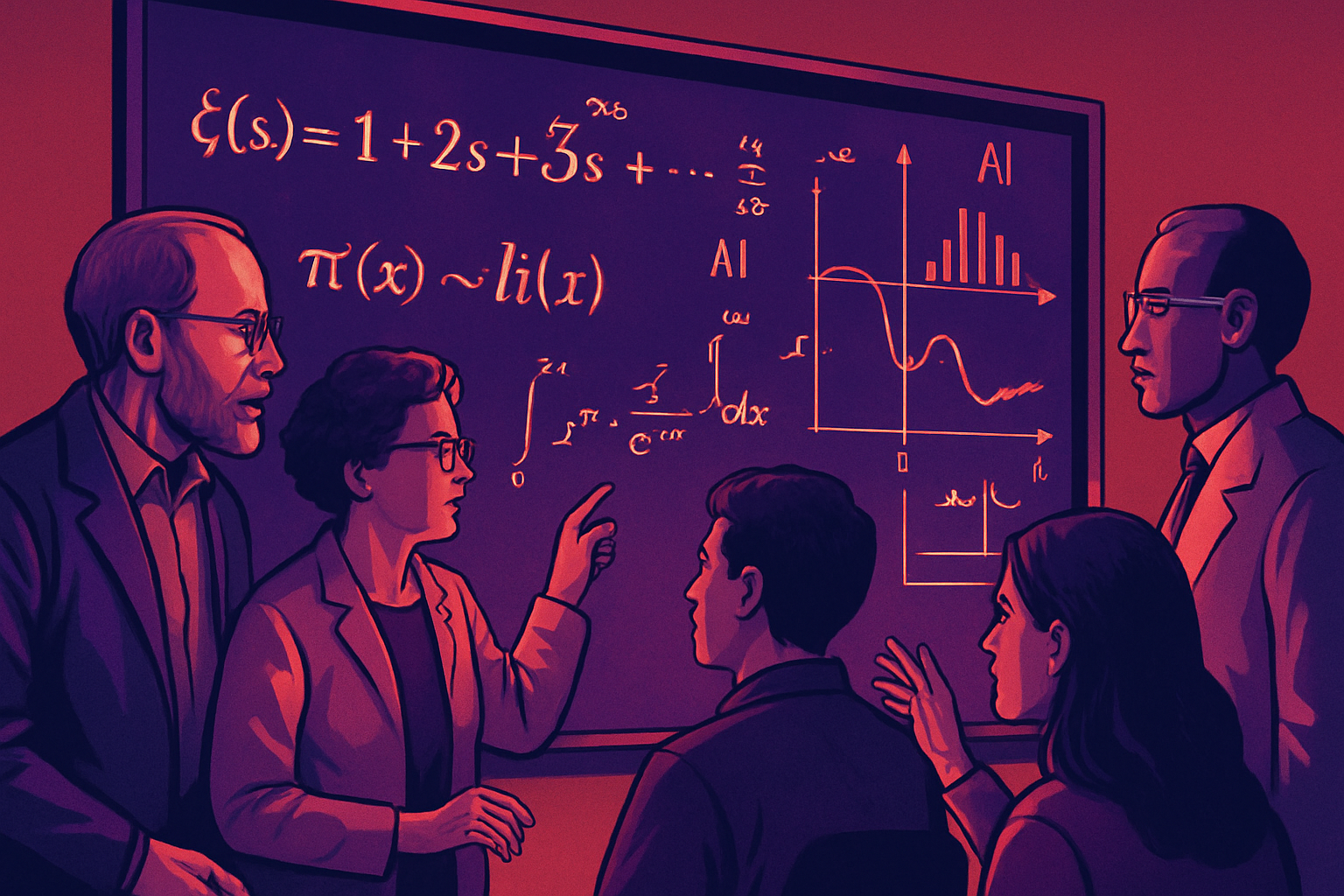
For over 150 years, the Riemann Hypothesis has remained one of the major unresolved problems in mathematics, a long-standing mystery concerning the distribution of prime numbers. Currently, a reward of $1 million is offered for a functional general proof of the hypothesis, which remains unclaimed.
Contemporary AI models still fail to solve it as well — but they can make progress far beyond what one might expect, a discovery likely to reopen long-standing questions about the ability of contemporary AI to uncover new scientific and mathematical ideas.
On Monday, Anthropic announced that an unpublished model had made significant advances on the Riemann Hypothesis, greatly increasing the lower bound of the solutions for which the hypothesis holds true.
Even more impressive is how this progress was achieved: a staff member at Anthropic, without significant mathematical training, asked the model to "seriously tackle" the proof of the hypothesis, then allowed the model to coordinate the task over the next day and a half.
In total, the model tested 650 different ideas to solve the problem, coordinating 60 sub-agents and expending a total of 31 million output tokens.
- "Among the 60 sub-agents, two were responsible for developing the key mathematical ideas," explains a footnote in the article,
- "13 contributed ideas to these agents, 30 attempted (but failed) to develop new ideas, 13 served as validators to check the correctness of the arguments, and the last two helped draft the initial article."
The discovery was confirmed by two internal mathematicians at Anthropic and formalized using the open-source proof assistant Lean.
This is the latest in a series of mathematical breakthroughs led by large language models, or LLMs. A number of Erdős problems have been solved by AI models this year, and the release of more powerful models has led to even more impressive results. OpenAI recently published a set of 10 major results proven by its internal model "Astra," while a separate effort by Anthropic refuted the long-standing Jacobian conjecture.
The growing accumulation of results has sparked both excitement and concern in the mathematical community. In a public statement signed in June, a group of prominent mathematicians expressed concerns that AI could undermine critical values of the field — particularly the norm that true mathematical proofs should be "attributable to specific authors who take credit for their discovery and assume responsibility for its correctness."
However, the field remains divided on how mathematicians should approach these new research techniques. In a blog post responding to the statement, Fields Medal winner Timothy Gowers questioned whether the influence of AI could change mathematics in more complex and positive ways.
"If we arrive at a world where mathematical theorems are no longer associated with mathematicians, perhaps that will not be more problematic than the fact that stars are not named after astronomers and that most are not named at all," Gowers wrote.
Brief IA — L'actualité IA en français
L'essentiel de l'actualité de l'intelligence artificielle, décrypté et expliqué chaque jour.