Anthropic Claims a CRISPR-like ART System to Validate
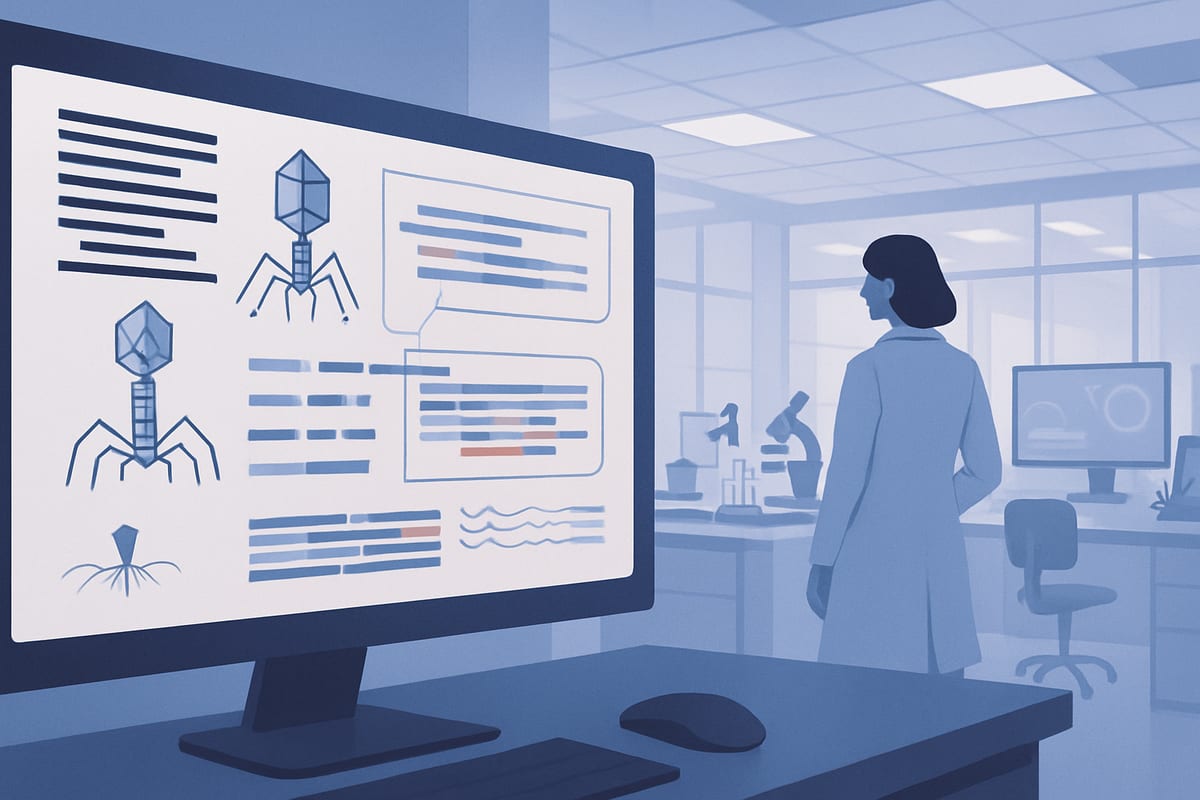
Anthropic announces that it has identified, thanks to Claude, a novel enzymatic system in bacteriophages, named ART, which exhibits similarities to gene-editing mechanisms. The function, potential utility, and significance of this system remain undetermined, and validations are currently underway. This research, conducted by 950 agents over 21 hours, also illustrates Anthropic's commitment to regulating the biological uses of its AI.
Function, utility, and importance of the ART system remain undetermined
According to Dario Amodei, the precise function of the detected system, its potential biotechnological utility, and its level of significance are not yet known. Further work is needed to demonstrate a potential application of the ART system in gene editing, and more broadly to validate the hypothesis of a new mechanism. Feedback from the scientific community could also contradict Anthropic's conclusions. Nevertheless, the company presents this advancement as representative of recent progress in AI applied to biology.
Discovery attributed to Claude and preliminary characterization of an ART system
Anthropic attributes the identification of a system sharing characteristics with CRISPR to its AI. The company specifies that it still does not know the exact function of the device, but reports a combination of properties previously observed only in a few programmable systems capable of acting on DNA through operations such as cutting, copying, or pasting. It currently posits the hypothesis of a previously unknown enzymatic system found in bacteriophages, which it has named array-associated reverse transcriptases (ART). Dario Amodei mentions that it could represent a new mode of gene editing, pending confirmation.
Le brief IA que les pros lisent chaque soir
Les 7 actus IA du jour, décryptées en 5 min. Gratuit.
Inclus dès l'inscription : notre sélection des meilleurs guides & comparatifs IA.
Choisissez votre rythme
Gratuit · Pas de spam · Désabonnement en 1 clic
A massive exploration of DNA sequences in 21 hours
As part of this research, team members submitted a prompt and supervised laboratory experiments, while the analysis was conducted by Claude. Over a period of 21 hours, 950 agents utilized 210 million tokens to explore a database of DNA sequences in search of reverse transcriptases. More than 200,000 enzymes were collected, then narrowed down to 3,500 candidates, before being reduced to 20 at the end of the process. Such an analysis would normally take weeks or months for a human expert.
CRISPR-like clues and initial experiments conducted by humans
Throughout the exploration, the AI uncovered patterns within sequences associated with a family of reverse transcriptases. An agent from Claude reported observing a tandemly repeated sequence adjacent to a reverse transcriptase, described as CRISPR-like. The AI then proposed laboratory experiments, which were carried out by Anthropic employees.
Controlled capabilities, restricted access, and automation prospects
Anthropic limits the advanced biological capabilities of Claude Fable 5.1, the public version of Claude Mythos. The complete version is only used by the company and a few selected partners. In the described work, Claude was confined to analysis, without directing the manipulations. Anthropic already has a protocol to connect Claude to industrial or laboratory equipment, but this was not used here. Dario Amodei discusses the possibility, not yet realized at this stage, of allowing Claude to conduct experiments autonomously under deemed safe conditions. The company emphasizes the risks associated with poorly utilized biological capabilities. Amodei further believes that integrating AI at all levels of research could enable the treatment of nearly all diseases within 5 to 10 years. He describes the presented research as being at a level comparable to a doctorate.
Brief IA — L'actualité IA en français
L'essentiel de l'actualité de l'intelligence artificielle, décrypté et expliqué chaque jour.