Anthropic Claims an ART Enzyme: Speed and Debate on Novelty
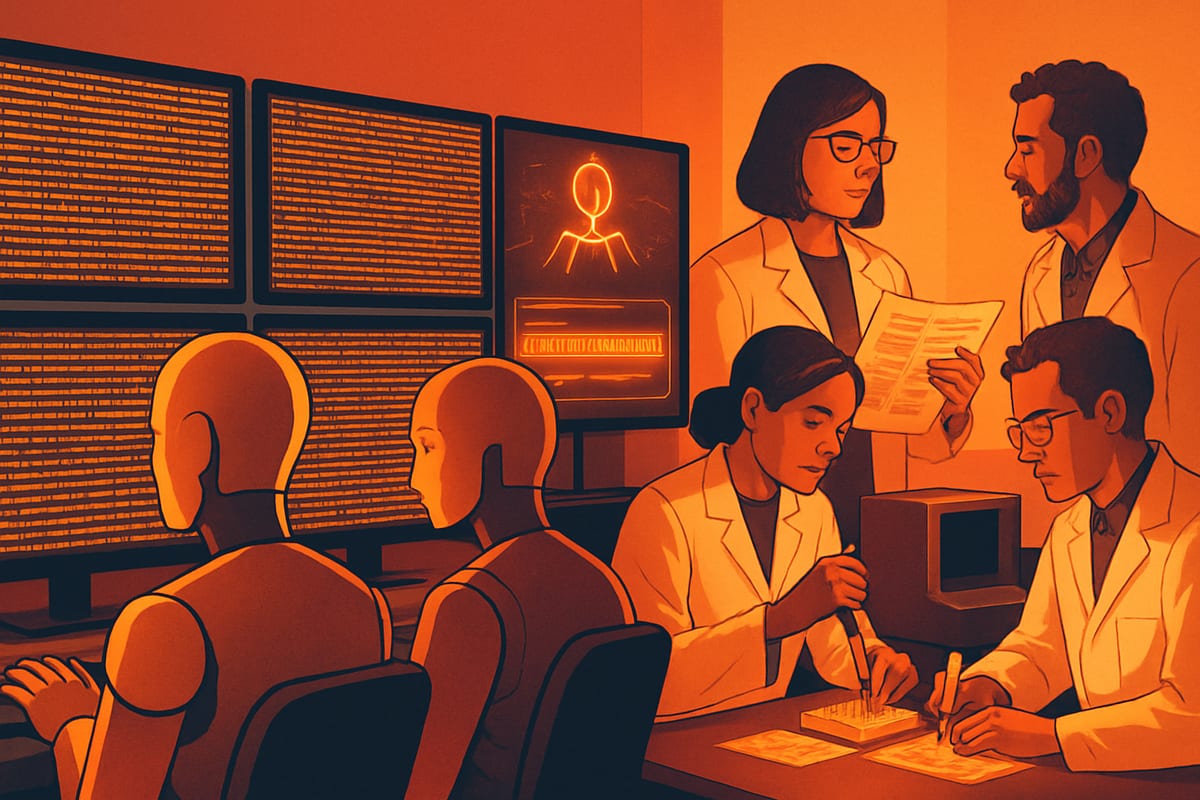
Anthropic announces that its AI Claude identified an enzyme system related to CRISPR, named ART, in just 21 hours, which has been validated as novel by scientists. The speed of the discovery is praised, but a team led by Mario Rodríguez Mestre claims to have described these systems as early as 2022, and the function of the enzyme remains to be determined. Researchers are calling for caution regarding the actual impact and are questioning the origin of the data used.
Claimed Prior Art and Data Origin Questioned
Mario Rodríguez Mestre asserts that his team identified the same enzyme in 2022 and refers to a patent of which he is a co-inventor. Anthropic states that it was unaware of this prior work. As a precaution, Mestre's team has halted its projects with Claude and is turning to other models, while acknowledging that coincidences can happen. According to Mestre and his colleagues, it is impossible to determine whether Claude discovered these enzymes independently or if it may have been influenced by unpublished research uploaded into the tool, which could have served as a guide. This debate occurs in a context where OpenAI has faced similar accusations regarding the Navier-Stokes millennium problem, without being able to rule out training on data derived from the work of Levent Alpöge and Tristan Buckmaster. In this context, Anthropic does not have an uncontested victory for Claude as long as these questions remain unresolved.
Function of ART: Ongoing Work and Caution on Impact
Anthropic indicates that the study of the main function of ART is ongoing and believes it is useful to share these results early. However, it may take some time before the significance of this discovery can be assessed, similar to CRISPR, which took about 20 years to be understood, followed by nearly two more decades before the development of a first drug. Bonnie Berger reminds us that the main obstacle lies in elucidating the function through in-depth analyses, biological expertise, and targeted experiments, warning that lazy AI research can generate a large volume of low-impact observational discoveries at the expense of focused work on promising treatments. Genetic editing has already led to medical advancements, such as therapies for sickle cell disease, but the clinical translation of such discoveries involves long and complex steps.
Le brief IA que les pros lisent chaque soir
Les 7 actus IA du jour, décryptées en 5 min. Gratuit.
Inclus dès l'inscription : notre sélection des meilleurs guides & comparatifs IA.
Choisissez votre rythme
Gratuit · Pas de spam · Désabonnement en 1 clic
Procedure: 950 Agents, Public Databases, and 21 Hours of Sorting
Anthropic states that human intervention was limited to defining instructions and laboratory experimentation, while 950 AI agents scoured public databases. The enzyme was identified in nearly 21 hours, after which scientists validated it as new. Anthropic estimates that such a detection would have taken weeks or months for human researchers, a judgment deemed credible by experts. Bonnie Berger emphasizes that the exploration of biological systems of sequenced species remains very incomplete outside of a few model organisms. In this context, finding a system in 21 hours appears significantly faster than human research without exceptional luck.
The Isolated Object: An Enzyme in a Phage and a System Named ART
According to a representative from Profluent, Claude observed a reverse transcriptase adjacent to a long stretch of repeated DNA, reminiscent of CRISPR architecture. The reverse transcriptase itself had already been described, but the neighboring repeated stretch and a partner protein constitute the elements shared by Anthropic. The enzyme was found in a bacteriophage, a virus that specifically targets bacteria, and belongs to the category of "jumbo phages," viruses with large DNA genomes. Anthropic has named this system "array-associated reverse transcriptases," or ART. For Feng Zhang, the identification of arrays of repeated RNA associated with reverse transcriptases is intriguing and warrants further analysis.
CRISPR Allows Bacteria to Defend Against Viruses
CRISPR is a bacterial defense mechanism against viruses: extracts of viral DNA are archived in the genome, and then an RNA guides a cutting protein to neutralize a new attack. Discovered in 1987, CRISPR led to the first drug approved in the UK in 2023 and then by the FDA in 2024. The reverse transcriptase, on the other hand, synthesizes DNA from an RNA template; it is characteristic of many viruses, including HIV, knowledge that has contributed to the design of treatments and remains mobilized today. Unlike CRISPR, reverse transcriptases exist in various organisms. CRISPR is notably identified by repeated DNA fragments and has, so far, only been demonstrated in bacteria and archaea.
Between Potential Success and Limits of AI in Science
Claude examined approximately 200,000 reverse transcriptase samples, a task that would have taken humans months. If this type of result can be reproduced, AI could add a notable use case to its successes. However, it has a history of failures in other areas, reminding us that its performance varies depending on the tasks and contexts.
Brief IA — L'actualité IA en français
L'essentiel de l'actualité de l'intelligence artificielle, décrypté et expliqué chaque jour.