Anthropic Revolutionizes Slack with Integrated AI Agents
Le brief IA que les pros lisent chaque soir
Les 7 actus IA du jour, décryptées en 5 min. Gratuit.
Inclus dès l'inscription : notre sélection des meilleurs guides & comparatifs IA.
Choisis ton rythme
Gratuit · Pas de spam · Désabonnement en 1 clic
Anthropic Introduces Claude Tag in Slack
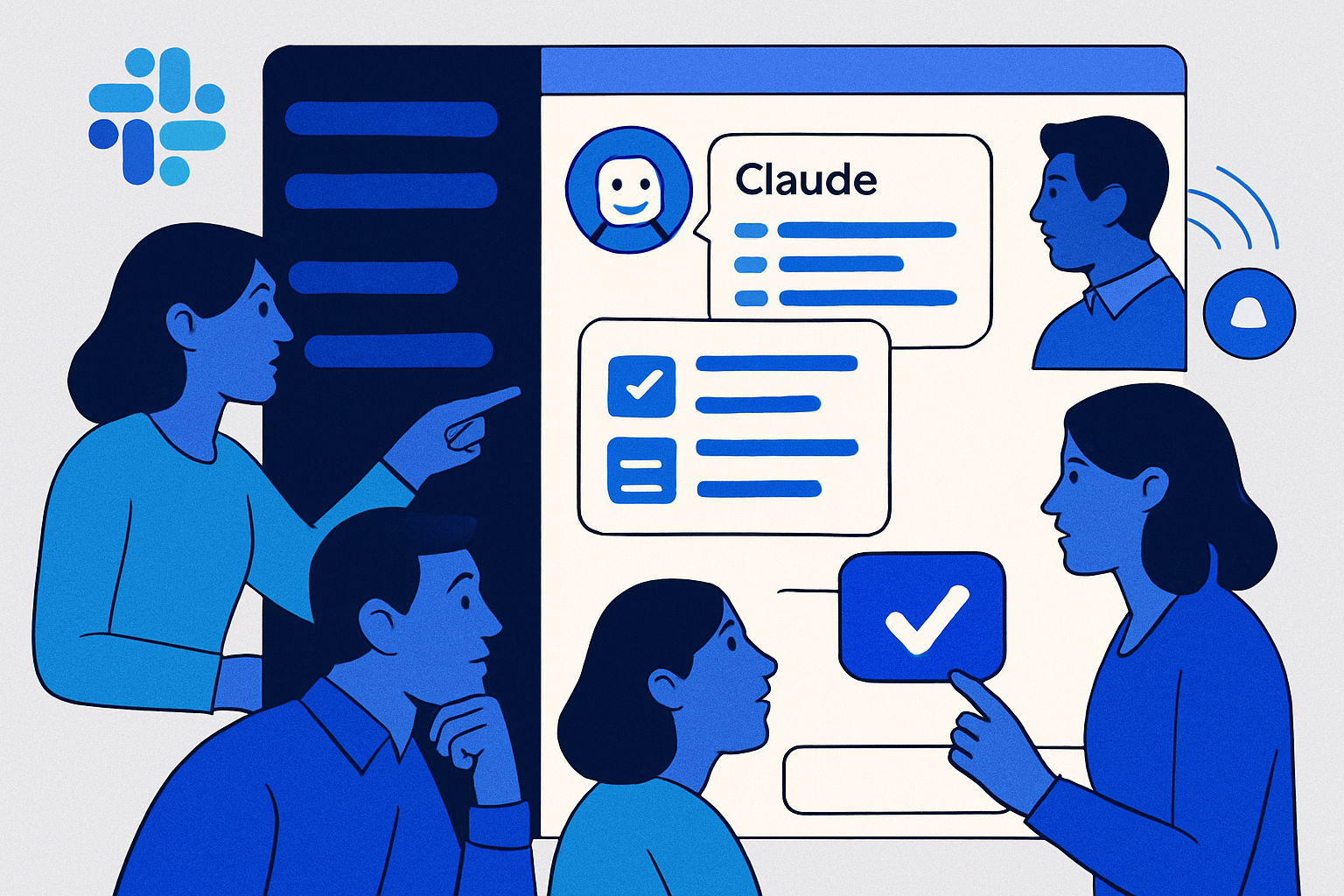
Anthropic recently unveiled a beta version of its new feature, Claude Tag, aimed at users of the Enterprise and Team tiers of Slack. This innovation allows the Anthropic chat model to be integrated directly into shared Slack channels, transforming the way teams interact with artificial intelligence. By moving away from traditional isolated chat boxes, users can now invoke the AI model simply by using the @Claude command in active group discussions.
This integration provides team members with the ability to delegate tasks, review results provided by the model, and revisit earlier points in the discussion if necessary. This change comes after an impressive Series H funding round, reaching $65 billion, which has propelled Anthropic's post-money valuation to $965 billion. This amount far exceeds OpenAI's valuation of $852 billion.
Revolutionizing Workflow in Channels
Traditionally, generative software requires employees to transfer data between team discussions and separate browsers. Anthropic aims to eliminate this back-and-forth by restructuring its AI agents to operate within collaborative environments.
Rob Seaman, General Manager of Slack, explained that Claude Tag operates seamlessly within team discussions, thereby changing how context is managed within organizations. With this shared visibility, team members can track task progress in real-time, directly within the communication window.
The system utilizes ongoing information from active channels to build context, reducing the need to continuously re-enter essential data or project objectives.
Technical Functionality and Asynchronous Tasks
The integration of Claude Tag relies on Anthropic's Opus 4.8 engine. When a task is assigned, the model breaks it down into sequential steps and utilizes enterprise databases, tools, and code repositories to complete the work.
A key feature of these AI agents is their ability to operate asynchronously, without immediate human intervention. If a network administrator activates "ambient" mode, Claude Tag can monitor discussions and manage tasks autonomously. The agent is capable of checking inactive discussions, flagging priority notifications, and tracking unresolved tasks over several days.
Cat Wu, Product Lead for Claude Code, emphasized that this innovation focuses on enhancing user configuration rather than a complete overhaul of logic. She explained that the ability to tag Claude Tag as a colleague is very powerful, allowing the system to analyze incoming communications and send immediate alerts in Slack.
Administrative Measures and Controls
Internal reports from Anthropic reveal that the automation of code generation has transformed engineering activities, with 65% of the code produced by the internal group thanks to Claude Tag.
Beyond software development, the company is also targeting non-technical office employees. Early implementations at client sites focus on querying databases, data analysis, and processing IT support tickets.
This expansion requires a distinct security infrastructure to protect sensitive information. System administrators must create limited-scope Claude identities to restrict data access. All tool integrations are confined to specific channels authorized by the IT department.
Management portals also provide detailed tracking logs of user queries and organizational caps to regulate monthly token costs.
Challenges for the Company: Autonomy and Governance
Integrating generative tools into corporate communication channels offers clear benefits, such as optimizing routine tasks. By centralizing information in active discussions, companies can reduce friction and capture context across changing project teams.
However, this delegation of tasks to automated agents presents risks for IT departments. The access of automated systems to chat histories and email accounts increases the risk of exposing internal data.
If access limits are poorly configured, sensitive information could be shared in unapproved channels. Additionally, the autonomy of agents eliminates direct human verification, exposing teams to errors if the model misinterprets instructions.
Decision-makers must weigh productivity gains against the security and compliance requirements necessary to manage a constantly active agent safely.
Brief IA — L'actualité IA en français
L'essentiel de l'actualité de l'intelligence artificielle, décrypté et expliqué chaque jour.