Archaeologists Reassess an AI "Discovery" by a Googler
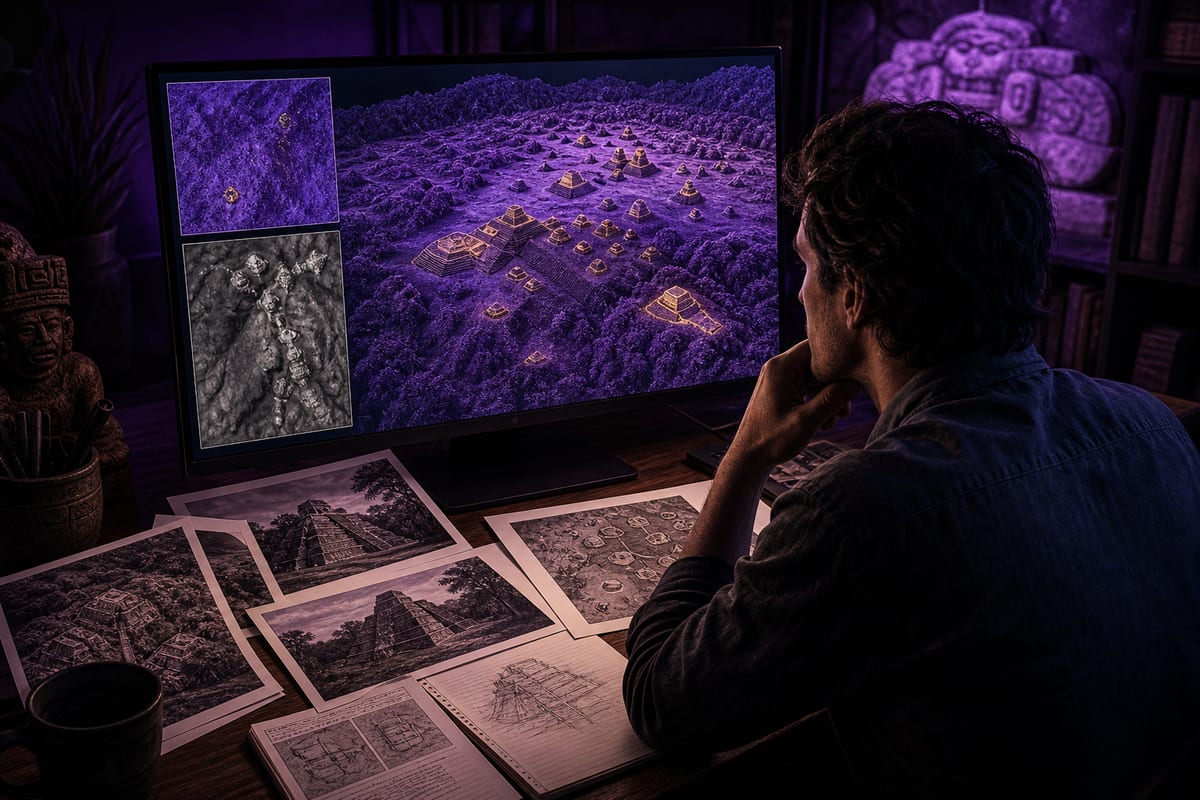
A Google researcher has announced the identification of a Maya site using 48 AI agents and lidar data. The location had been published the previous year. Archaeologists and authors of the paper emphasize the importance of verification, highlight concrete risks, and contextualize AI within the realities of fieldwork and funding.
Specialists Challenge the Announcement and Highlight Concrete Risks
Co-author of the article documenting the site in question, Ivan Šprajc, expresses little admiration for the work done with agents. He reminds us that archaeologists have been using lidar and other sophisticated remote sensing tools for a long time and believes that merely spotting a shape does little to enhance knowledge. He is also concerned about being overwhelmed by claims of discoveries from amateurs using AI, mentioning receiving an email from another "discoverer" on the same day. In his view, uncontrolled publicity about locations can attract looters, although he does not see a major problem as long as there is no looting.
Elizabeth Graham, a professor of Mesoamerican archaeology, asserts that the real issue is not finding new sites. According to her, most researchers in the Maya region are already aware of many unexplored, unexcavated, or unmapped sites, often identified on foot. She also criticizes the use of the word "discover," as local communities are often already aware of these places. While she considers the lidar mapping of mounds to be a valid effort—though a delicate interpretation—she stresses a more pressing obstacle: funding. She points out that there are no longer resources available for excavation or mapping as there once were, making the number of "newly discovered" sites largely irrelevant.
How the Announcement Was Made and What the Author Actually Did
Pietro Miotti, a researcher at Google, claimed to have identified a Maya site in Mexico that might not be present on existing maps, mobilizing a team of 48 artificial intelligence agents. The idea reportedly came to him during a trip to Peru. He chose to use lidar, a laser mapping technology that produces three-dimensional images, and had NASA's lidar data analyzed for signs of undocumented sites. Believing that Peru is poorly covered by public data, he focused on the Maya area.
The agents flagged numerous promising locations, including a large village that did not appear to be recorded. Miotti presents the entire endeavor as a personal project without Google resources and states that he contacted INAH to verify whether the site was known, including through unpublished research. He indicates that he used agents to translate his communications into Spanish and reports receiving a response from INAH stating that there was no record for this location. He claims that less than 72 hours elapsed between the idea and an official response from the Mexican government, while emphasizing that he is not an archaeologist and calling for verification through fieldwork. He simultaneously advocates for mapping the planet with lidar to help agents "find the rest."
Le brief IA que les pros lisent chaque soir
Les 7 actus IA du jour, décryptées en 5 min. Gratuit.
Inclus dès l'inscription : notre sélection des meilleurs guides & comparatifs IA.
Choisissez votre rythme
Gratuit · Pas de spam · Désabonnement en 1 clic
What AI Brings and Where It Falls Short Against Scientific Practices
Miotti explains that archaeologists do not publish the coordinates of sites, which requires comparing images with figures from articles rather than querying a database. He finds this verification challenging for AI agents and believes these tools need to improve. He states that he has updated his post and blog to credit the reported work. According to him, these agents can assist experts in sorting through large volumes of data, and his workflow has generated interest from archaeologists and doctoral students curious about its operation and potential utility.
More broadly, AI tools produce impressive results but do not always interact with existing literature. Announcements of breakthroughs may have already been made by others or lack acknowledgment of prior work, and even genuinely new findings can be deprived of the context provided by a specialist. Amateur usage then shifts the burden to experts to establish what has been found and why it matters. Nevertheless, Miotti defends the idea of an ongoing scientific revolution while acknowledging the need for expertise to validate what the agents identify.
The "Discovery" Was Already Published: Methodological Reminders and Corrections
The site highlighted had been discovered and documented the previous year in an academic journal. The announcement triggered criticism among archaeologists, who quickly pointed out online the prior publication. Professor Sarah Parcak emphasizes the importance of systematic verification against existing research and reminds us of the role of peer review, clarifying that an absence in a government database does not mean a location is unknown or unmapped. Other researchers denounce the spread of misinformation and the appropriation of credit for work done over decades with advanced digital tools.
Miotti admits he did not anticipate the extent of the attention and acknowledges that an unregistered site does not equate to an unmapped site. The reminder from specialists that local communities often know these places also fuels criticism of the use of the term "discovery."
Brief IA — L'actualité IA en français
L'essentiel de l'actualité de l'intelligence artificielle, décrypté et expliqué chaque jour.