AstroForge Aims for Earth-Independent AI Ship by 2027
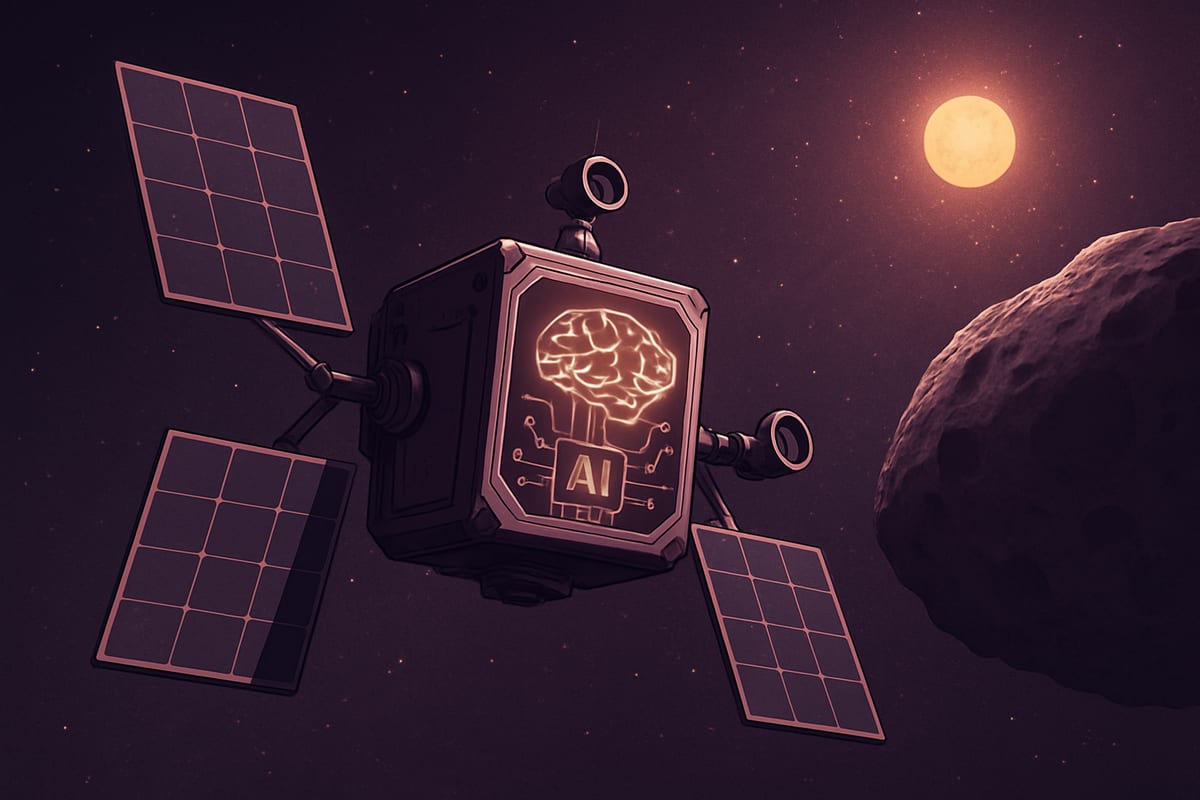
AstroForge is preparing an entirely embedded flight control system, even considering a spacecraft that does not receive commands from the ground. The Solo system, based on transformers, will first be evaluated in "shadow" mode in 2026 before a NASA-supported mission in 2027. This shift follows communication difficulties and represents a still-rare bet for space exploration.
No radios planned for Autonomy-1, testing starting in 2026
Matthew Gialich, co-founder and CEO of AstroForge, does not plan to install radios capable of receiving ground signals on the Autonomy-1 mission, while noting that the team could convince him before the flight, but for now, he maintains the option without radios. Before this mission, the company's third vehicle, DeepSpace-2, is set to launch alongside Intuitive Machines' third lunar mission, expected by the end of 2026. Solo, the autonomous control system, will then be onboard in "shadow" mode to be tested by AstroForge engineers. Afterward, AstroForge plans to fly its first autonomous spacecraft in 2027 aboard the first rocket launched by Stoke Space, during a NASA-supported mission that is expected to collect scientific data on the sun.
Limited communications and prototype failures
The number of ground stations capable of establishing a link with vehicles operating hundreds of thousands of miles away remains limited, and communication periods are brief. In 2025, AstroForge sent its vessel Odin into deep space, but the company faced difficulties in establishing communication and was unable to regain control. Previously, AstroForge had already launched two prototypes of spacecraft, each of which experienced anomalies that deprived them of the majority of their mission objectives.
Le brief IA que les pros lisent chaque soir
Les 7 actus IA du jour, décryptées en 5 min. Gratuit.
Inclus dès l'inscription : notre sélection des meilleurs guides & comparatifs IA.
Choisissez votre rythme
Gratuit · Pas de spam · Désabonnement en 1 clic
A cost-risk trade-off regarding the ground network
Matthew Gialich discusses a choice between building a ground network of about five antennas for a cost of approximately $200 million, plus its operation, or attempting to replace it with an onboard model. Following the loss of contact, the company considered integrating enough intelligence onboard so that the vessel could solve its own problems. Gialich notes that no onboard system attempted to recover Odin and expresses the hope that an embedded system could try in case of failure right from launch.
What Solo needs to do and how it is built
Armand Awad, who leads flight software development at AstroForge, states that the company has chosen to rely on advancements made with transformer models. The Solo architecture combines classical control algorithms, models trained from test data for subsystems such as navigation or power generation, and a layer of general intelligence trained from around 2,500 sensors integrated into the vessel. According to Matthew Gialich, the goal is to achieve limited autonomy, relying on a very small number of sensors, rather than generalized autonomy. In theory, the vessel's control agent should manage tasks such as anomaly resolution; Awad imagines, for example, that it could correlate a loss of position and a power anomaly to a star tracking issue and attempt a resolution by rebooting.
A still uncommon bet in space
In the space sector, vessel autonomy most often relies on classical control algorithms, with neural networks raising concerns about their reliability. It was only last year that a neural network was used for the first time to control the attitude of a satellite in orbit. AstroForge, founded in 2022 and backed by $56 million in funding, designs solutions for asteroid mining and has already developed its own transformer model in-house, the Solo stack. In comparison, missions like OSIRIS-REx have mobilized large teams, with 100 operators per eight-hour shift, relying on redundant and automated ground operations, which startups do not possess.
Brief IA — L'actualité IA en français
L'essentiel de l'actualité de l'intelligence artificielle, décrypté et expliqué chaque jour.