At Caltech, a Mathathon Brings Together Participants
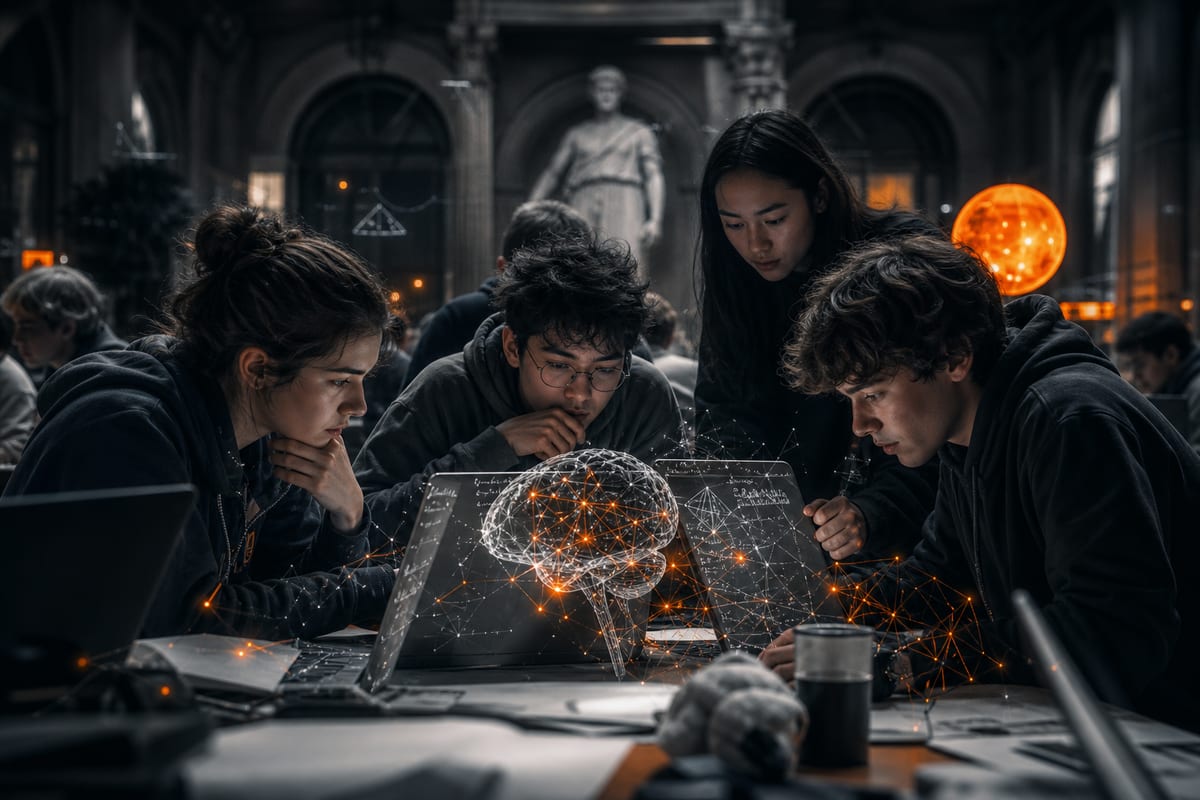
At Caltech, a mathathon brought together participants to solve mathematical problems using AI, following negotiations on the event's objectives. Among the attending students, some prioritize human understanding, while others verify the models' answers or reconsider their professional futures.
Mayla Ward Redirects the Mathathon
Mayla Ward, a second-year mathematics student at Caltech, had signed a public petition calling for the cancellation of the mathathon before becoming one of its organizers. Proposed by undergraduate students, the project was initially set to be sponsored by OpenAI and Anthropic. Ward viewed it as a commercialization of her discipline and suspected the companies would profit from it.
However, she understood the initiators' approach. Along with other graduate students, she negotiated for the event to help humans understand mathematics rather than prioritize demonstrations produced by AI, which are often incomprehensible. She aimed to bring the parties closer together; each ultimately accepted concessions, and then recognized researchers supported the meeting.
Ward now hopes to develop models dedicated to solving mathematical problems with Sergei Gukov, a professor at Caltech. She presents this research as the one that attracts her the most. She is among the students, along with Shaowu Zhang and Jack McKoen, who testified during the mathathon earlier this month.
Shaowu Zhang Verifies OpenAI's Answers
Shaowu Zhang, a final-year PhD student and teaching assistant at Caltech, is already using AI to help him write code aimed at proving conjectures. When ChatGPT launched in 2022, one of his mentors immediately confronted him with mathematical exercises. Zhang says he did not immediately see its potential. Now responsible for mentoring many students, he follows their debates and respects opponents of AI without fully subscribing to their positions: he advocates for its responsible use to enhance mathematical work.
This practice does not prevent him from questioning the companies' announcements. In October, OpenAI presented solutions to hundreds of previously unsolved problems; Zhang recounts feeling sadness at first, then wanting to verify their validity. A few days later, he activated his X account to examine several proposals, praising some contributions, suggesting extensions, or criticizing failures. On October 11, regarding a manuscript, he believed OpenAI's internal model was still far from being able to replace mathematicians.
The AI brief the pros read every evening
The 7 best AI stories, the essentials in 5 min. Free.
Included when you join: our pick of the best AI guides & comparisons.
Choose your rhythm
Free · No spam · Unsubscribe in 1 click
Zhang criticizes some for accepting OpenAI's claims without verification and asserts that the company subsequently retracted some solutions. He places more trust in mathematicians. Having grown up in China, he attended international conferences over the past decade and lived in Boston, Zurich, Hong Kong, and then Paris before moving to California.
Jack McKoen Reassesses His Professional Future
Jack McKoen, a 26-year-old PhD student at Carnegie Mellon, specializes in Lean, a language used to formalize conjectures for computer verification. This Canadian, who holds a master's degree in mathematics from the University of Alberta, joined Carnegie Mellon this year and lives near the university. He explains that he was drawn to the feeling of uncovering the secrets of the universe, while describing a large part of his discipline as "masturbatory."
On September 5, at 1:20 PM, OpenAI claimed on X that its agents had solved the Millennium Prize problem of Navier-Stokes. McKoen identifies this announcement as the moment he began to seriously consider AI. After four years and thousands of dollars spent on his specialty, he questioned the industrial opportunities he hoped to find. According to him, a person without experience can now perform part of their tasks with AI.
Between ignoring these tools, joining a young AI company, or adapting his practice, he has so far chosen the latter path. His mentor encouraged him in this direction: upon learning that he was not using AI, he recommended that he revisit his methods. McKoen is grateful for this, especially since he claims that other professors discourage this learning for their students and believes that a PhD student can thus be misdirected. Some students leave academic mathematics, others go to young AI companies, while others adopt the models while defending the role of human researchers.
McKoen does not consider his adaptation complete and believes his specialty is highly exposed to replacement by AI. He continues to contemplate a job in a young company in the sector. Some friends would disapprove, he thinks, but they would understand his decision.
Brief AI — AI news in French
The essentials of artificial intelligence news, decoded and explained every day.