At Lambda, NVIDIA Photonics Uses Removable Lasers
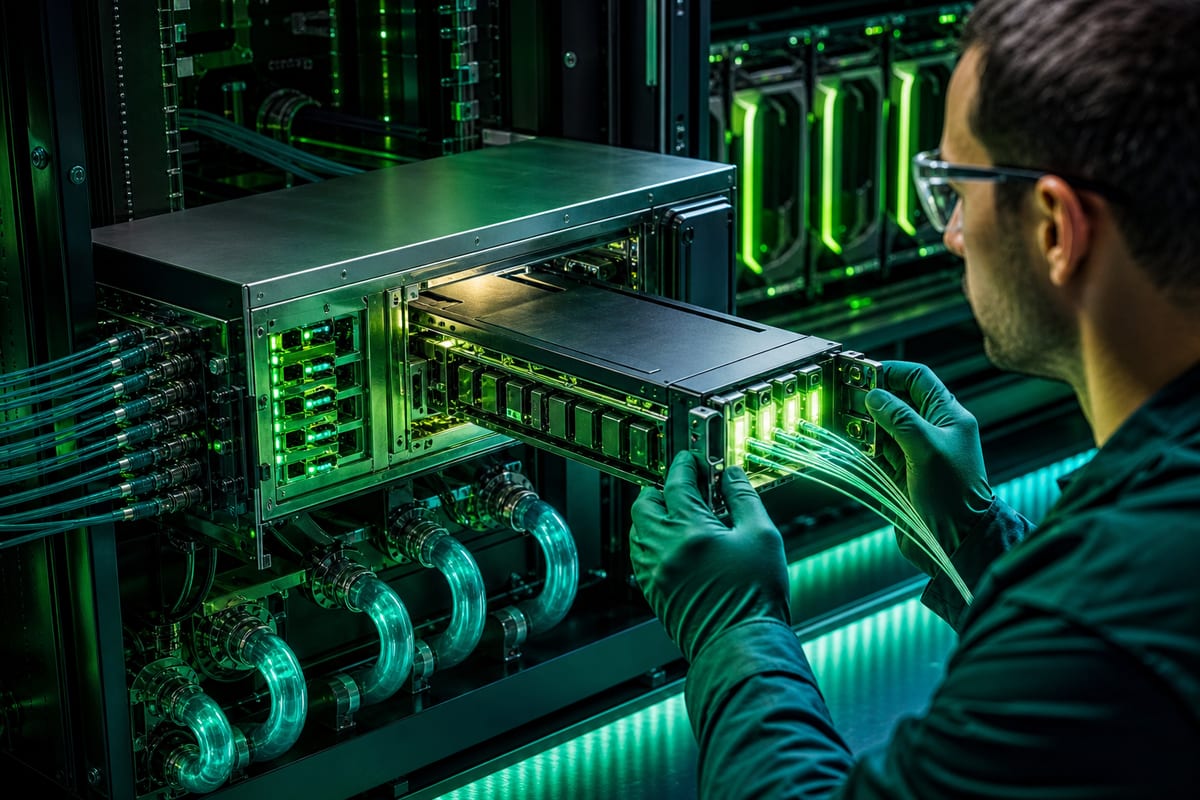
Replaceable light sources on-site equip the photonic switches deployed at Lambda. The provider also reports cooler optics compared to their conventional plug-in equivalents.
Technicians Can Replace Light Sources
Each switch installed at Lambda includes 18 external, removable light sources that power its optical engines. Their modules can be changed by technicians on-site. In contrast, a traditional plug-in optic requires the entire module to be replaced when a laser fails.
These devices each offer 144 ports at 800 Gb/s. The circuit responsible for switching, as well as the optical engines, are cooled by liquid. Lambda indicates that the median temperature of the optics reaches 36°C, compared to 51°C with conventional plug-in models. The provider also reports better signal integrity stability in its tests.
Lambda Connects Over 10,000 GPUs
Cloud provider Lambda employs NVIDIA Photonics co-packaged optics, known as CPO, to interconnect NVIDIA GB300 NVL72 racks. The deployment brings together over 10,000 GPUs. Dave Ward, president of cloud services at Lambda, believes that networks must keep pace with the growing demands of large clusters. He considers this integration of CPO a significant step in building the infrastructure for the next generation of AI.
Le brief IA que les pros lisent chaque soir
Les 7 actus IA du jour, décryptées en 5 min. Gratuit.
Inclus dès l'inscription : notre sélection des meilleurs guides & comparatifs IA.
Choisissez votre rythme
Gratuit · Pas de spam · Désabonnement en 1 clic
Training can involve thousands of GPUs working together, with requirements for speed, efficiency, and resilience for the network. This directly impacts the productivity of the infrastructure: a broken link can immobilize thousands of processors during a major training session. In an agent-based inference system, a network failure can also propagate delays to numerous agents. These interruptions represent lost time.
NVIDIA Claims Reliability Up to 15 Times Higher
The hardware principle involves replacing plug-in transceivers with optical engines housed in the same enclosure as the switching circuit, located right next to it. The conversion of electrical signals to light occurs closer to the circuit; data then travels via fiber between the cluster elements. The electrical path shrinks from several inches to a few millimeters, limiting signal loss. This architecture also eliminates the need for retimer chips, resulting in fewer components along the signal path and reduced power consumption.
Compared to conventional plug-in optics, NVIDIA claims up to 5 times greater energy efficiency and up to 15 times greater reliability. The manufacturer also announces 4 times fewer lasers, thus fewer components that could fail. It presents Lambda's deployment as less energy-intensive, more resilient, and with an extended mean time between interruptions (MTBI). The electricity used for the network is not available for computing operations.
Brief IA — L'actualité IA en français
L'essentiel de l'actualité de l'intelligence artificielle, décrypté et expliqué chaque jour.