Attio, the CRM that fills itself in and the AI that asks permission before writing
Le brief IA que les pros lisent chaque soir
Les 7 actus IA du jour, décryptées en 5 min. Gratuit.
Inclus dès l'inscription : notre sélection des meilleurs guides & comparatifs IA.
Choisis ton rythme
Gratuit · Pas de spam · Désabonnement en 1 clic
In partnership with Attio.
Connect a mailbox, then wait. A few minutes later, thirty-two contact records and fourteen company records have been created, each tied to the right person, the right domain, the right history of correspondence. Not one was typed in. Not one was imported.
Better still, they arrive already qualified: the strength of the relationship, calculated from the volume and recency of the correspondence, the date of the last email, the date of the last shared meeting. Nobody filled in those three columns. The tool read what had happened and drew the map nobody would have taken the time to draw: who matters, who is cooling off, who has never replied.
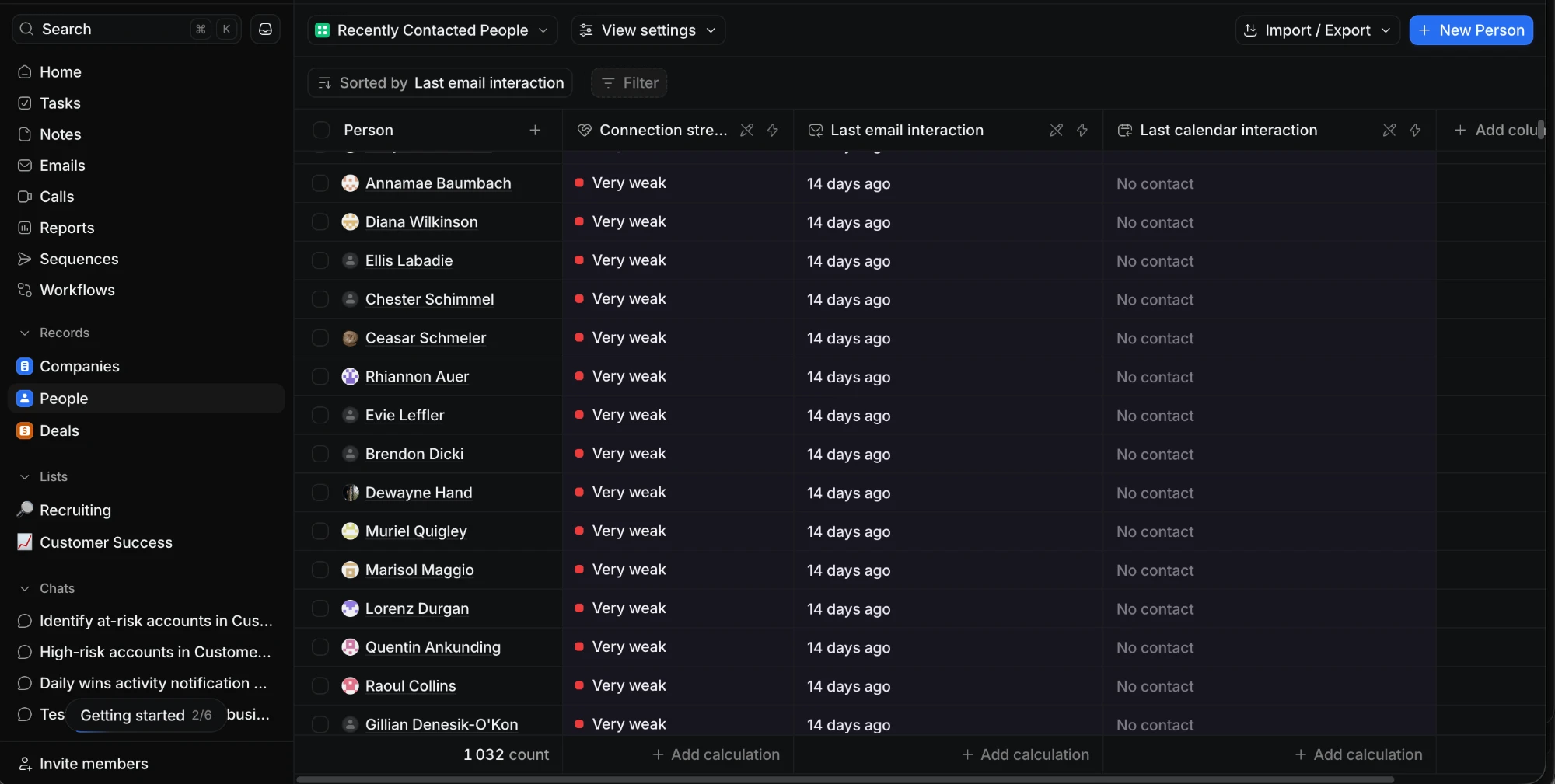 Relationship strength, last email, last meeting: three calculated columns, not one of them typed in.
Attio is an agentic CRM, which is to say the place where a company keeps its customers, its contacts and its open deals. It has more than 30,000 customers, including teams from Parallel, Turbopuffer, and Wordsmith. Its tagline reads "Welcome to agentic revenue", and the promise behind it is easy to state and hard to keep: that the CRM should stop recording sales work after the fact, and take on part of it instead.
We spent a day inside the product, opening every door. What follows is what we found, in the order in which the machine gains ground, and at every level the same question: who stays in control?
 Nicolas Sharp (left) and Alex Christie, co-founders of Attio
A database that fills itself
CRMs ask sales people to type in what they have just done, so the quality of the data depends on the discipline of the team, which is another way of saying that it decays. Attio reverses the burden: it plugs into email and calendar and infers the database from what happens there, fifteen million emails a day across its customer base.
A company record arrives with its description, country, founding year, social audience and business categories, along with an estimate of recurring revenue, the headcount bracket, known funding rounds and the date of the next meeting. A salesperson opening it before a call has, without preparing anything, the context it would have taken twenty minutes to assemble across three browser tabs.
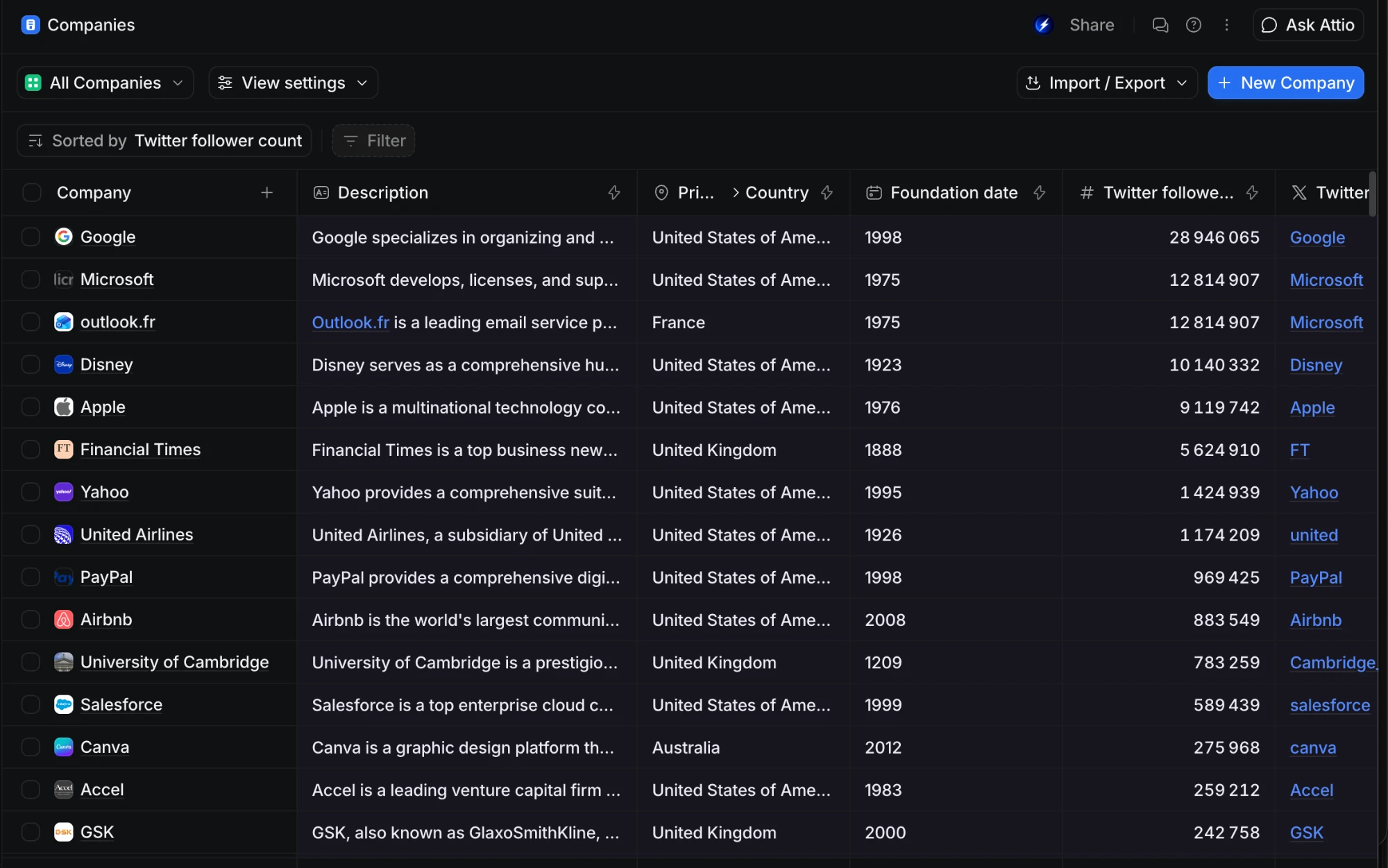 Records arrive enriched: description, country, founding year, audience. Not one of these columns was filled in by hand.
Underneath that automatic layer, the structure stays open: the workspace we looked at uses three of the twelve available objects, with thirty-four attributes on companies alone. A recruitment firm, an investment fund and a software company do not share the same central object, and Attio lets each of them define it rather than imposing its own.
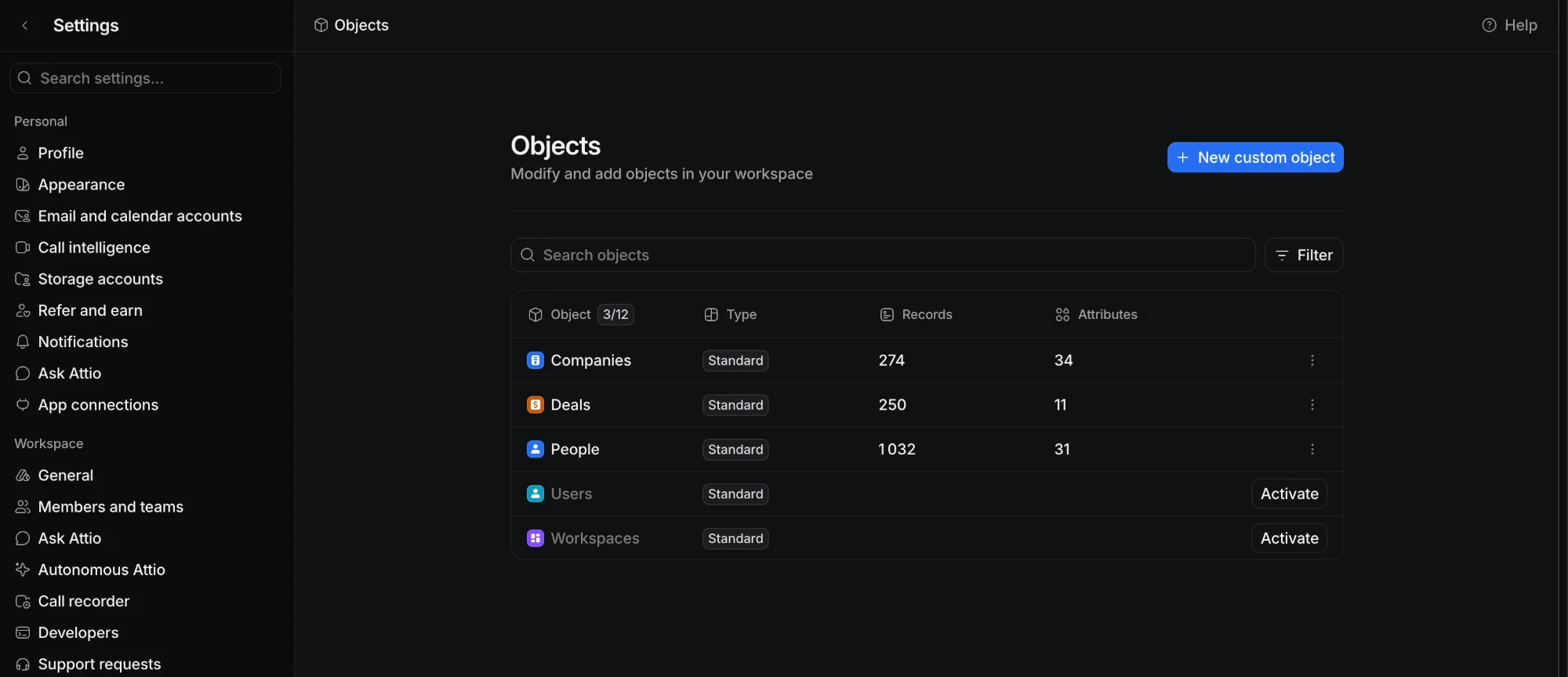 Three active objects out of twelve, and thirty-four attributes on companies alone.
Lists then lay out the same records according to a given process. Customer success reads as columns, from trial to expansion, each card carrying the account's recurring revenue, its health status and its owner. A director opening that view sees in a second where the risk sits, and how much money is attached to it.
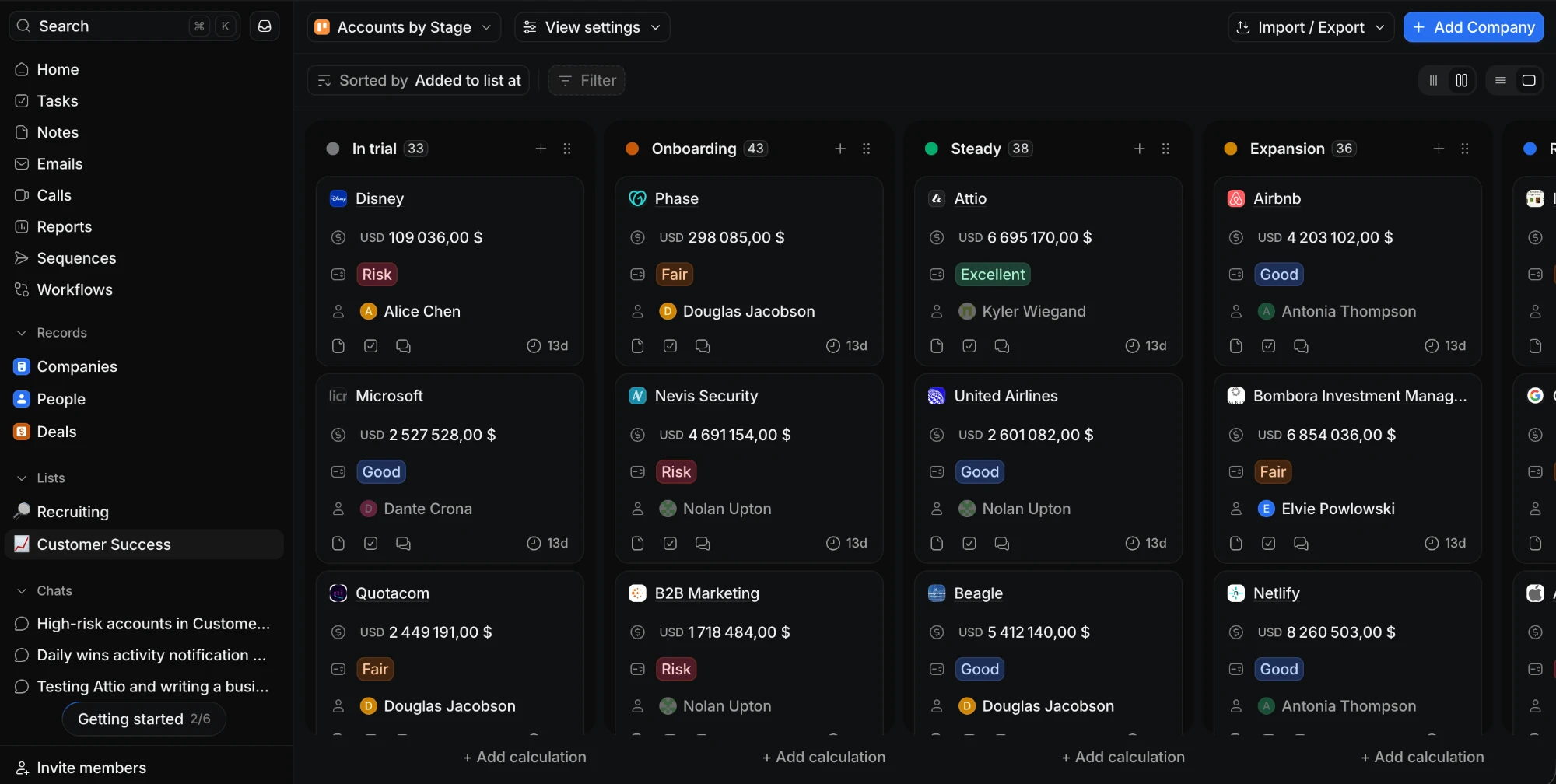 Every account shows its recurring revenue, its health status and its owner.
Ask it a question, and it shows its working
Ask Attio is reachable from any screen, and it sits at the centre of the home page: where other CRMs display a dashboard, Attio displays an input field.
Our question deliberately combined several conditions, and we asked it in French: in the customer success list, which accounts are at risk with more than two million dollars of recurring revenue?
Ask Attio does not answer from memory. It unfolds its reasoning on screen, in the language of the question: it finds the list, explores its attributes, identifies the health field with its "Risk" option and the recurring revenue field, then runs the query.
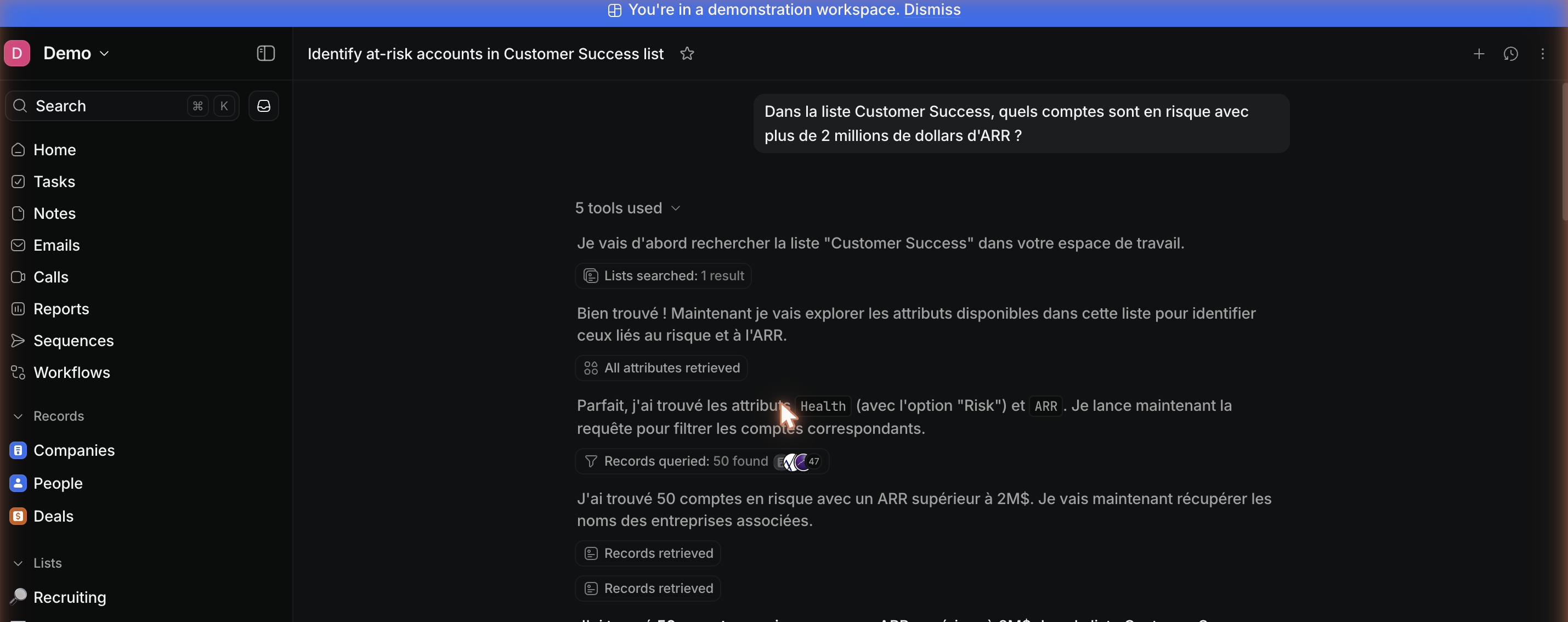 Ask Attio answers in French and shows every step: the list it found, the attributes it identified, the query it ran.
Fifty accounts come back as a table, ranked by descending amount, each with its lifecycle stage.
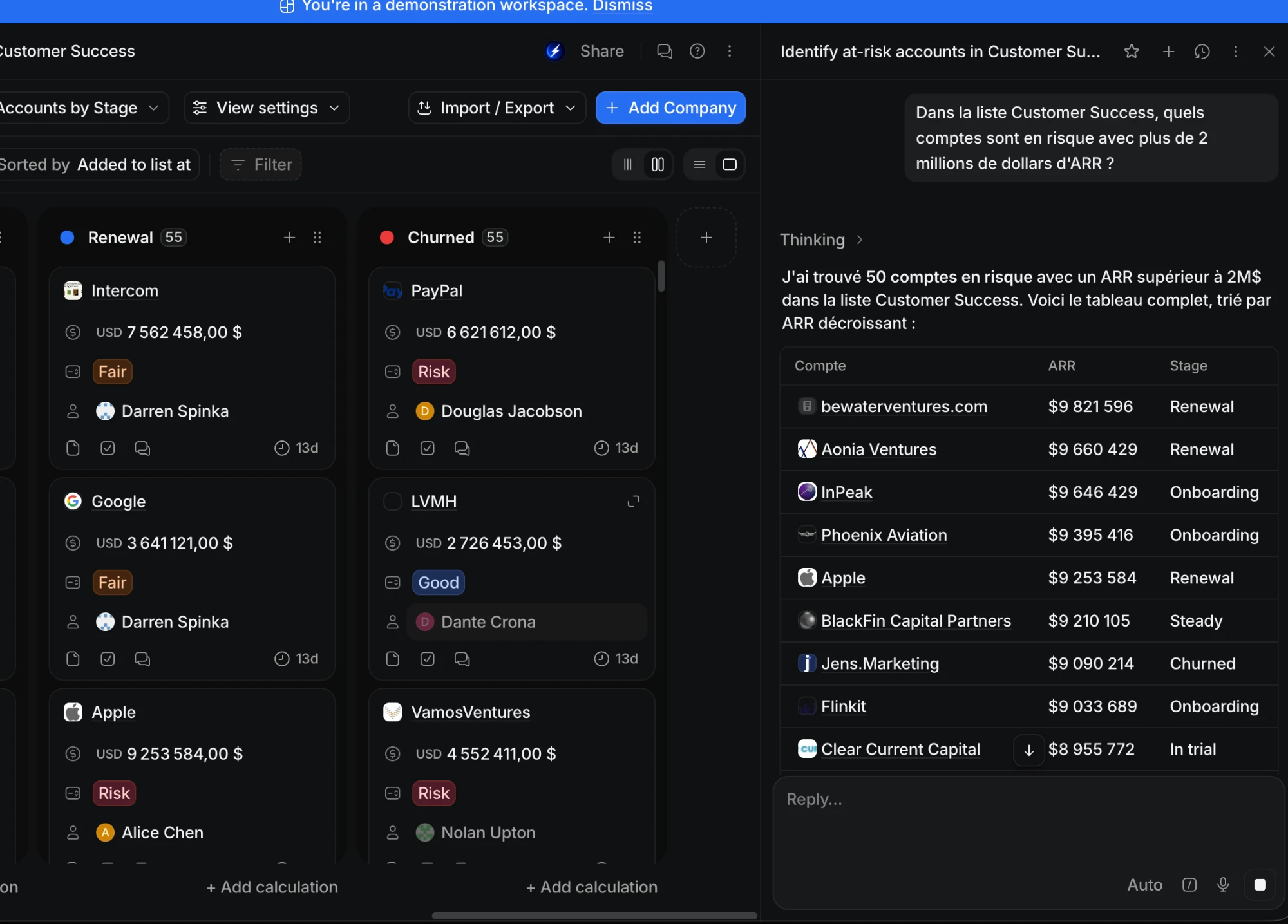 Fifty accounts identified, with their amounts and their stages.
Anyone who has watched an agent produce a figure that was plausible and wrong will see the difference. The whole route is on show: you can check which fields it leaned on, contradict it, or send it back to run the query again. The same cross-tabulation would have taken a quarter of an hour in a spreadsheet.
Ask it to write, and it asks permission
Plenty of tools can read a database. Writing into one is another matter, and that is where the promise stands or falls.
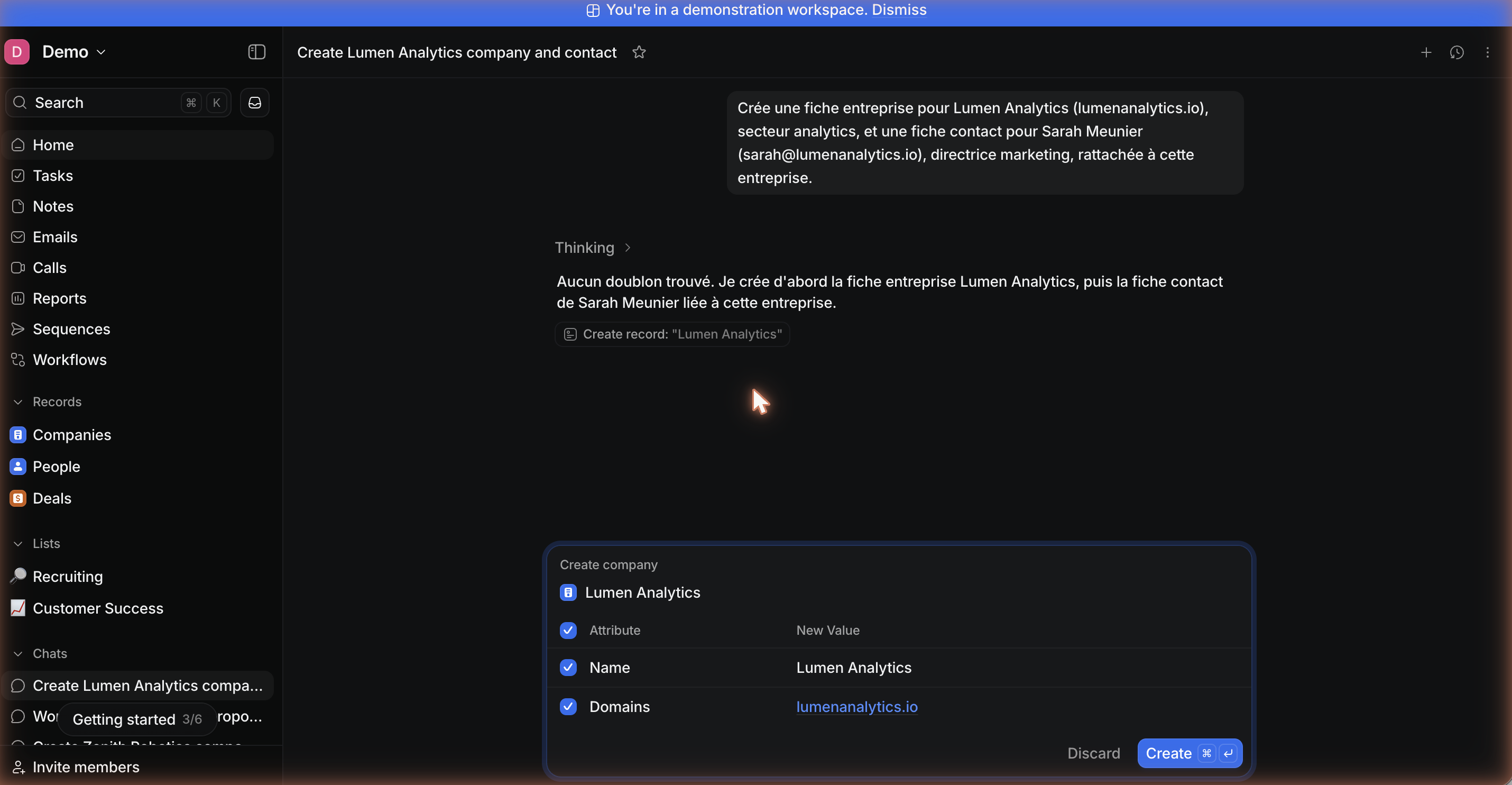
We gave it a single sentence: create a company record, a contact record for its head of operations, link them, then open a deal worth $24,000 at the initial stage, attached to both.
The agent checks that it is not about to create a duplicate, retrieves the attribute definitions for all three objects, and then comes the gesture that matters: it writes nothing. It presents a confirmation panel, field by field, with the value it proposes for each and a tick box beside it. You keep the job title, drop the amount, correct the stage, then approve. Each record has its own card, with its own undo button.
Nothing is written without approval: every proposed field is displayed, and every field can be unticked.
The most instructive moment is an incident. The company record runs into a uniqueness constraint, because creating the contact had just brought that same company into existence automatically, from the email domain. A basic automation would have stopped at the error, or created a duplicate. Attio re-reads the database, works out what happened, explains it in a sentence, reuses the existing record and carries on with the link, then the deal. Ten tools called, three records correctly linked, all from a single sentence.
Try Attio for freeCreating a workspace and connecting a mailbox takes a few minutes.
Describe an automation, and it builds it
Attio's automation builder is a canvas where you wire blocks together: a trigger, a condition, an action. Some of those blocks are agents, handed a whole task described in plain language.
You can also build nothing at all, and describe the scenario instead. Ours fitted in one sentence: when a deal moves to the "In progress" stage with an amount above $20,000, research the company on the web, write a summary note on the record, and create a task for the deal owner, due in three days.
Attio announces its plan, then lays the blocks down on the canvas one by one and wires them together. Twenty-four tool calls later, six blocks are in place: a trigger watching the stage attribute alone, so it does not fire on every edit; a filter for the two conditions; a web agent that researches the linked company, its offering, its competitors and its recent news; a note that writes those answers onto the deal record; a date calculation that turns "within three days" into a timestamp; and the task, assigned to the deal owner.
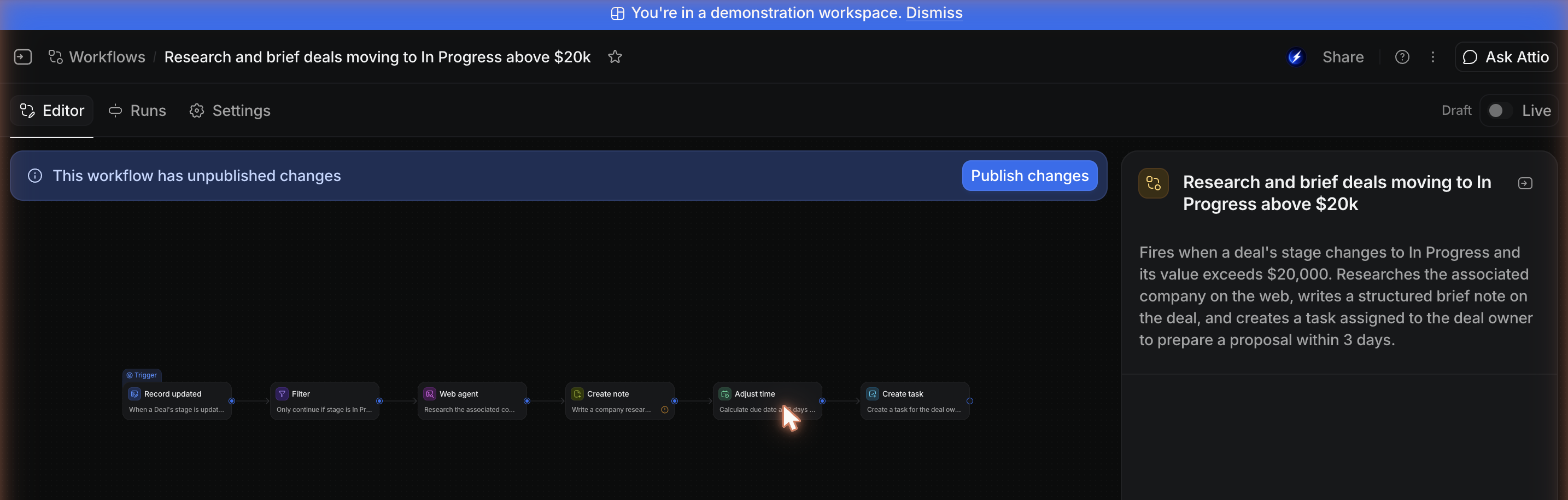 The scenario described in one sentence, wired into six blocks, with the summary Attio wrote for itself.
Nothing was forgotten or approximated, and the workflow carries an accurate description Attio wrote for itself, which is what makes its work reviewable. None of it goes live on its own: it stays in draft until you flip the switch yourself. And it is used at scale: the company reports 76,000 agents running across its customer base, and 10.9 million calls a month over MCP, the protocol that has become, in two years, the standard for connecting models to tools.
The rest of the chain
Around that core, Attio covers the full revenue cycle, with the serious settings in place. Reporting shows time spent in each stage and movements between stages, the two measures most often missing elsewhere. Sequences can include an AI-written block generated for each recipient at send time, the call recorder applies note templates you define, and imports from forty-three products mean the fear of losing your history no longer stands in the way of switching.
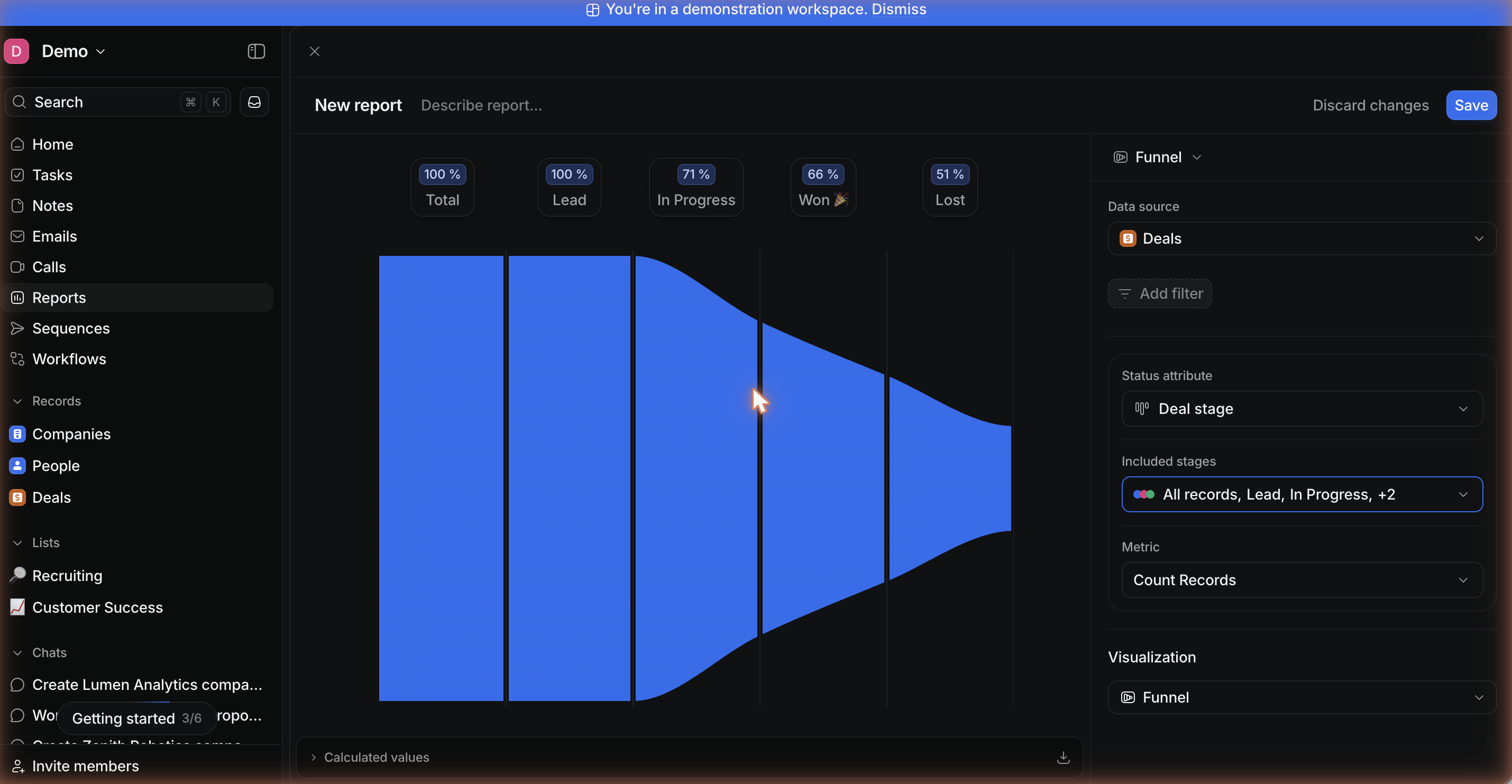 A funnel built in three clicks, with the conversion rate at each stage.
What it costs, and what it consumes
The free tier opens three seats, three objects and fifty thousand records, enough to form a serious opinion before reaching for a card. Plus is €39 per user per month, and Pro, at €93, holds most of what we have described: unlimited seats, twelve objects, one million records, sequences, Call Intelligence and advanced reporting. AI usage runs on credits, a thousand per user per month on Pro plus a shared workspace pool of ten thousand, with consumption shown member by member and a ceiling the administrator can set. No management team will wake up to an AI bill it never saw coming.
The Brief IA verdict
A CRM is only as good as what it holds, and nobody has ever enjoyed filling one in. Attio decided to stop asking: it plugs into email and calendar, and infers the database from what happens there. That alone would put it above the market average.
What wins you over comes next. Every time Attio is about to act, it shows its working first. Ask it a question, and it unfolds its reasoning. Ask it to write, and it proposes, field by field, and waits for your approval. Ask it to build an automation, and it announces its plan before laying the first block. When a record clashed with one created seconds earlier, it worked out why, said so in one sentence and carried on. We have rarely seen an AI product so willing to be argued with.
At €93 per user per month on Pro, Attio is not an entry-level CRM, but the arithmetic settles quickly once you count the hours of data entry that disappear, and the free tier lets you check it for yourself.
Attio says it was built with AI and agents in mind from the beginning. After a day in the product, it shows: nothing feels bolted on. Not a CRM that decides for you, but a CRM that prepares everything, lays its work on the table, and waits for you to say yes.
Brief IA — L'actualité IA en français
L'essentiel de l'actualité de l'intelligence artificielle, décrypté et expliqué chaque jour.