Beyond RAG: Agentic Systems for Business
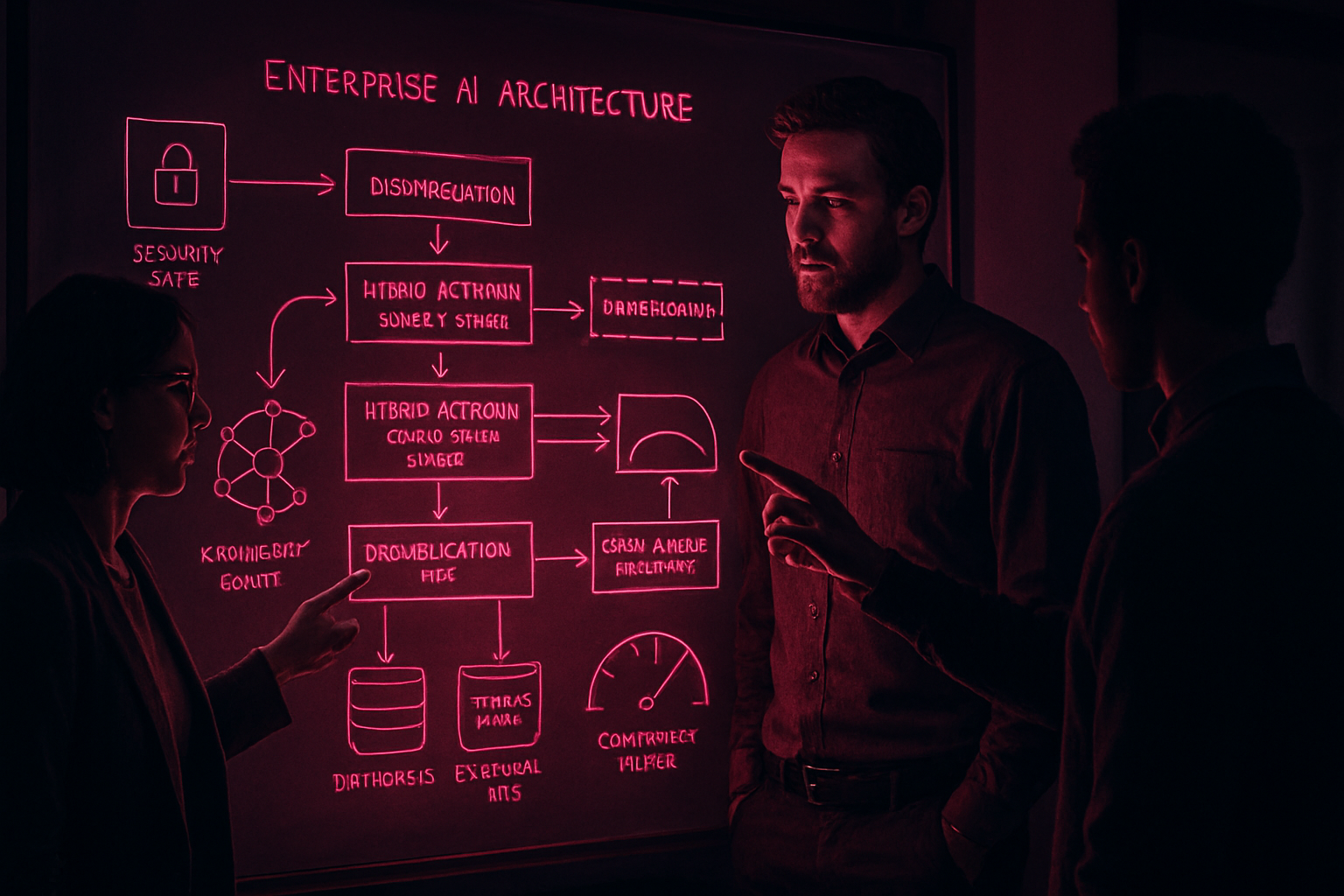
The limitations of RAG quickly become apparent in production: unresolved ambiguities, missed documents, and opaque trust. Proven practices are emerging to address these issues: hybrid retrieval, knowledge graphs, agentic orchestration, and security at the forefront of the pipeline. The result is latency gains of up to 40% and responses with uncertainty finally measured conservatively.
Security First and Conservatively Calculated Trust
In enterprise contexts, queries can carry customer data, employee information, or confidential references. Therefore, the first step in the pipeline must be a security assessment, designed as an architectural boundary rather than just a downstream filter. If sensitive elements are detected, the query is rejected before any retrieval or generation occurs. This priority is presented as the most critical architectural decision for enterprise AI systems. On the reliability side, trust assessment proves to be a recurring weak point for RAG in production. The average trust signals mask the weaknesses of individual components. A multiplicative scoring, standard in decision theory, is more cautious: an uncertain link significantly lowers overall trust. With 0.9 in planning and 0.9 in retrieval, the product yields 0.81; with 0.9 and 0.1, it drops to 0.09, while an average would return 0.5. This choice allows the system to say "I don't know" when uncertainty prevails.
From Fixed Pipeline to Agentic Reasoning and Orchestration
Agentic architectures replace the rigid retrieve-then-generate schema with dynamic reasoning, where the system decides step by step on the next action based on intermediate results. This capability clearly distinguishes these systems from traditional pipelines. Five key disciplines are highlighted in the industry: tool usage, memory management, planning, coordination, and evaluation; security, as an architectural boundary, is added as an essential requirement for enterprise deployment. Workplace questions are rarely one-dimensional: comparing requires understanding and synthesizing two concepts; planning necessitates breaking down into subtasks; diagnosing aggregates documentation, structured databases, and external APIs. Given the ambiguity of organizational language, light disambiguation, backed by a database and guided by frequency heuristics and mapping tables, achieves comparable or better accuracy than an LLM, with significantly lower latency, in line with embedded NLP principles. For complex queries, an LLM can break down the request into sub-questions, each linked to dedicated tools; presenting this plan to the user before execution serves as a human checkpoint and aligns with emerging standards like the Model Context Protocol. Finally, classifying the necessary sources by sub-question and executing in parallel significantly reduces latency compared to a strict sequence.
Le brief IA que les pros lisent chaque soir
Les 7 actus IA du jour, décryptées en 5 min. Gratuit.
Inclus dès l'inscription : notre sélection des meilleurs guides & comparatifs IA.
Choisissez votre rythme
Gratuit · Pas de spam · Désabonnement en 1 clic
Graph-Enriched Retrieval: Entities, RRF, and Continuous Reindexing
A classic RAG treats each chunk as isolated, without awareness of entities, relationships, or ontologies: it ignores product hierarchies, synonyms across corpora, and parent categories. Adding a knowledge graph to the pipeline, an approach referred to as GraphRAG, fills this gap by enriching both retrieval and generation. Two design choices weigh heavily in production. First, preferring deterministic entity extraction over LLM-driven NER: while the latter is often recommended, they introduce hundreds of milliseconds of latency per call, API costs at ingestion, and non-determinism that hampers debugging in regulated environments. In contrast, a multi-pass matching (first against an entity index, normalizing variants, then tokens) provides consistent results in microseconds at nearly zero marginal cost, in the spirit of established information extraction techniques. Next, leveraging the graph in scoring: chunks labeled by entities are scored based on the number of relevant entities, and this signal competes with vector and lexical scores via the same Reciprocal Rank Fusion used in hybrid approaches. To support continuous ingestion, uninterrupted reindexing relies on proven schemas: delta processing for incremental updates and atomic exchanges for complete resynchronizations, maintaining availability during entity remapping.
Dense-Sparse Hybrid: Deduplication, RRF, and Competing Latency
In enterprise settings, no single search method suffices in isolation. Vector search captures meaning and associates, for example, "stockouts" with "zero inventory" or "supply gaps," but it can overlook key keyword matches, problematic in acronym-heavy and product code environments. A hybrid schema executes dense search and BM25 in parallel, then merges the results. Deduplication must occur before reranking, in multiple passes (identifier, source location, fingerprint) to limit redundancies. Rank fusion relies on Reciprocal Rank Fusion, proposed in 2009 by Cormack, Clarke, and Buettcher, which rewards what ranks high in either source without requiring score normalization. Latency is a top criterion: executing searches concurrently, asynchronously rather than sequentially, can reduce retrieval latency by 40% or more while maintaining quality. A cross-encoder reranker then provides the final precision filter. Users do not adopt slow systems, regardless of the perceived quality of responses.
Why the "Just RAG" Fails in Production
Anchoring responses in internal documents via a vector database and providing context to an LLM often works for simple questions on a well-organized corpus. At the enterprise scale, this sufficiency evaporates: a standard RAG pipeline does not illuminate intent when abbreviations have multiple meanings, vector search may miss key documents due to a lack of shared terminology, and the system does not express exploitable trust, rendering a grounded response indistinguishable from an hallucination. These difficulties are the norm, not the exception. Hybrid retrieval and GraphRAG provide solutions to the retrieval problem, but real-world use cases then require reasoning and orchestration capabilities to handle multidimensional queries.
Brief IA — L'actualité IA en français
L'essentiel de l'actualité de l'intelligence artificielle, décrypté et expliqué chaque jour.