Avride Enhances Its Robots in Four Cities
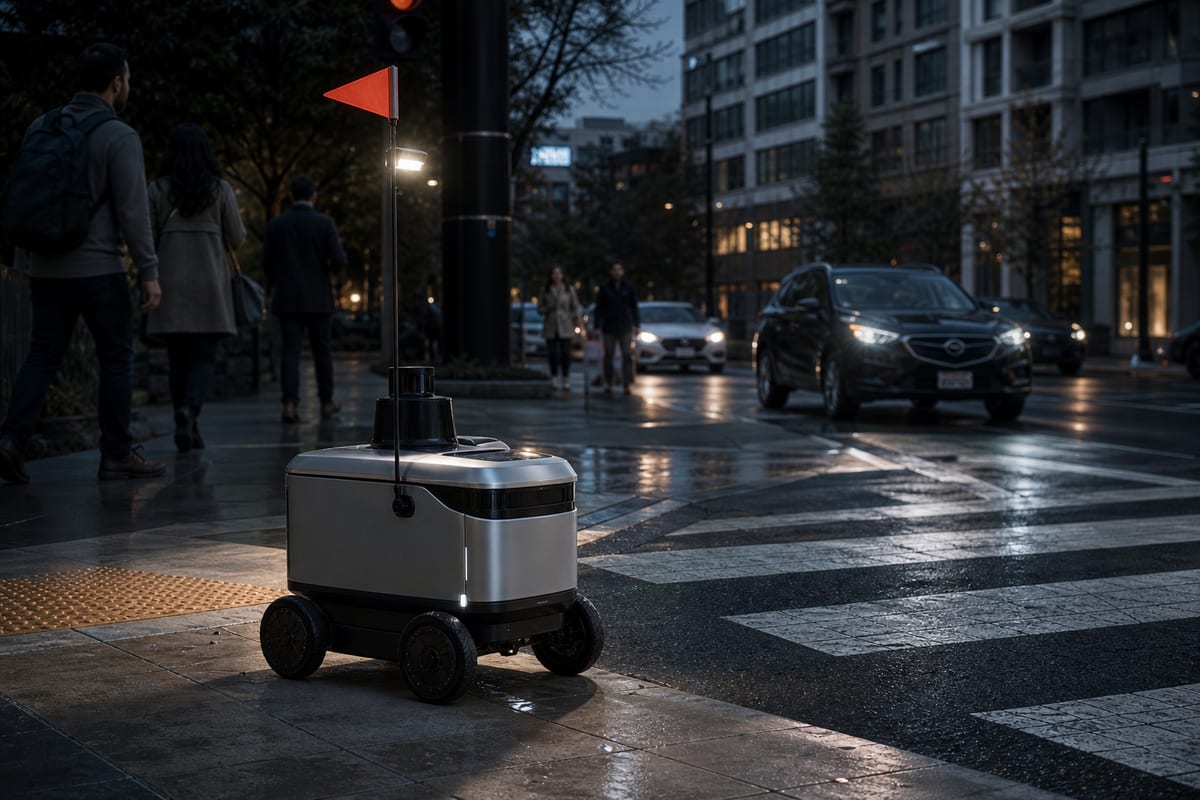
Avride prioritizes the improvement of its delivery robots in the four cities where they operate rather than seeking new launch locations. On the sidewalks, the challenges involve both vehicle traffic and the condition of pathways, as well as the actions of pedestrians.
Crossings and Sidewalks Complicate Routes
Earlier this year in Philadelphia, a truck struck an Avride robot while it was crossing. Published images show minor damage and the robot struggling to continue its journey to the opposite sidewalk. In Arlington, during a demonstration held on a recent Friday morning, the flashing pedestrian signal displayed 17 seconds remaining: the robots are trained to wait until they receive the next crossing authorization.
Laura Lawton, Avride's communications manager, clarifies that the machine must also monitor cars turning, both right and left. Just because pedestrians are given the go-ahead doesn't mean that drivers will actually yield to them. The unpredictable behavior of drivers is part of the challenges faced in real-world conditions.
Aside from crossings, the machines only use pedestrian pathways, particularly sidewalks. Their insufficient width or irregularities due to lack of maintenance can hinder movement. Sergei Kirillov, Avride's commercial director, emphasizes the role of public infrastructure, the condition of which can sometimes be difficult to predict before operations begin.
A Reinforced Mast and Pivoting Wheels
According to Laura Lawton, people would bend the mast of the robots as they passed by, sometimes even breaking it. This 2.5-foot equipment carries a red flag and a light. The frequency of these actions forced Avride to rethink its design to make it resistant to manipulation, she notes.
Le brief IA que les pros lisent chaque soir
Les 7 actus IA du jour, décryptées en 5 min. Gratuit.
Inclus dès l'inscription : notre sélection des meilleurs guides & comparatifs IA.
Choisissez votre rythme
Gratuit · Pas de spam · Désabonnement en 1 clic
Avride claims to have designed its robot to coexist with pedestrians: each of its four wheels pivots to navigate crowded passages. The device can operate for 13 hours on urban sidewalks and carry six extra-large pizzas. The company has dedicated time and resources to training its autonomous driving; more broadly, companies developing vehicles for food or passenger delivery are investing heavily in driving AI, cameras, and LIDAR sensors used for training.
DoorDash has paid workers by the task to transport orders from a restaurant counter to the parking lot and load its Dot robots. To make these machines more appealing, some companies also add expressive signs: Dot can greet passersby and has lights resembling eyes.
Avride employs similar functions. During the Arlington demonstration, its robot displayed a dog on the screen when pedestrians accompanied by their dogs passed by.
Cities Chosen for Their Dense Housing
The locations selected for expansion feature numerous apartments, condominiums, and other forms of dense housing, explains Sergei Kirillov. According to him, this configuration concentrates more food orders within a reduced area. The environments served by Avride are primarily urban.
In October, the company announced additional robots in Jersey City, New Jersey, where a pilot program already existed. It also announced their arrival in Hoboken, in the same state, as well as in Philadelphia and Arlington, Virginia. In the cities served, it collaborates with independent restaurateurs and with Wonder, the food hall chain created by Marc Lore; in Jersey City, its robots also handle orders for Uber Eats.
Sergei Kirillov indicates that the company continues to learn from each deployment, as conditions rarely resemble one another.
Brief IA — L'actualité IA en français
L'essentiel de l'actualité de l'intelligence artificielle, décrypté et expliqué chaque jour.