Bill Gates: AI Thresholds Crossed, Bioterrorism "50x"
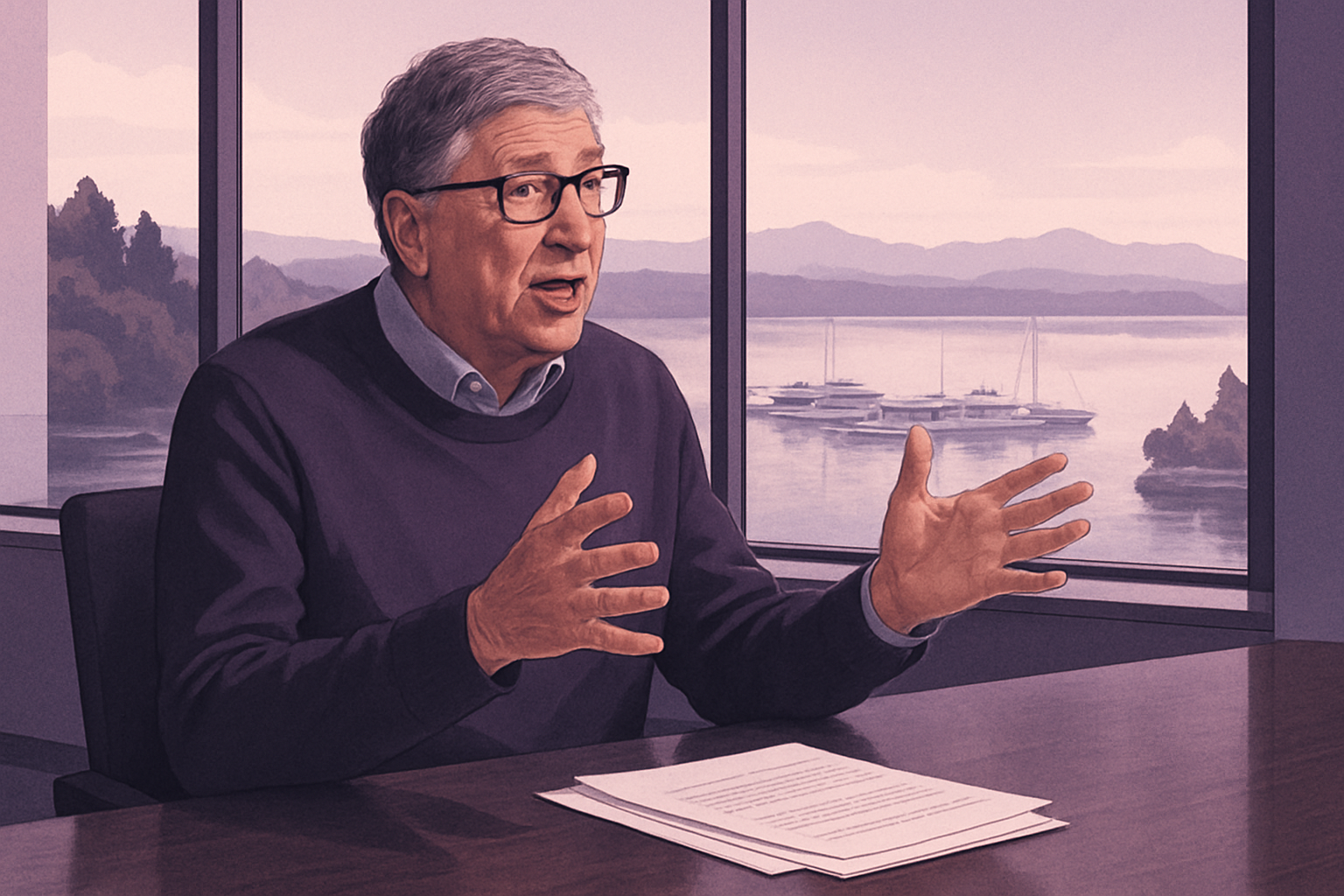
Bill Gates claims that AI has already surpassed dangerous thresholds, from bio to cyber and including the labor market, and that existing safeguards are inadequate. He warns of a low-cost substitution for a large portion of white-collar jobs, with error rates likely lower than those of humans. He proposes reserved positions for humans and taxes on robots and tokens, while funding concrete projects in health, science, and access to rights.
Gates anticipates a rapid shift in white-collar jobs
Bill Gates argues that this time, the dynamics of AI differ from previous technological waves. He believes it will take a few years for public opinion to realize that a very high percentage of white-collar jobs can be performed by much cheaper AIs, with error rates likely lower than those of humans.
According to him, about 50% of the labor market consists of roles that do not require a "lifetime of experience": telemarketing, phone support, accounting department tasks. He cites month-end closing (which revenues to include or exclude), managing discounts after customer incidents, and accounting presentations as well-defined examples for which he claims AI is cheaper and better.
However, Gates emphasizes that AI has not yet reached forms of implicit judgment and human collaboration, illustrating his point with Warren Buffett, whose implicit learning since the age of 13 and over 80 years of experience does not constitute an "exploitable trace" for training a model. He notes that efforts are underway to encode such skills.
He adds that limitations in capabilities and reliability are being lifted and that the shift will not take a long time. The reduction of entry-level hiring by some companies appears to him as a signal, albeit modest. Regarding robotics, he speaks of "stunning" progress, slightly more pronounced in China than in the United States, while reminding that the appreciation of the speed of these advancements can vary. He finally considers traditional economic readings misleading and recalls having previously argued that no technology had destroyed net jobs.
He warns of thresholds already crossed and a bio risk "50×"
Bill Gates asserts that thresholds have been crossed in terms of bio-capabilities, cyber-capabilities, psychosocial capabilities, labor market destruction capacity, and loss of control. He says he observes signs of difficulties in these areas and is shocked that these milestones have been surpassed while many aimed to restrict access to dangerous uses or prevent the copying of models as these thresholds approached.
Le brief IA que les pros lisent chaque soir
Les 7 actus IA du jour, décryptées en 5 min. Gratuit.
Inclus dès l'inscription : notre sélection des meilleurs guides & comparatifs IA.
Choisis ton rythme
Gratuit · Pas de spam · Désabonnement en 1 clic
His concerns particularly focus on the bio-capabilities of cutting-edge models. He believes that any model capable of generating new molecules should be subject to oversight. He also considers the risk of bioterrorism to be about 50 times more frightening and more likely than a naturally occurring pandemic.
Reserved positions for humans and taxes on robots and tokens
To address upcoming shocks, Bill Gates proposes the idea of reserved positions for humans, to preserve jobs explicitly assigned to people, with scopes that may vary from country to country. He also suggests taxes on robots and tokens, an approach he has long advocated for the "robot" share.
According to him, this tax system would set aside a portion of the value created when AI replaces human labor, in order to free up resources to address substitution effects.
Concrete uses: vaccines, Biomni at Stanford, NextLadder, and rights assistance
Bill Gates remains confident about the contributions of AI to agriculture, health, and education, while warning of a period of turbulence before a possible abundance. He states that the Gates Foundation is already using these tools for innovation in vaccines and medicines, participates in a public domain effort to aggregate data at the protein and cell levels, and funds Biomni at Stanford, a biotech AI agent for research.
He further believes that AI is particularly effective in handling bureaucracy and complex regulatory frameworks, for example, to assist with a small claims court filing, even though there is not yet a truly AI-enhanced interaction pathway with the administration. The Gates Foundation has created NextLadder, focused on situations experienced by low-income families such as eviction, reentry from prison, or personal bankruptcy. Given the complexity of these processes, he thinks AI should act as an agent to help access public or private assistance.
Governance: he finds anti-data center protests ineffective
Bill Gates expresses being struck by the lack of attention paid to AI risks outside the industry and has decided to take on a strident voice on the subject, both publicly and privately. He believes people should be concerned, sees this alert role as necessary, and anticipates potentially greater negative effects than positive ones.
Regarding immediate action levers, he criticizes the effectiveness of protests against data centers: according to him, even shutting down all data centers in the United States would not change the problems he describes, as infrastructures are built on a global scale anyway. He considers this type of mobilization not the best starting point for discussing risk reduction and compares this strategy to confronting an oil executive to solve climate issues. He also notes that the sector is reluctant to internal criticism, complicating the debate.
Brief IA — L'actualité IA en français
L'essentiel de l'actualité de l'intelligence artificielle, décrypté et expliqué chaque jour.