BLS: 206 Jobs Highly Exposed to AI, But Growth Prevails
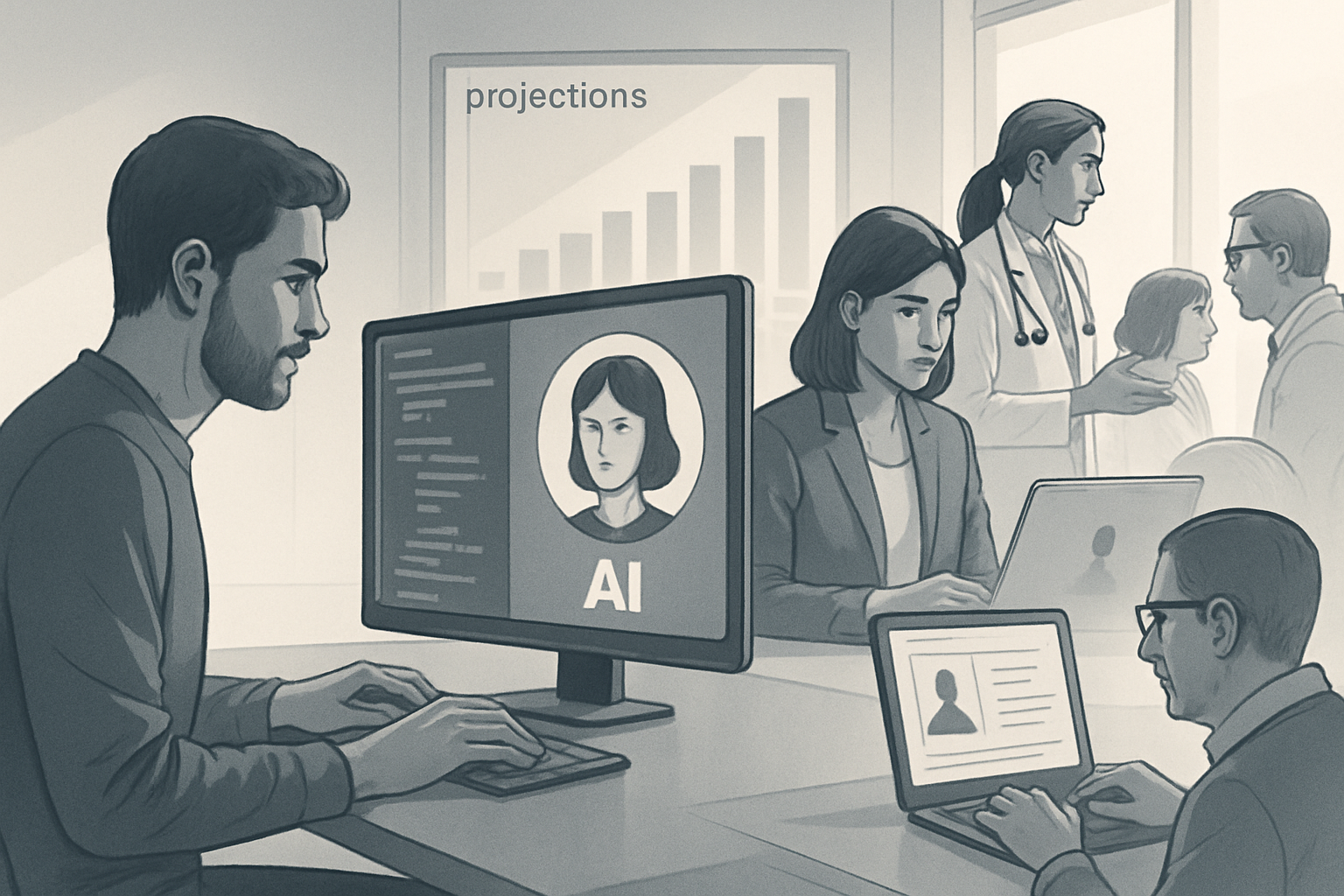
The Bureau of Labor Statistics classifies 206 professions as highly exposed to AI, without concluding that this will lead to massive job losses. Its projections, on the contrary, forecast increases in workforce numbers in many fields, including software developers, while HR roles are being redefined and certain healthcare professions are advancing with low exposure.
HR Highly Exposed: Automatable Tasks and Strategic Choices
Human resources specialists are among the non-technical professions classified as having very high exposure to AI. They are already receiving applications written with the help of generative tools and are using AI themselves to speed up recruitment, for example, by pre-selecting profiles. Brian Elliott, CEO of a think tank and consulting group, believes that HR departments are at a pivotal moment. According to him, one scenario weakens the function, with more automation in onboarding and training, or even a transfer of certain tasks to other leaders equipped with new tools like skills filtering. The other scenario elevates the role of HR, which would drive organizational transformation and engagement while taking responsibility for employee interactions with AI.
Healthcare: Expected Growth with Low Exposure
Professions such as medical assistants and optometrists are reported to be well-paid and projected to grow over the decade while remaining minimally exposed to AI. For the BLS, low exposure means that the job requirements do not align well with the current capabilities of AI models, and language models have not been observed performing many tasks in these professions.
Le brief IA que les pros lisent chaque soir
Les 7 actus IA du jour, décryptées en 5 min. Gratuit.
Inclus dès l'inscription : notre sélection des meilleurs guides & comparatifs IA.
Choisissez votre rythme
Gratuit · Pas de spam · Désabonnement en 1 clic
Developers: +175,000 Projected Positions, 6th Employment Boom
Employment for software developers is projected to increase by about 175,000 positions between 2025 and 2035, reaching nearly 2 million professionals by 2035. Among all professions, this job ranks 6th in terms of expected workforce growth during this period. In practice, Dan Krzyzanowski describes a transformed practice: AI removes some monotony and allows him to focus on creation. However, he emphasizes that the fundamentals of coding, including debugging, remain essential and that code generated by AI often requires review.
Drivers of Software Demand According to the BLS
The BLS anticipates sustained demand for developers, quality assurance analysts, and testers. It links this dynamic to the ongoing expansion of software for AI, the Internet of Things, robotics, and other automation applications. The bureau also mentions a possible increase in needs for software security and the impact of the rise in software-driven products. In practice, systems are continuously being developed for consumer electronics, connected devices, and electric vehicles.
BLS Framework: 831 Professions Studied, 206 Highly Exposed
The BLS assessed the exposure of hundreds of professions based on recent studies, and out of 831 professions, classified 206 as having very high exposure to AI. More than 100 of these jobs had a median salary of at least $75,000 last year, and most are projected to grow. Software developers and management analysts fall into this category. For the BLS, very high exposure means that a larger fraction of tasks can be performed or assisted by AI, with language models already observed on certain tasks. However, the bureau clarifies that this exposure does not necessarily imply job losses and notes that many highly exposed professions are well-paid and expected to grow.
Brief IA — L'actualité IA en français
L'essentiel de l'actualité de l'intelligence artificielle, décrypté et expliqué chaque jour.