Celebrity Deepfakes: Unequal Moderation at Meta and YouTube
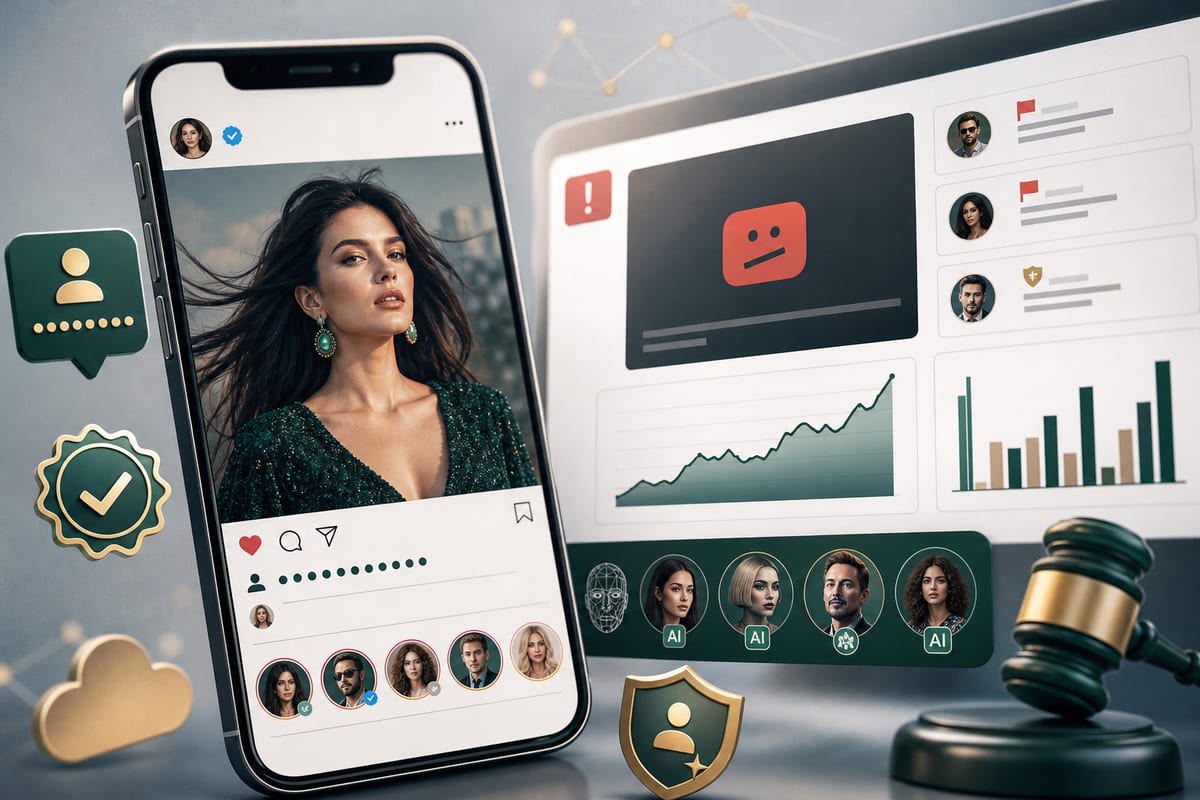
The removal of fake accounts is not enough to curb the circulation of AI-generated content imitating celebrities. Between partial labeling rules, takedown requests on YouTube, and viral formats on Instagram and Facebook, the Mia Goth incident reveals an ecosystem where confusion thrives and some creators monetize these distortions.
Unlabeled Static Images and Thriving Accounts
At Meta, static images are not subject to the AI labeling requirement, unlike realistic videos of people and synthetic voice audios that must be flagged. This lack of obligation allows posts to use AI-generated celebrity faces without specific mention. Despite the removal of some accounts, others continue to publish and gain traction, in a flow where synthetic content and authentic images intermingle. An active Instagram account dedicated to Scarlett Johansson boasts over 300,000 followers and shares a mix of real images and generated visuals, including a seemingly synthetic post that garnered nearly 500,000 likes, without any mention of AI.
The Mia Goth Incident: A Viral Fake, Bought Verification, Then Removal
An image attributed to Mia Goth showed her wearing a t-shirt that read "MY EX IS MY BIGGEST FAN," set to the backdrop of Beyoncé's "Single Ladies," just days after Shia LaBeouf filed for divorce. The account @miagoth_, which had over a million followers and displayed a blue checkmark, was labeled a fan page. The visual racked up nearly 500,000 likes within days. The actress's representative reported to Instagram the dissemination of "counterfeit and AI-generated images" and expressed concern that a fan account could obtain a blue checkmark, reminding that Meta allows it to be purchased without being a public figure. The visibility of the post was amplified by coverage in celebrity media, followed by Google results showcasing an AI-generated preview and a section of social links around the t-shirt. Instagram subsequently removed the account for impersonating a public figure.
Targeted Figures and Reactions: Takedowns, Appeals, Clarifications
Celebrity deepfakes have led to takedowns and reactions. YouTube removed an AI-generated song imitating Drake for copyright infringement. Scarlett Johansson engaged a legal team after a ChatGPT voice was perceived as close to hers without her consent. Ariana Grande reportedly blocked an account sharing AI content about her. Taylor Swift stated she supported Kamala Harris in 2024 after false images suggested her backing of Donald Trump. A significant portion of this content targets women and adopts a sexualized tone: profiles dedicated to Johansson redirect to subscriptions on Patreon and Telegram, exploit her AI image to promote adult content, and other accounts share realistic visuals of actresses and musicians like Millie Bobby Brown, Zendaya, and Ariana Grande. Some accounts explore niches, even staging "weddings" between Stranger Things actors.
Le brief IA que les pros lisent chaque soir
Les 7 actus IA du jour, décryptées en 5 min. Gratuit.
Inclus dès l'inscription : notre sélection des meilleurs guides & comparatifs IA.
Choisissez votre rythme
Gratuit · Pas de spam · Désabonnement en 1 clic
Viral Formats and Mass Audience on Instagram and Facebook
Stereotypical formats are multiplying: an AI Taylor Swift rapping to a Drake track with profanity sparked comments on the language used. Similar variants reach a wide audience, with 3.1 million views for an AI Shrek, 371,000 for an AI Steve Jobs, and 2.1 million for an AI Lionel Messi; another video features Lewis Hamilton and Max Verstappen lip-syncing to "APT" (2.9 million views). One clip depicts an AI Swift and AI Travis Kelce wedding at an AI Madison Square Garden, which a fan "verified" by noting a white tuxedo. On Facebook, "premieres" generated where the original cast walks alongside a replacement cast circulate. Meanwhile, a creator economy is taking shape, with online courses priced at $29 per month explaining how to profit from AI content, fueling production favored by algorithms.
What Platforms Are Doing: Detection on YouTube, Labeling and AI Profiles on Meta
YouTube employs an image detection system, recently expanded to vocal similarities, to scan the platform and allow concerned individuals to request takedowns. Decisions consider public interest, newsworthiness, and consent. Initially reserved for public figures, the system now covers any adult with a YouTube account. The platform has previously indicated receiving relatively few requests, and in March, a product manager noted that the impact of flagged content is often benign or additive for creators. Developed in collaboration with the entertainment industry, the detection has led to the removal of over 95% of flagged videos in the first half of 2026. For its part, Meta frequently applies "AI" labels and has created "AI-generated profile" tags for accounts whose avatars do not exist in the real world.
A General Void, A Targeted Exception, and Concrete Risks
In the absence of a general national law on the right to one's image in the United States, the management of AI content featuring real people primarily falls on the platforms. A notable exception exists: the Take It Down Act of 2025 criminalizes the distribution of non-consensual intimate images, including those generated by AI, and mandates their removal within 48 hours. For the rest, the continuous growth of synthetic content flow creates tangible risks of confusion. In the Mia Goth case, the viral post suggested she was mocking Shia LaBeouf, already facing abuse allegations and filmed in 2015 making a conditional threat. The episode highlights the limitations of trust and safety mechanisms in the face of catchy and timely content.
Brief IA — L'actualité IA en français
L'essentiel de l'actualité de l'intelligence artificielle, décrypté et expliqué chaque jour.