ChatGPT and AI: Unbearable Pressure on Developers
Le brief IA que les pros lisent chaque soir
Les 7 actus IA du jour, décryptées en 5 min. Gratuit.
Inclus dès l'inscription : notre sélection des meilleurs guides & comparatifs IA.
Choisis ton rythme
Gratuit · Pas de spam · Désabonnement en 1 clic
Constant Pressure on Developers
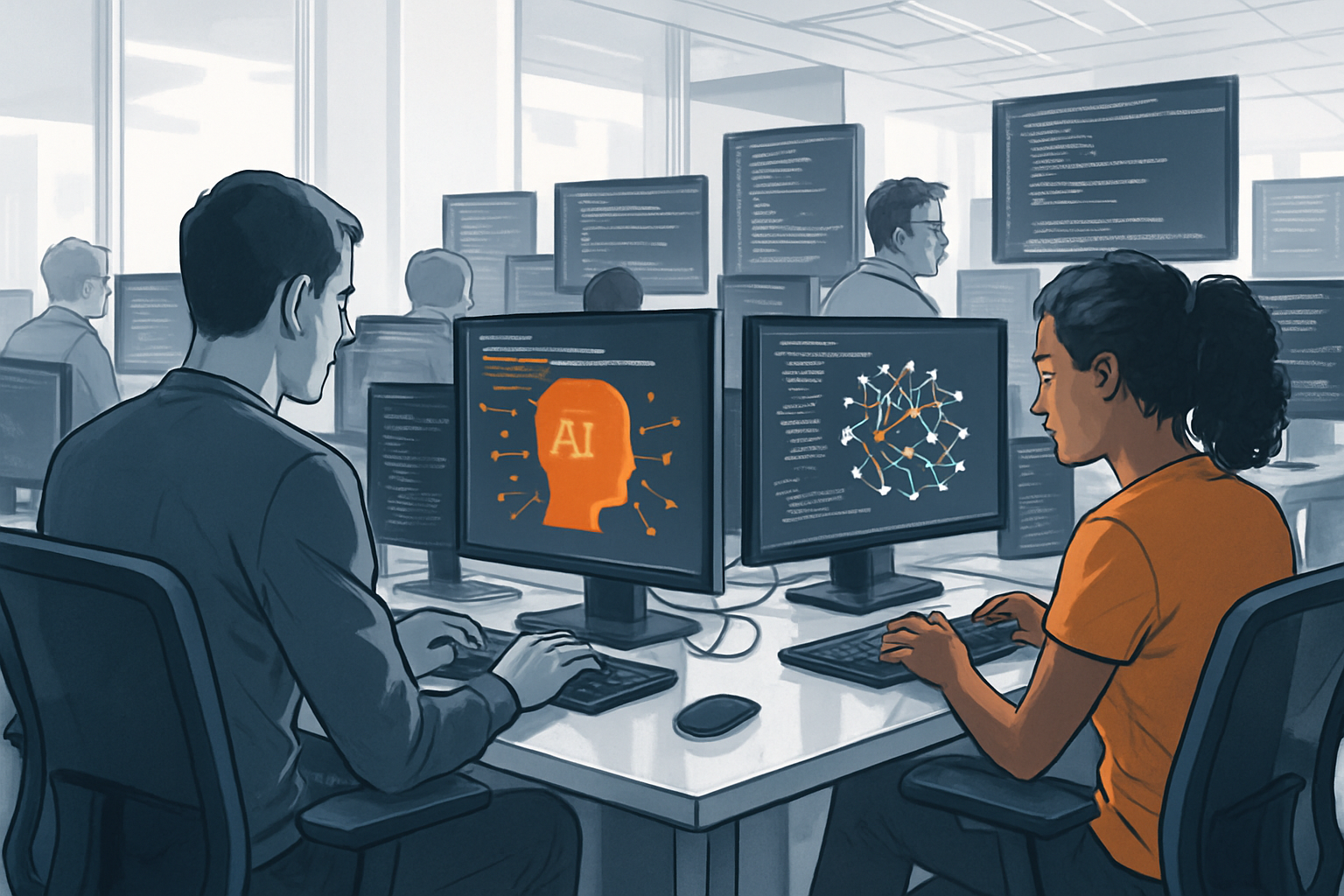
Danny Hamam, a software engineer based in New York, feels an incessant pressure that extends beyond his office hours. Every time a new artificial intelligence tool is launched, he can't help but feel overwhelmed. "My first reaction is not excitement, but rather a sense of urgency: 'I need to master this quickly,'" he confides. This sentiment is shared by many professionals in the tech industry, faced with an avalanche of AI tools since the launch of ChatGPT in late 2022. Companies like Anthropic, Google, and OpenAI are engaged in fierce competition to dominate the market with their latest models.
Unprecedented Acceleration
Since 2023, the pace of AI model releases has quadrupled, according to Peter Assentorp, a Danish coder and designer who has developed a database to track this evolution. "The pace has become so fast that I lose track of the new releases, even while working daily with these models," he explains. The number of major releases has jumped from 18 in 2023 to 69 in 2025, based on his calculations. By mid-2026, major companies had already released 30 additional models.
The Consequences of Rapid Evolution
This frantic pace can make mastering a specific tool seem pointless, according to Jack Boudreau, CEO and co-founder of Habits, a fintech specializing in financial planning. "It's almost pointless to become an expert, because in a week, a new tool will simplify everything," he asserts. While advancements in AI promise increased productivity, they also impose a pace of change that is difficult for software engineers to keep up with. This information overload can lead to paralysis at work and a feeling that the tools to master are taking over.
Sacha Greif, a developer in Japan, believes this is just the beginning. He anticipates that AI giants will render many standalone software tools obsolete, such as project management tools, thereby reducing opportunities for the companies that produce them. "I see a weakening of the industry," he states.
The Threat of Job Loss
For some, the future already looks bleak, with fears that AI will replace their jobs. Greif, who runs Devographics, a tech research publisher, recently conducted a survey of 7,000 developers. More than four in ten fear that AI tools threaten their job security.
These concerns are fueled by the speed at which work is evolving. As AI takes on more coding tasks, developers are spending more time managing these systems. Annie Vella, a developer in New Zealand, summarizes: "We are creating the machine that creates the machines." However, these changes have not yet led to a decrease in hiring. Job postings in software development have even slightly increased. But the fear of replacement is not the only concern; developers must also rethink their relationship with their profession as tools become increasingly capable of writing code.
Employer Pressure
Employers are exerting increasing pressure for their employees to engage with AI. Companies are using dashboards to track employee AI usage, monitoring the number of tokens consumed and incorporating AI adoption into performance evaluations. Herminia Ibarra, a professor at the London Business School, emphasizes that this pressure often comes from managers who overestimate engineers' ability to adapt to AI quickly.
Ben Eubanks, a technology HR analyst, notes that the anxiety is such that some engineers are considering shifting to less technical roles, such as sales or support.
A New Professional Dynamic
Not all developers feel this fatigue. Rafa Rafael claims that AI allows him to spend less time solving technical problems and more time understanding product needs. "I feel more involved in the overall product," he says.
For Angga Pratama, managing workflows and AI tools has replaced coding, increasing the mental intensity of his work. "The pressure has shifted from 'Can I finish this?' to 'How much can I optimize?'" he explains.
Discussions about technology are ubiquitous, whether at work, online, or in daily life. Akshyae Singh, a cognitive science graduate, has channeled his uncertainty into launching Frame, a startup in San Francisco that supports video creators on the impact of AI.
Hamam concludes on a positive note: "You realize things you never thought possible without this pressure."
Brief IA — L'actualité IA en français
L'essentiel de l'actualité de l'intelligence artificielle, décrypté et expliqué chaque jour.