ChatGPT and Turnitin: Education Confronts 2.0 Cheating
Le brief IA que les pros lisent chaque soir
Les 7 actus IA du jour, décryptées en 5 min. Gratuit.
Inclus dès l'inscription : notre sélection des meilleurs guides & comparatifs IA.
Choisis ton rythme
Gratuit · Pas de spam · Désabonnement en 1 clic
Education at a Technological Crossroads
Education is undergoing a major transformation, marked by a decline in birth rates that leads to a decrease in school enrollments. This phenomenon forces institutions to rethink their pedagogical approach. At the same time, teachers, often exhausted, express their frustration with the growing challenges of their profession, particularly on platforms like TikTok. The massive introduction of artificial intelligence into classrooms, while approved by many institutions, poses additional challenges. This technology, although it offers opportunities for innovation, is difficult to control and demonstrate, further complicating the educational landscape.
Cheating and Detection Tools: A Game of Cat and Mouse
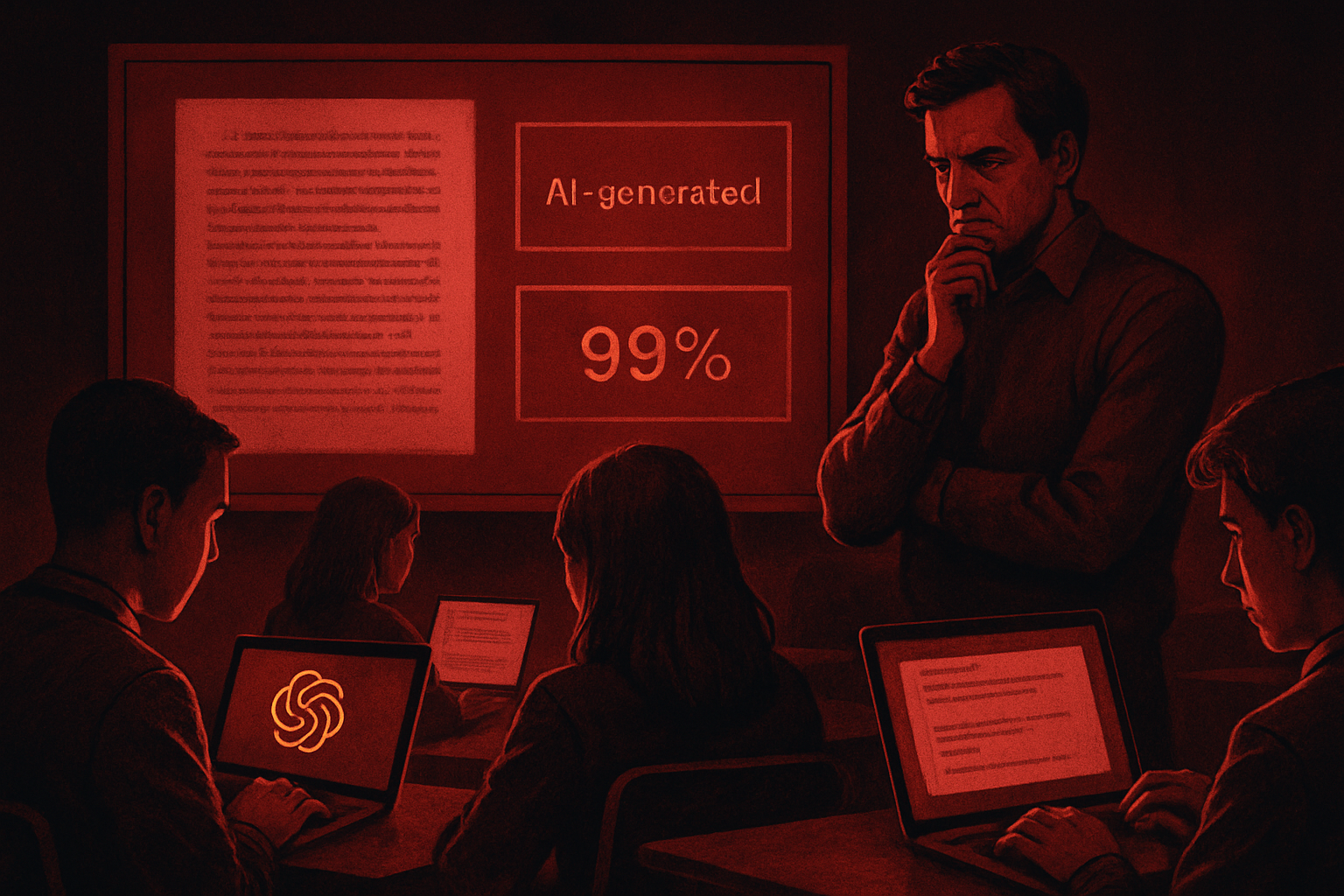
In the current context, several technological tools have emerged to address the growing concerns about academic cheating. Applications such as ChatGPT, Claude, Gemini, and NotebookLM (now known as Gemini Notebook) have become go-to references for circumventing traditional academic requirements. I spent an afternoon testing these tools by submitting various assignments in PDF format. Each of them produced well-structured and persuasive essays, demonstrating their ability to mimic human work. However, what is particularly intriguing is how tools like Turnitin, originally designed to detect plagiarism, have evolved. They now include specific features to transform AI-generated text into content that passes their own detection checks. Indeed, I asked Gemini to write the introductory paragraph of a discussion assignment, which I then submitted to Turnitin. Within seconds, this tool suggested modifications to make the text sound more natural and human-like. It even provided explanations on how these new phrases, entirely generated by AI, could successfully pass Turnitin's AI detection test.
The Illusion of Learning Through AI
The idea that students can genuinely learn by using AI for their assignments is often illusory. I submitted an assignment designed to be AI-proof to Claude. This type of assignment, often presented by educators as a better alternative, is based on the notion that AI can help structure learning outcomes. However, the only instruction I gave the tool was to complete the assignment, including visual elements, and format it for standardized submission. The tool produced sleek infographics, well-crafted enough to appear as if created by a student using a Canva template. Yet, these deliverables, while mediocre, were difficult to identify as AI-generated. I used several AI image detectors to verify their origin, but the results were mixed. For example, Winstonai identified my infographic as 100% AI, while an image I had created long before the era of generative AI was also flagged as 100% AI. Another detector, AI or Not, estimated that my infographic was only 1% AI. Thus, a student trying to pass off this work as their own could easily point to these contradictory results to close the debate.
Simplistic Solutions to Complex Problems
None of the AI tools used in this research explicitly present themselves as cheating applications. Instead, they describe themselves as "study guides" or "homework aids," with bold promises such as guaranteeing an "A+ result." Services like Gauth AI, which is a paid study aid tool, and Studocu, which offers a free version with a paid tier starting at $7 per month, provide direct solutions to assignments. For instance, I used Studocu to generate answers to a complex five-page astronomy assignment from the University of Northern Iowa. This assignment included explicit instructions to use a unique dataset for each student, based on their student IDs. Within seconds, the tool utilized this specific data to produce personalized answers to each problem. Gauth AI also rose to the challenge, at a cost of $12 per month or $100 per year. These tools allow students to succeed without ever having to grasp complex concepts, such as the HR diagram.
Passing Tests Without Studying
Tests, once considered the ultimate means of assessing skills, are now an easily circumvented obstacle thanks to AI. Some universities are adapting their assessment methods by randomizing questions from large banks and increasing the number of in-person tests. However, for schools that continue to use locked browsers and timed digital tests, students have tools to bypass these protections. Applications like Hiding AI utilize data on improved test scores through their subscription software, which claims to offer an undetectable experience for $192 per year. Another discreet tool, Pluely, presents itself as an exam aid. It is particularly effective for dialogue, allowing students to read exam questions and receive answers in a discreet and undetectable window. These tools, while marketed as educational aids, are actually designed to serve students eager to succeed without effort.
For every application, service, or AI tool designed to assist in creating educational content, there is an equivalent designed to help pass that work off as human. It is a market where the primary customer is the student, not the educator. No matter what the marketing materials say, these tools are not designed to help teachers teach or students learn. They are made to serve the primary client who likely just wants to get it over with.
Brief IA — L'actualité IA en français
L'essentiel de l'actualité de l'intelligence artificielle, décrypté et expliqué chaque jour.