ChatGPT Drives 100,000 Researchers Towards Innovation
A Democratized Access to AI for Researchers
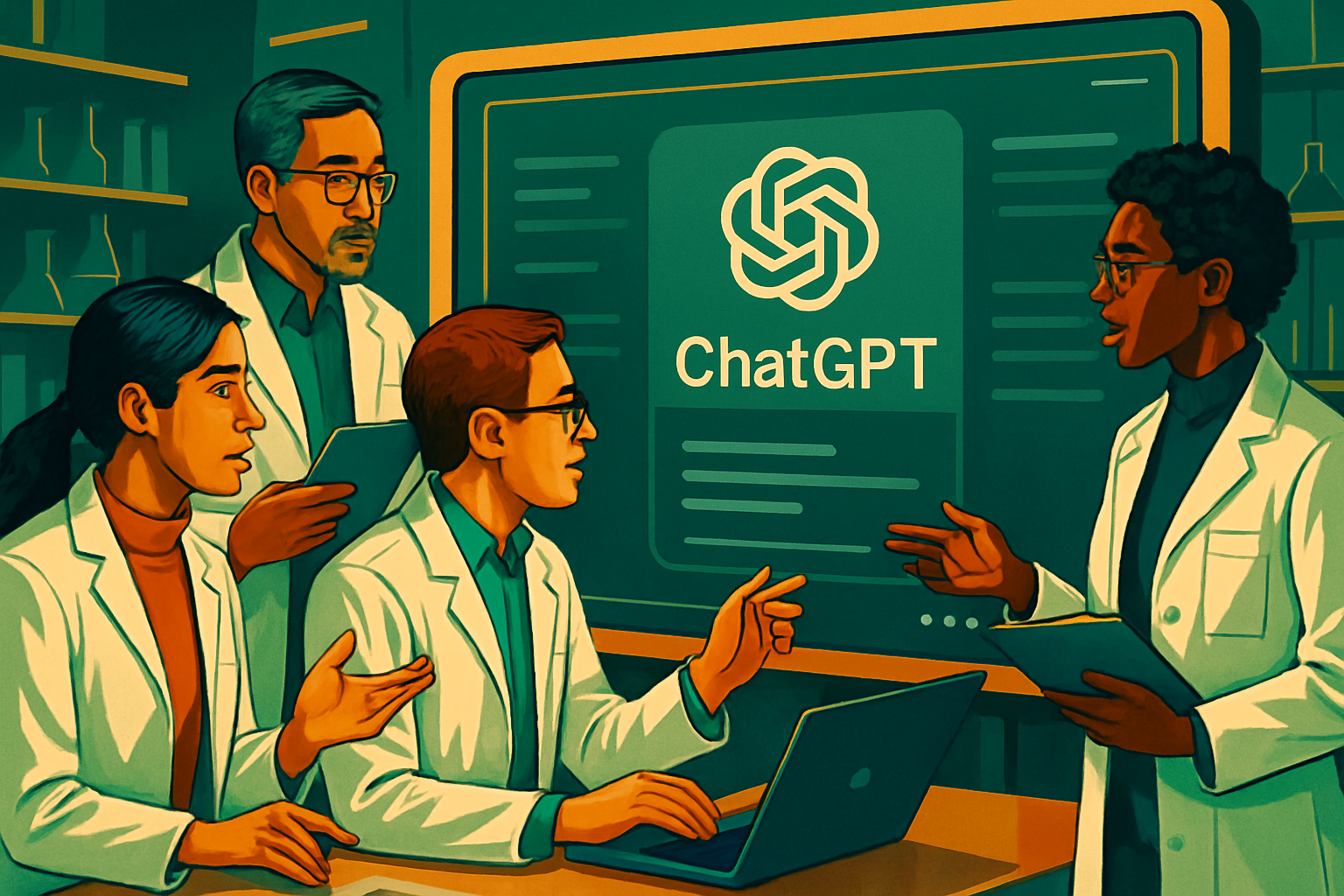
The importance of artificial intelligence (AI) in the field of scientific research continues to grow. However, until now, these cutting-edge technologies were often confined to large companies and well-funded laboratories. OpenAI, aware of this limitation, has decided to change the game by launching an ambitious program: ChatGPT for Academic Researchers. The goal is clear: to provide powerful tools to researchers so they can ask the right questions, test new hypotheses, and build upon existing discoveries. By closely collaborating with researchers, OpenAI aims to design models that not only accelerate research but also leave researchers in complete control of their work.
An Ambitious Program for 100,000 Researchers
The ChatGPT for Academic Researchers program plans to offer free access to its cutting-edge models to 100,000 researchers from selected academic institutions by 2027. This program is designed to assist researchers in various fields such as science, mathematics, and engineering in solving complex problems, accelerating their discoveries, and improving their productivity. Whether for preparing grant applications or testing hypotheses, this free access represents an unprecedented opportunity.
Starting this summer, 10,000 researchers have already begun to benefit from this access, including those from prestigious institutions like the Institute for Advanced Study (IAS) and the École Normale Supérieure (ENS). OpenAI plans to expand this program to 100,000 researchers by 2027. Participants will have access to cutting-edge models, including GPT‑5.6 Sol Pro at launch, and will be able to invite up to four collaborators from their institution. The provided workspaces ensure high levels of confidentiality and security, and researchers' data will not be used to train the models by default. The tools available cover a wide range of needs, from genomic analysis to grant writing.
Significant Financial Support
The ChatGPT for Academic Researchers initiative is part of a broader commitment of over $250 million by 2027 to support external scientific research. This includes projects like NextGenAI, a $50 million initiative aimed at supporting research institutions, as well as a collaboration with the Genesis Mission of the Department of Energy to bring cutting-edge AI to researchers at national laboratories and universities. These joint efforts reflect OpenAI's belief that scientific progress accelerates when more researchers have access to the tools necessary to explore their own ideas.
AI: An Essential Tool for Research
AI is increasingly establishing itself as an indispensable tool in the field of research. Each week, approximately 1.3 million people use ChatGPT for advanced sciences and mathematics, generating around 8.4 million messages. This rapid adoption is particularly notable in the field of mathematics, where AI has transitioned from sporadic use to regular integration in mathematical research. A growing number of scientific papers now acknowledge the contribution of ChatGPT, highlighting how essential this tool has become for researchers.
Le brief IA que les pros lisent chaque soir
Les 7 actus IA du jour, décryptées en 5 min. Gratuit.
Inclus dès l'inscription : notre sélection des meilleurs guides & comparatifs IA.
Choisissez votre rythme
Gratuit · Pas de spam · Désabonnement en 1 clic
Diverse Tools for Varied Needs
Participants in the program will receive free access to several cutting-edge models through ChatGPT, ChatGPT Work, and Codex, including the GPT‑5.6 model family at launch. These models offer enhanced in-depth research capabilities, higher usage limits, and broader context windows, thereby supporting scientific reasoning and research workflows across various disciplines.
- GPT‑5.6 Terra is designed to balance capability and efficiency for everyday research.
- GPT‑5.6 Luna provides quick responses for less complex tasks.
- GPT‑5.6 Sol is intended to tackle the most challenging scientific and mathematical problems.
On the FrontierMath Tier 4, which assesses research-level mathematical reasoning, GPT‑5.6 Sol scores 83%, surpassing GPT‑5.5, which achieves 72.5%. On GeneBench Pro, which evaluates the analysis of complex biological data, GPT‑5.6 Sol Pro solves 31.5% of tasks.
Researchers have access to over 75 life sciences skills, covering areas from genetics to drug discovery. Connectors facilitate interdisciplinary research, providing access to scientific literature, genomic and clinical databases, satellite imagery, and much more.
Personalized Training and Support
Researchers participating in the program will have varying levels of experience with AI. Some will discover these tools for the first time, while others will develop advanced applications in their respective fields. The program offers training tailored to these different experience levels, ranging from familiarization with the tools to enhancing workflows and applying advanced research techniques.
Participants will benefit from support from specialists familiar with research workflows, who will help them integrate these tools into their work. OpenAI also plans to create opportunities for researchers to share their practical approaches, learn from each other, and showcase innovative uses across disciplines. Feedback from researchers will be invaluable for improving the models and making them even more useful for the scientific community.
Application Process
The initial program is open to qualified researchers from selected academic institutions. Eligible institutions must be recognized colleges or universities that confer degrees with a high level of research activity. Candidates will need to verify their institutional affiliation and provide information about their active research and intended scientific use. Approved researchers can invite up to four collaborators from their institution, with each collaborator also needing to verify their affiliation.
Applications are open today, and interested researchers can review the eligibility criteria and apply to join this innovative program.
Brief IA — L'actualité IA en français
L'essentiel de l'actualité de l'intelligence artificielle, décrypté et expliqué chaque jour.