Five Studies Explain How Agentic AI Works
Le brief IA que les pros lisent chaque soir
Les 7 actus IA du jour, décryptées en 5 min. Gratuit.
Inclus dès l'inscription : notre sélection des meilleurs guides & comparatifs IA.
Choisis ton rythme
Gratuit · Pas de spam · Désabonnement en 1 clic
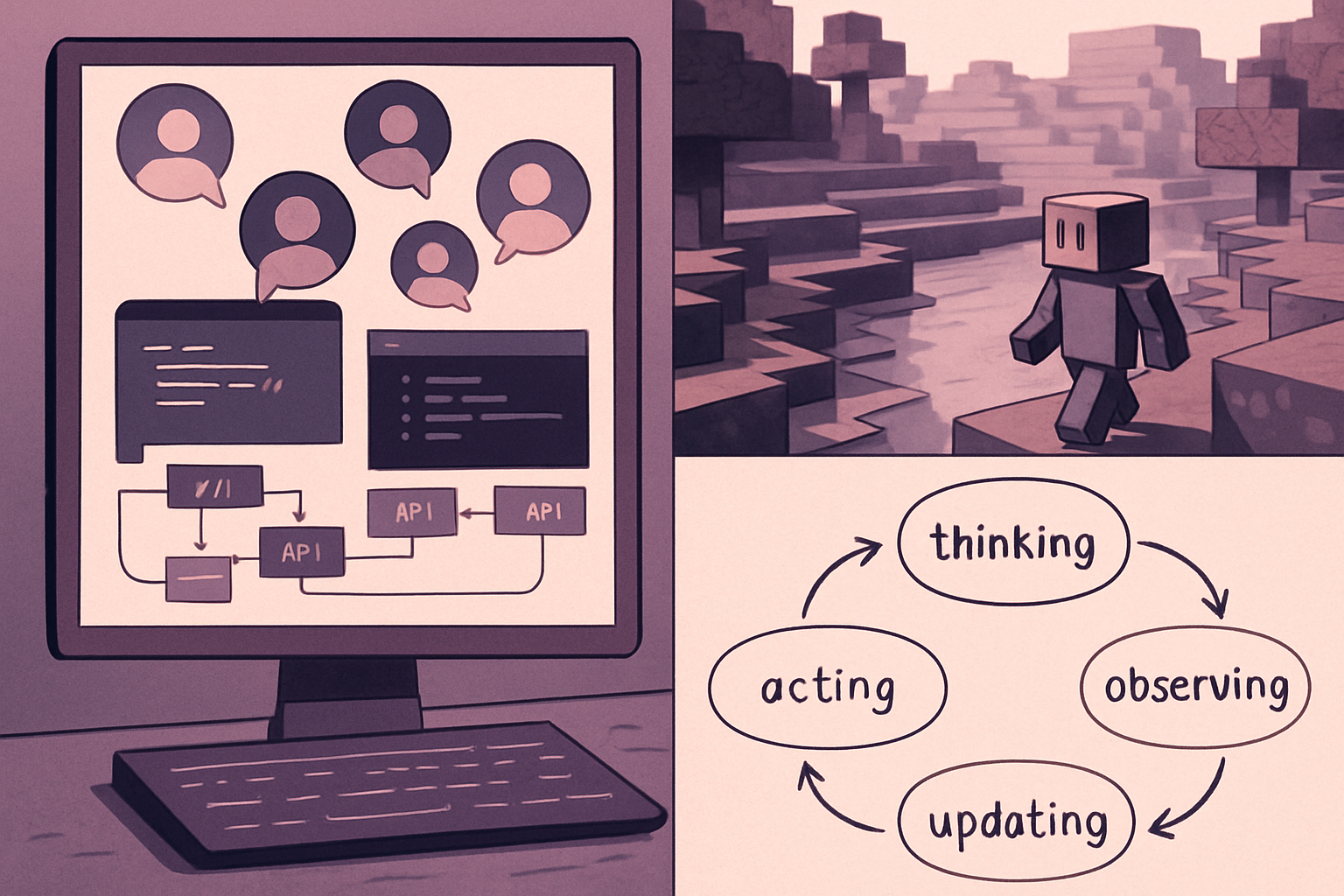
Five research works help to clarify what agentic AI encompasses, from teams of agents that communicate to long-term learning in a simulated world. Together, they detail how a LLM can reason, act, utilize tools, memorize, and coordinate. Here’s what each covers, and why these components often combine in current systems.
Teams of Agents that Communicate and Coordinate
AutoGen: Enabling Next-Gen LLM Applications via Multi-Agent Conversation, authored by Qingyun Wu, Gagan Bansal, Jieyu Zhang, Yiran Wu, Beibin Li, Erkang Zhu, Li Jiang, Xiaoyun Zhang, Shaokun Zhang, Jiale Liu, Ahmed Awadallah, Ryen W. White, Doug Burger, and Chi Wang, formalizes interactions among multiple agents to solve tasks. The framework allows each agent to take on a specific role, use tools, and execute code, while integrating humans into the loop when necessary. Coordination occurs through conversational exchanges between agents, structuring the decomposition and verification of steps. The paper documents applications in programming, mathematics, question-answering, operations research, and decision-making, and mentions other areas of use. It highlights a shift from a single assistant to specialized teams of agents capable of collaborating. This approach concretely illustrates how to articulate roles, tool calls, and execution within a multi-agent dialogue.
Reusable Skills in an Open World
Voyager: An Open-Ended Embodied Agent with Large Language Models, by Guanzhi Wang, Yuqi Xie, Yunfan Jiang, Ajay Mandlekar, Chaowei Xiao, Yuke Zhu, Linxi Jim Fan, and Anima Anandkumar, transposes agentic AI into an embodied environment: Minecraft. Rather than completing a bounded task and stopping, the agent continues to explore, discovers new elements, and enriches a library of reusable skills. Its architecture relies on an automatic curriculum to guide exploration, a library storing executable behaviors, and iterative prompting that uses feedback from the environment and execution errors to improve. Presented this way, the framework illustrates the needs of a long-term agent and how it can continuously progress by leveraging signals from the world in which it operates.
LLMs that Decide When to Use a Tool
Toolformer: Language Models Can Teach Themselves to Use Tools, written by Timo Schick, Jane Dwivedi-Yu, Roberto Dessì, Roberta Raileanu, Maria Lomeli, Luke Zettlemoyer, Nicola Cancedda, and Thomas Scialom, addresses a central issue in agentic AI: the use of tools. LLMs, proficient in writing and reasoning, still struggle with certain tasks such as arithmetic, fact-finding, translation, or accessing up-to-date information. The article describes a self-supervised learning process where the model chooses when to use a tool, selects which one to employ, determines the arguments to pass, and decides how to incorporate the obtained response into its own output. The experiments focus on a calculator, a search engine, a translation tool, a calendar, and a question-answering system. Presented this way, the method highlights the transition from traditional text generators to a system capable of appropriately leveraging external resources.
Reasoning Then Acting, in a Loop
ReAct: Synergizing Reasoning and Acting in Language Models, authored by Shunyu Yao, Jeffrey Zhao, Dian Yu, Nan Du, Izhak Shafran, Karthik Narasimhan, and Yuan Cao, proposes a prompting scheme that alternates between reasoning and action. The reasoning steps serve to plan, track progress, and recover from errors, while actions trigger interactions with external resources, such as search APIs, knowledge bases, or decision tasks. This thought-action coupling anchors the agent in an iterative loop, often described as "think, act, observe, update, continue." The paper is presented as a useful entry point for understanding the foundations of agents backed by LLMs.
Memory, Reflection, and Planning in a Simulated World
Generative Agents: Interactive Simulacra of Human Behavior, authored by Joon Sung Park, Joseph C. O'Brien, Carrie J. Cai, Meredith Ringel Morris, Percy Liang, and Michael S. Bernstein, features agents that simulate credible human behavior in a setting inspired by The Sims. The agents wake up, establish plans, memorize and reflect on their experiences, communicate with each other, and coordinate future actions. The architecture explicitly combines memory, reflection, and planning, with an emphasis on continuity: what the agent retains, how it updates its beliefs, and the influence of past events on its future decisions. The paper is recommended for appreciating the critical role of memory and reflection in agent design.
Reading Guide and Scope of Selection
This selection brings together five references to approach agentic AI in practice. It assumes a shift from a purely generative text framework to agents that reason, use tools, retain memories, and collaborate, in contexts ranging from simulated environments to teams of agents. Readers are encouraged to focus on the key ideas rather than implementation details during an initial reading. Presented together, these works illuminate families of agents commonly encountered: tool usage, memory, planning, collaboration, and autonomous exploration. They finally indicate that many current systems are built by combining seven recurring components: reasoning, action, tools, memory, environmental feedback, planning, and collaboration.
Brief IA — L'actualité IA en français
L'essentiel de l'actualité de l'intelligence artificielle, décrypté et expliqué chaque jour.