Five Free Courses to Master Language Models
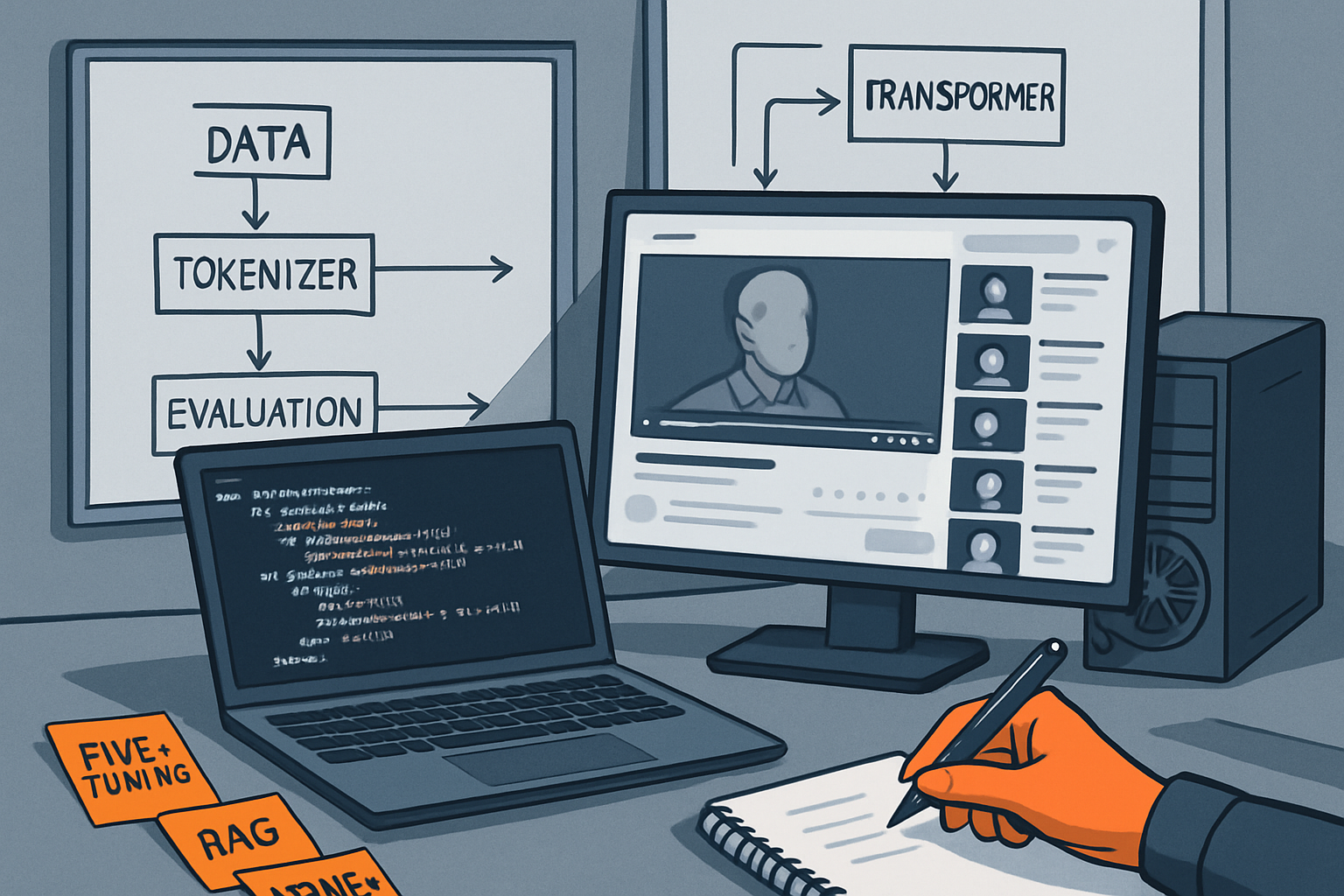
Five free courses, designed to be taken in sequence, promise a clear path from the basics of neural networks to deployed agents. Combining academic courses, engineering bootcamps, and hands-on workshops, the itinerary blends theory, practice, and application. Formats, prerequisites, and durations are specified to facilitate a swift transition from study to execution.
A 5-Step Pipeline and Repetitions to Take Action
The itinerary is based on the idea that a tight set of five interconnected courses constitutes a more useful pipeline than multiple scattered starting points. The five modules are arranged to successively cover the fundamentals, system architecture, large-scale theory, fine-tuning practice, and finally, agent deployment. It is not required to complete each course in its entirety before moving on: a recommended progression involves finishing Karpathy's course, going through the FSDL bootcamp for architectural intuition, targeting relevant sections of CS336, and then practicing with Hugging Face and DeepLearning.AI as soon as a project begins to take shape. According to Vinod Chugani, the difference between reading about LLMs and knowing how to build them often comes down to the number of training loops actually executed, observed loss curves, and debugged fine-tuning runs. The entire setup aims to provide these repetitions, ultimately enabling the pursuit of projects beyond simple API prompting.
Laying the Foundations: From Raw Python to Stanford Theory
The journey begins with Neural Networks: Zero to Hero by Andrej Karpathy, which teaches how to build neural networks in Python without relying on frameworks. Learners code micrograd for auto-differentiation, build makemore at the character level, and push up to a GPT-2 architecture, including a BPE tokenizer implemented from scratch. Achievements include a functional autograd engine, a bigram model, an MLP, as well as a GPT-2 trained on real text and a tokenizer aligned with OpenAI's implementation. The course, available for free through nine lectures with notebooks on GitHub, requires solid foundations in Python, knowledge of derivatives, and 20 to 30 hours of active coding. In parallel, Stanford CS336, taught by Percy Liang and Tatsunori Hashimoto, adopts a systems approach: building a model from data and fundamental components. The content covers data collection, deduplication, and corpus design, transformer implementation, training optimization including rate schedules and gradient clipping, as well as evaluation methodologies and benchmarks. Resources – slides, assignments, and notes – are publicly available. The advanced-level course follows a philosophy similar to that of OS courses and succeeds CS324 (2022), which was older and more theoretical.
Le brief IA que les pros lisent chaque soir
Les 7 actus IA du jour, décryptées en 5 min. Gratuit.
Inclus dès l'inscription : notre sélection des meilleurs guides & comparatifs IA.
Choisissez votre rythme
Gratuit · Pas de spam · Désabonnement en 1 clic
Structuring and Applying: From the FSDL Bootcamp to Agents and Services
For the production transition, the Full Stack LLM Bootcamp from FSDL provides a comprehensive overview of engineering around models: system-level prompting, LLMOps, evaluation harnesses, latency/cost trade-offs, UX of natural language interfaces, and pipelines with evaluator models. Recorded over two days in San Francisco in April 2023 and available for free with slides, it assumes knowledge of how to invoke an API and code in Python. Its contribution lies in connecting the building blocks that make up a deployable and observable application, down to typical breaking points. In the final step of the journey, short courses from DeepLearning.AI address orchestration: controllable agents with LangGraph, vLLM service, RAG, and semantic routing. These one to three-hour modules, taught by framework creators and infrastructure teams, lead to building a stateful LangGraph agent with human checkpoints, a RAG pipeline with vector search and re-ranking, and a vLLM endpoint optimized for throughput and latency. They are free during their learning beta, subject to availability.
Tooling Practice: Fine-Tuning and Reasoning with Hugging Face
The Hugging Face LLM Course, officially broken down into thirteen chapters and announced to be updated until mid-2026, covers the complete ecosystem: transformer architectures, tokenizers, Datasets, SFT via TRL, and LoRA via PEFT. New chapters address building reasoning models with GRPO in the spirit of DeepSeek R1. Chapters 10 to 12 detail data curation with Argilla, the use of SFTTrainer with LoRA, and alternatives to RLHF such as DPO. The exercises target models fine-tuned with LoRA on custom datasets, curated corpora for instruction tuning, Gradio demos, and a concise LoRA fine-tuning pattern presented as standard and elaborated in chapter 11.
Formats, Prerequisites, and Scope: What Each Step Requires
The modules differ in format and requirements. Karpathy's course is a YouTube playlist of nine lectures supported by notebooks, with an estimated practice time of 20 to 30 hours and prerequisites in Python and differential calculus. The FSDL bootcamp, recorded over two days in April 2023, is available for free with its slides, but some API references date back to 2023, although the architectural principles remain presented as valid. On the academic side, CS336 offers its materials publicly, in an advanced-level framework, and succeeds CS324 from 2022. The Hugging Face curriculum announces updates until mid-2026. The short courses from DeepLearning.AI, lasting one to three hours, are taught by framework practitioners and offered during a beta phase, with availability to be confirmed. This assembly aims to address the abundance of superficial or outdated tutorials by delivering a structured and comprehensive path to practice.
Brief IA — L'actualité IA en français
L'essentiel de l'actualité de l'intelligence artificielle, décrypté et expliqué chaque jour.