Claude also creates its visuals by writing code
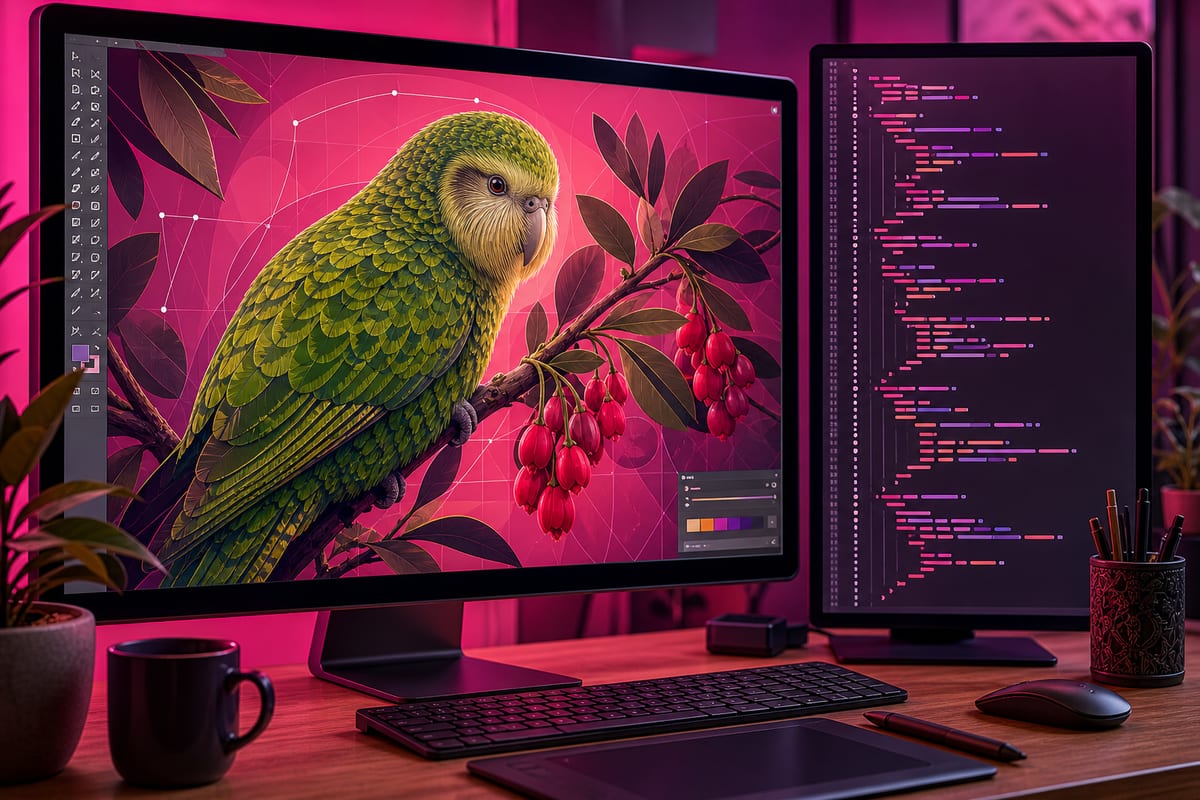
Claude produces presentations and web mockups with visuals defined by code, while Claude Design offers a design system platform based on this approach. Other language models can also create illustrations or graphic objects through programming. These files remain editable, but their visual control depends on the available tools.
Code Provides Access to Graphic Elements
A generated raster image remains a flat surface: its elements and layers cannot be manipulated separately. To request a retouch, users must go through a written instruction or draw an annotation on the visual. Anomalies may persist in the details, and the characters drawn by the model lack the consistency of a composition using fonts.
Direct generation of raster images remains the operation of most tools, a path explored notably by Stable Diffusion, DALL-E, or Midjourney. Over the past 15 months, variants driven by language models have emerged, including Nano Banana at Google and ChatGPT Images at OpenAI. They can retain details during successive retouches on an existing image.
With a programmatically defined illustration, a person, like a model, can intervene in the code. In an SVG file, the text itself remains directly editable. A visual retouch is also possible with Inkscape, Adobe Illustrator, or Boxy SVG.
Agents Produce Multiple Graphic Formats
Programming-based production is not limited to vector illustrations: it also includes 2D images and 3D objects. Connected to a programming agent environment, a model can execute the instructions it writes to create the visual result. Mechanisms relying on a saved file or the output of a script fall within this scope.
The AI brief the pros read every evening
The 7 best AI stories, the essentials in 5 min. Free.
Included when you join: our pick of the best AI guides & comparisons.
Choose your rhythm
Free · No spam · Unsubscribe in 1 click
Possible formats include image files, PDFs, HTML pages with CSS, 2D HTML Canvas elements, scripts for Blender, and WebGPU shaders. Claude Opus 5.5, GPT-6 Astra, and Gemini 4 Neon can thus program 3D models, textures, or sprites intended for games. Their adaptation, reuse, or combination then involves further modifications to the code.
Google and OpenAI also offer models dedicated to image generation. At Anthropic, Claude's web presentation and design capabilities, as well as the Claude Design platform, rely on visuals derived from programming.
AI Studio Still Requires Visual Control
An experiment conducted with Gemini 4 Neon in AI Studio focuses on an SVG poster dedicated to the kakapo recovery program. The brief calls for prior research and graphics inspired by the 1970s. Several exchanges are necessary to revise the result.
AI Studio does not render SVG files: the model cannot identify visual flaws without assistance. The requested corrections concern the realism of the bird, particularly its face, with a search for reference images. Other instructions point out text overflowing its shape as well as several elements needing correction.
Google searches are used to gather the figures for the poster; the person conducting this experiment claims to have verified them all. The illustration also features, on a branch, red rimu fruits, which are essential during the kakapo's breeding season. The conversation was exported in Markdown format, as this person could not find a way to share the session without requiring a Google login.
Brief AI — AI news in French
The essentials of artificial intelligence news, decoded and explained every day.