Claude Code: 7 Alternatives for Agentic Coding in CLI
Claude Code and Its Limitations in Agentic Coding
Claude Code has become a major player in the field of agentic coding, offering developers the ability to create projects from simple descriptions. It can modify files, execute commands, fix errors, and connect to MCP servers, APIs, databases, and other essential tools for building a complete application. However, despite its impressive capabilities, Claude Code has some drawbacks. Its cost can quickly become prohibitive, and its harness, which manages files, context, terminal commands, tools, permissions, and multi-step tasks, is not always the most efficient. While the AI model provides the intelligence, it is the harness that determines its effectiveness in a development environment.
In this article, we will explore seven alternatives to Claude Code for agentic coding in the command-line interface (CLI). These alternatives offer open-source solutions, increased model flexibility, custom tools, support for local models, more robust harnesses, require fewer tokens, and come with their own integration ecosystems, providing better control over the coding workflow.
OpenCode: Open-Source Flexibility
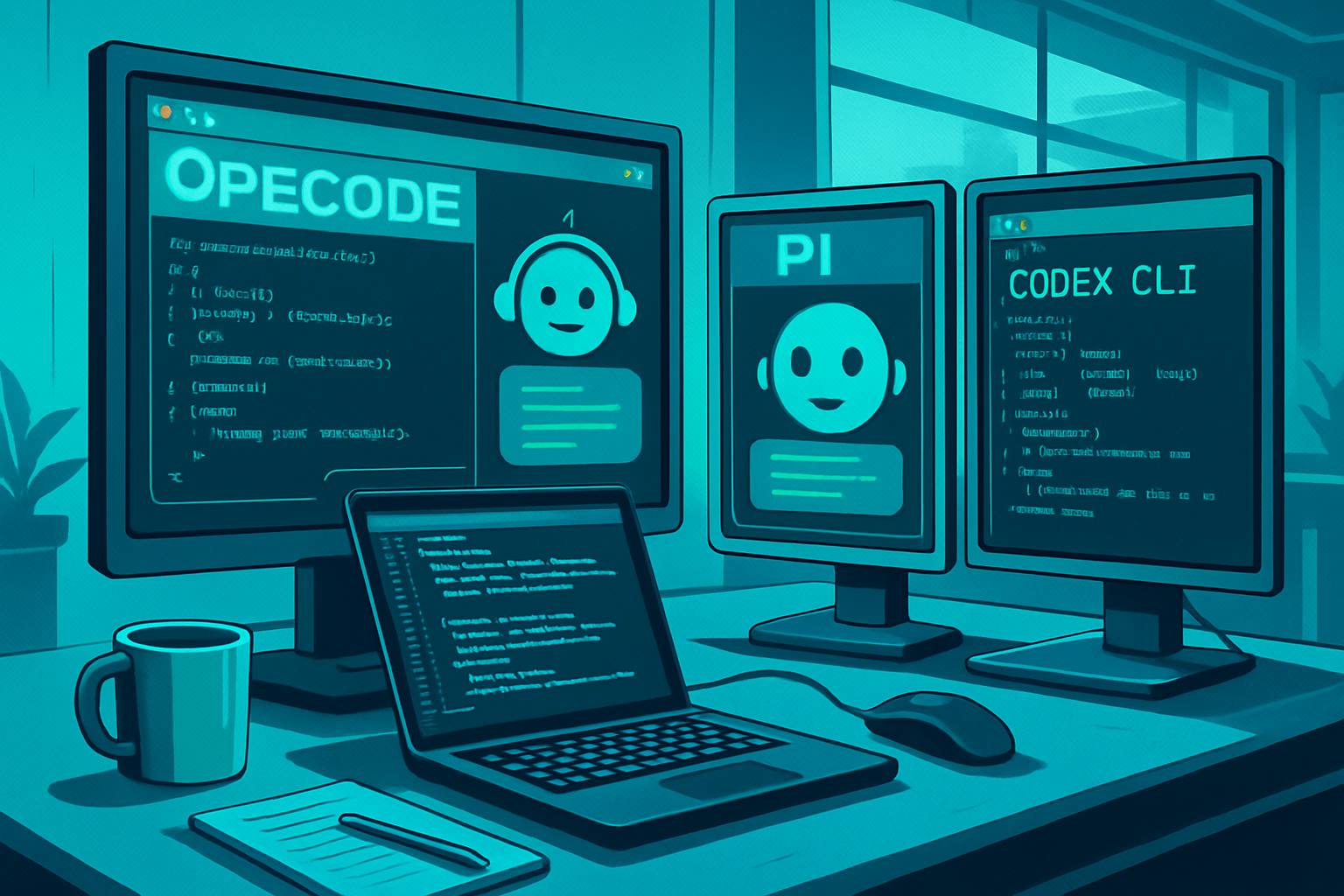
OpenCode is an open-source coding agent that operates in the terminal, integrated development environment (IDE), and desktop application. It can understand your code, modify files, execute commands, and assist with tasks such as bug fixing, feature addition, and code review. It also automatically loads language servers, helping it understand different programming languages and provide more accurate modifications.
What makes OpenCode better than Claude Code for some developers is its flexibility. You are not limited to a single model provider, and you can choose the model that best fits your budget and task. You can also run multiple sessions, create custom agents for scheduling or code review, and build your own workflows. It is an excellent choice for developers who want an open-source tool with more control over models, agents, and integrations.
Pi: A Lightweight and Customizable Harness
Pi is a lightweight, open-source coding agent harness that operates in the terminal. It keeps the core system simple and allows you to add the features you need through extensions, skills, reusable prompts, themes, and project instructions. It supports over 15 model providers, including Anthropic, OpenAI, Google, Kimi, OpenRouter, and Ollama, and you can even switch models during the same session.
Pi may be better than Claude Code for developers who want more control over their coding agent. Its small system prompt can use fewer tokens, while its extensions allow you to add tools, commands, interfaces, memory, sub-agents, and custom scheduling workflows. You can also revert to a previous message, create a new branch, and continue without losing the original session. However, some features are not included by default, so Pi is better suited for users who enjoy building and customizing their own setup.
Factory Droid: Automation for Teams
Factory Droid is a coding agent that operates in the terminal and IDE. You can give it a task in plain language, and it can explore code, write code, run tests, review changes, and fix issues. It also supports saved sessions, custom commands, plugins, MCP servers, different AI models, and specialized sub-agents for tasks such as code review or security checks.
Factory Droid may be better than Claude Code for teams that need automation and broader development workflows. Its droid execution mode can perform tasks without interactive chat, making it useful for scripts, batch jobs, and CI/CD pipelines. Factory Missions can also break down a large project into smaller steps, assign them to different agents, and check the final work, ensuring effective management of complex projects.
Le brief IA que les pros lisent chaque soir
Les 7 actus IA du jour, décryptées en 5 min. Gratuit.
Inclus dès l'inscription : notre sélection des meilleurs guides & comparatifs IA.
Choisissez votre rythme
Gratuit · Pas de spam · Désabonnement en 1 clic
Codex CLI: The Cost-Effective Alternative for ChatGPT Subscribers
Codex CLI is an open-source coding agent from OpenAI that operates in your terminal. It can explore your project, modify files, execute commands, test code, and explain the changes it makes. It also supports MCP servers, project instructions, images, different permission levels, and a sandbox that limits what the agent can access.
Codex CLI is one of the best alternatives to Claude Code for those who already use ChatGPT. If your existing ChatGPT subscription includes access to Codex, the available usage is generally sufficient for normal daily coding tasks. Instead of paying for another coding agent subscription, I would recommend trying Codex first. It also supports automated tasks and local AI models, making it useful for interactive coding and repeatable workflows.
Antigravity CLI: Speed and Multi-Agent Functionality
Antigravity CLI is Google's terminal-based coding agent. It can understand your code, modify multiple files, execute commands, use tools, and remember your conversation history. It is lightweight, designed for keyboard-based workflows, and works well over remote SSH connections. It also supports skills, hooks, plugins, sub-agents, and project instructions.
Antigravity CLI may be better than Claude Code when you want faster execution and multi-agent workflows. It can run multiple agents on different parts of a large task — such as searching for an issue while another agent modifies the code — without blocking your terminal.
It also shares the same agent harness and settings as the Antigravity desktop application, allowing you to start a task in the terminal and continue it in the visual interface. It is a solid option for Gemini and Google Cloud users who want a fast CLI for coding, automation, and large projects.
Cline: Increased Choice and Control
Cline is an open-source coding agent that operates in your terminal and within editors like VS Code and JetBrains. It can read and modify files, execute terminal commands, use a browser, install dependencies, and test its own modifications. The CLI supports both interactive sessions and headless execution, making it useful for normal coding, scripts, code reviews, and CI/CD workflows.
Cline may be better than Claude Code for developers who want more choice and control. You can use your own API key, choose from many cloud providers, or run local models via Ollama and LM Studio. It also supports MCP tools, project rules, skills, parallel sub-agents, and a Kanban board to execute multiple coding tasks simultaneously.
Goose: Freedom and Versatility
Goose is an open-source AI agent that operates via a CLI, desktop application, or API. It runs on your machine and can inspect files, modify code, execute terminal commands, perform tests, and accomplish multi-step development tasks. It supports over 15 model providers, including OpenAI, Anthropic, Google, Ollama, OpenRouter, Azure, and Amazon Bedrock.
Goose may be better than Claude Code for developers who want more freedom over their models and tools. You can connect it to over 70 MCP extensions, use local models, or utilize supported ChatGPT, Claude, and Gemini subscriptions. It is also not limited to coding — you can use it for research, writing, data analysis, and automation.
Conclusion
For developers who love open-source tools and want more control over models, I would highly recommend Pi and OpenCode. Both are flexible, support different providers, and work well with open-source or local models. Pi is better for those who enjoy customizing the entire agent setup, while OpenCode offers a more comprehensive experience right from the start.
If you already have the $20 ChatGPT subscription, I would still suggest trying Codex CLI before paying for another coding agent subscription. The included usage is generally sufficient for normal daily coding. The other tools remain excellent choices, especially for local AI coding, custom workflows, automation, and developers who want more freedom in how their coding agent operates.
Brief IA — L'actualité IA en français
L'essentiel de l'actualité de l'intelligence artificielle, décrypté et expliqué chaque jour.