Claude Code Overestimates Time: Two Methods to Correct It
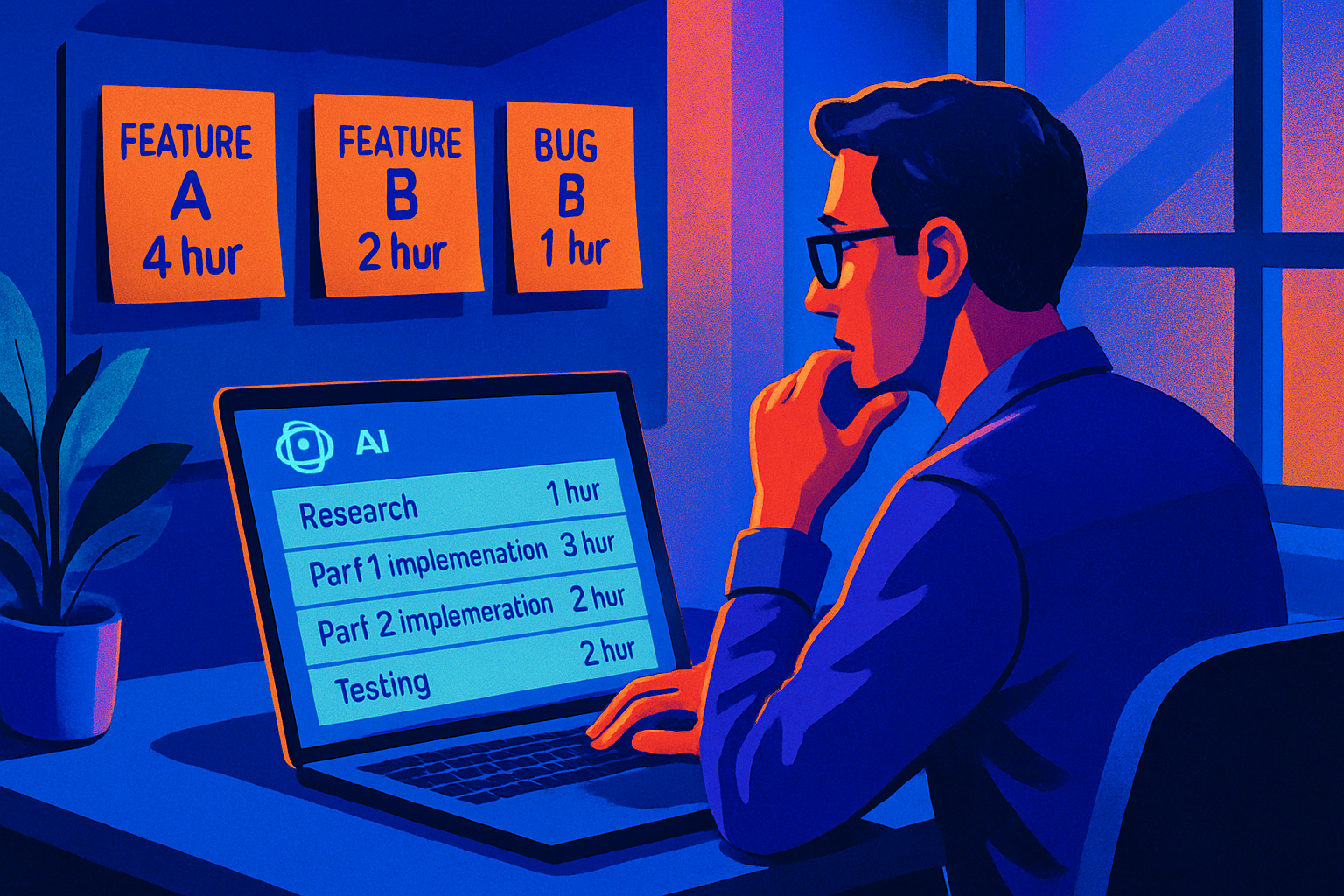
Claude Code often provides time estimates aligned with human benchmarks, sometimes significantly exceeding the actual durations observed with the help of an LLM. Two approaches are proposed to make these estimates more relevant: leveraging past durations and breaking tasks down into finer components while explicitly estimating on the LLM side. These methods, although improvable, aim to enhance reliability in team coordination.
Breaking Down Tasks and Explicitly Estimating on the LLM Side
The first method involves asking the agent to break down the functionality into subtasks and estimate the duration of each, specifying that the estimate should reflect the time of an LLM rather than that of a human. This approach does not require extensive historical data: it relies on a sufficiently precise breakdown to facilitate estimation. Typical subtasks include research, implementation of different parts, and testing, but it is recommended to go even further in specificity. The finer the granularity, the more accessible the estimation becomes, both for a human and for a model. The agent can draw on an implicit understanding of its own efficiency, particularly for research, which is significantly faster with an LLM than with manual searching. Once each duration is estimated, they can simply be summed to obtain a total estimate.
Anchoring Figures in Delivery History
Another approach involves creating an internal database of actual durations and linking it to the agent. Tracking can be done by documenting each task in Linear tickets or in a markdown file on Notion, precisely noting the start and end times for each intervention by the agent. After several deliveries and corrections, it becomes possible to create a dedicated skill that Claude Code can consult when a request for estimation arises. This database can contain examples such as 12 hours for feature A, 3 hours for feature B, or 4 hours for a bug fix. When faced with a new request, the agent compares the current task to these precedents to adjust its estimate. This method improves the relevance of responses, although it does not guarantee complete accuracy, as it remains impossible to foresee all obstacles in advance.
Le brief IA que les pros lisent chaque soir
Les 7 actus IA du jour, décryptées en 5 min. Gratuit.
Inclus dès l'inscription : notre sélection des meilleurs guides & comparatifs IA.
Choisis ton rythme
Gratuit · Pas de spam · Désabonnement en 1 clic
Why Proposed Durations Remain Aligned with Human Estimates
The gap between Claude Code's estimates and reality primarily stems from the model's training data. Claude was trained on human-sourced data from the web, such as blog posts detailing implementation durations or statistics from repositories at a time when code was written without AI assistance, before 2022. The benchmarks thus integrated reflect human rhythms: a feature might take four weeks, a bug fix two days. The estimates generated today extend these references and do not correspond to the working pace of an LLM.
Usage Observations: Significant Discrepancies on Common Tasks
Feedback indicates responses of three to four weeks for a single engineer when an agent is asked about a chatbot feature. This type of estimation comes up frequently, while the same task can be completed in a day with the right setup. Most features can be accomplished in twelve hours if the specification is clear, yet estimates in minutes are lacking. More broadly, without specific framing, most code AIs provide durations that exceed those observed in practice.
What This Changes for Organization and the Future
The reliability of estimates influences team coordination: product managers and colleagues need a clear horizon, especially since some tasks condition the work of others. Estimates should gradually improve as more data on durations obtained with LLMs becomes available online, with some delay before achieving better accuracy. This topic is deemed important in a context where these tools are changing practices and where the ability to align humans and models becomes an essential skill.
Brief IA — L'actualité IA en français
L'essentiel de l'actualité de l'intelligence artificielle, décrypté et expliqué chaque jour.