Claude Cowork: Anthropic Unveils Its Use for Office Tasks
Claude Cowork: Anthropic Reveals Its Use for Office Tasks
Anthropic's analysis shows that 50% of the usage of its AI agent Claude Cowork is dedicated to administrative processes and text-based tasks, making these office works the primary use case.
The tool is most often used for organizational tasks such as:
- Generating reports
- Creating checklists
- Preparing presentations
These routine tasks typically consume considerable time for employees.
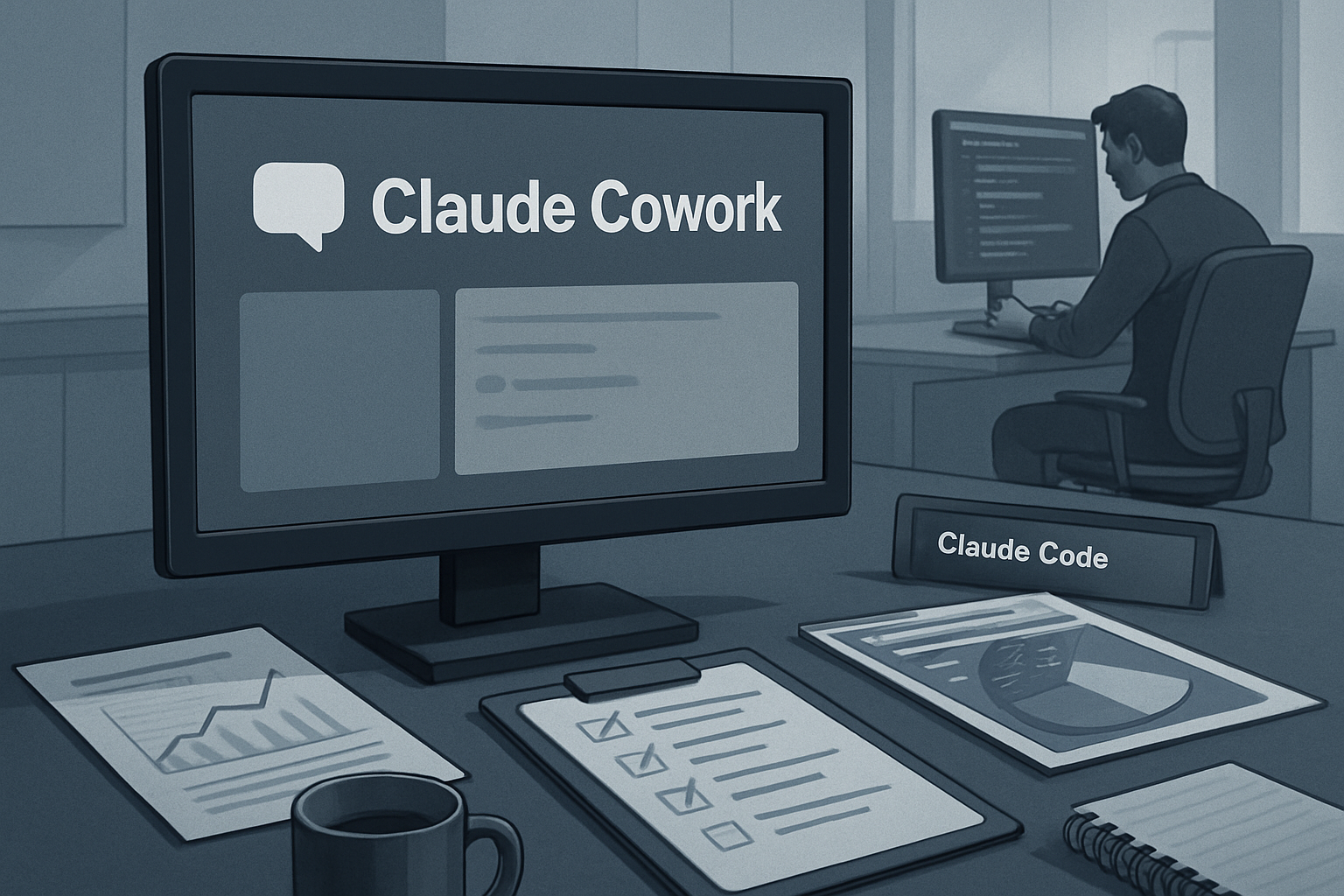
Software development accounts for only a small portion of Claude Cowork's usage, with developers tending to rely on Claude Code, Anthropic's specialized programming tool, for their coding needs.
An analysis of over one million Cowork sessions shows that about 50% of the usage is divided into two categories: business operations and text-based work.
Anthropic has broken down how users actually employ its chat agent, Claude Cowork. The analysis is based on a sample of 1.2 million anonymized sessions from May 11 to May 31, 2026, covering over 600,000 organizations. An automated system assigned each session to one of 20 work categories. According to Anthropic, about half of Cowork's usage relates to what the company calls "work around work," tasks that are rarely anyone's primary responsibility but accompany nearly every office job.
Two Categories Represent Half of All Uses
The largest category is "business processes and operations" at 33.4%. Anthropic indicates that this includes tasks such as:
- Compiling scattered status updates into a single report
- Creating onboarding checklists
- Reconciling spreadsheets
The second category is "content creation and writing" at 16.4%, encompassing drafts, presentations, publications, and proposals. Together, these two major categories represent "about half" of the usage described by Anthropic.
Business processes and operations constitute the largest share of all Claude Cowork sessions at 33.4%, followed by content creation and writing at 16.4%. The data shows that AI is most often used for structuring and communication tasks in knowledge work.
Anthropic describes these activities as "connective by nature." Spreadsheets consolidate scattered data into one place, presentations translate a decision for audiences with varying levels of knowledge, and onboarding checklists provide new hires access to an organization's institutional knowledge.
Le brief IA que les pros lisent chaque soir
Les 7 actus IA du jour, décryptées en 5 min. Gratuit.
Inclus dès l'inscription : notre sélection des meilleurs guides & comparatifs IA.
Choisis ton rythme
Gratuit · Pas de spam · Désabonnement en 1 clic
The remaining categories are much smaller. Software development accounts for 8.7%, DevOps and infrastructure 7%, research 6.4%, data analysis 5.8%, document processing 4.1%, and sales operations 4%. Personal assistance is at 3.8%, education at 2.4%, and meeting analysis at 1.8%.
Cowork Handles Peripheral Tasks While Claude Code Takes Care of Technical Work
The low share of coding confirms Anthropic's thesis that the interface plays a major role in how people adopt AI models. Developers continue to use Claude Code to build, debug, and ship software. In Cowork, they manage the communication tasks surrounding their work.
This model is corroborated by experience. After the launch of Claude Code in 2025, an unexpectedly high number of non-technical users began using the terminal, organizing folders, deleting duplicate files, and writing spreadsheet formulas. For others, the terminal remained a black box. Cowork was designed to bring these same agent capabilities to a familiar chat interface.
Anthropic illustrates this idea with three examples:
- A lawyer can have documents formatted and organized to free up more time for legal analysis.
- A recruiter uses it to schedule interviews and summarize feedback, allowing more time to focus on candidates and work samples.
- A team leader can have slides created to explain a difficult decision, giving them more time to actually make it.
The blank screen is often the first obstacle, and Cowork helps transform thoughts and information into a first draft, according to Anthropic.
The Taxonomy Has Gaps
Anthropic notes that business operations classify activities, not professions, and that there are no distinct categories for marketing, finance, or human resources. These functions are likely integrated into business operations, which, according to Anthropic, helps explain why this category accounts for a third of all uses.
The study presents other limitations. The sample captures only a fixed maximum number of sessions per hour, so peak periods are underrepresented. The figures are percentages, not absolute volumes. About 5% of sessions involve personal use such as leisure or discussions, so the dataset does not exclusively reflect work. Anthropic states that it will continue to update the analysis.
Anthropic recently expanded Cowork from the desktop application to the web and smartphones. Prior to this, the company had already given the agent the ability to operate directly on Mac and Windows desktops.
A review article written by Meta, Stanford, and the University of Illinois places systems like these in a broader trend. Code is no longer just the end product, but the operational layer on which AI agents function. Claude Code and Cowork, along with OpenAI's Codex (also known as ChatGPT Work), are seen as prominent examples of this shift.
Brief IA — L'actualité IA en français
L'essentiel de l'actualité de l'intelligence artificielle, décrypté et expliqué chaque jour.