Claude Science from Anthropic Releases Unique UV Sky Map
Le brief IA que les pros lisent chaque soir
Les 7 actus IA du jour, décryptées en 5 min. Gratuit.
Inclus dès l'inscription : notre sélection des meilleurs guides & comparatifs IA.
Choisis ton rythme
Gratuit · Pas de spam · Désabonnement en 1 clic
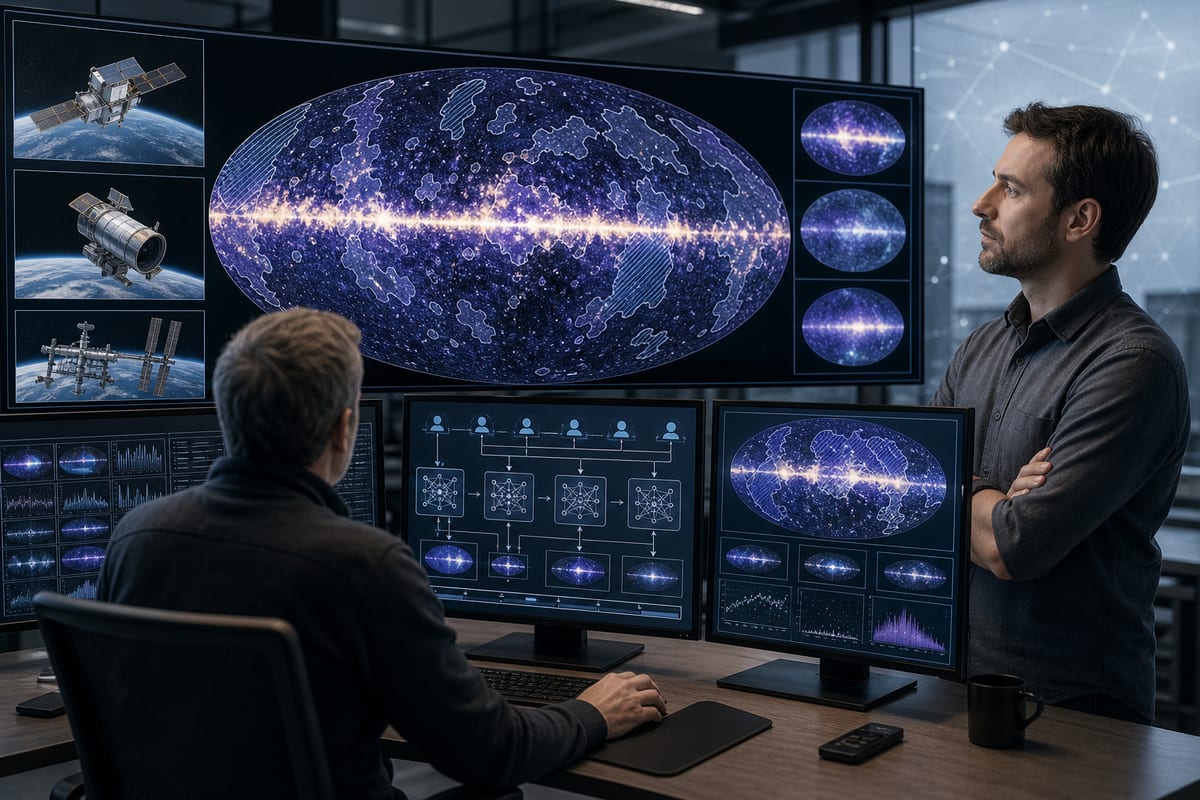
Tested with an average discrepancy of about 10%, the new ultraviolet sky map fills historical gaps through inpainting. Led by Claude Science from Anthropic, the project relies on merged spatial data and serves as an educational tool.
Announced Accuracy and Areas Left Out of Initial Surveys
Predictions from the automated processing show an average discrepancy of about ten percent compared to actual measurements. To achieve complete coverage, the teams employed inpainting, a method where a model learns from existing observations to reconstruct missing data. This technique allowed for the completion of areas not covered by NASA's GALEX mission, which had mapped about two-thirds of the ultraviolet sky, leaving out certain bright regions of star formation. Until now, a complete UV map did not exist, as ultraviolet light is blocked by the ozone layer and can only be measured from space.
Coordinated Agents, Multi-Missions, and Data Set Fusion
Claude Science coordinated AI agents to download data from multiple space missions, calibrate it, and merge it. This approach enabled the production of the first complete ultraviolet sky map. Observing this wavelength range reveals the presence of dust illuminated by starlight, particularly near young stars or in rings formed after stellar explosions.
An Educational Tool and Affordable Projects
The produced map is intended to serve as an educational resource for teaching and introducing astronomical data. The project also aims to demonstrate that AI can handle long and tedious data processing tasks that researchers would not have the time to undertake. Brice Ménard, an astrophysicist at Johns Hopkins, who details the approach on Anthropic's website, believes that many scientists have postponed similar projects, which AI could now make possible.
Brief IA — L'actualité IA en français
L'essentiel de l'actualité de l'intelligence artificielle, décrypté et expliqué chaque jour.