Ventura College: AI at the Heart of Educational Communities
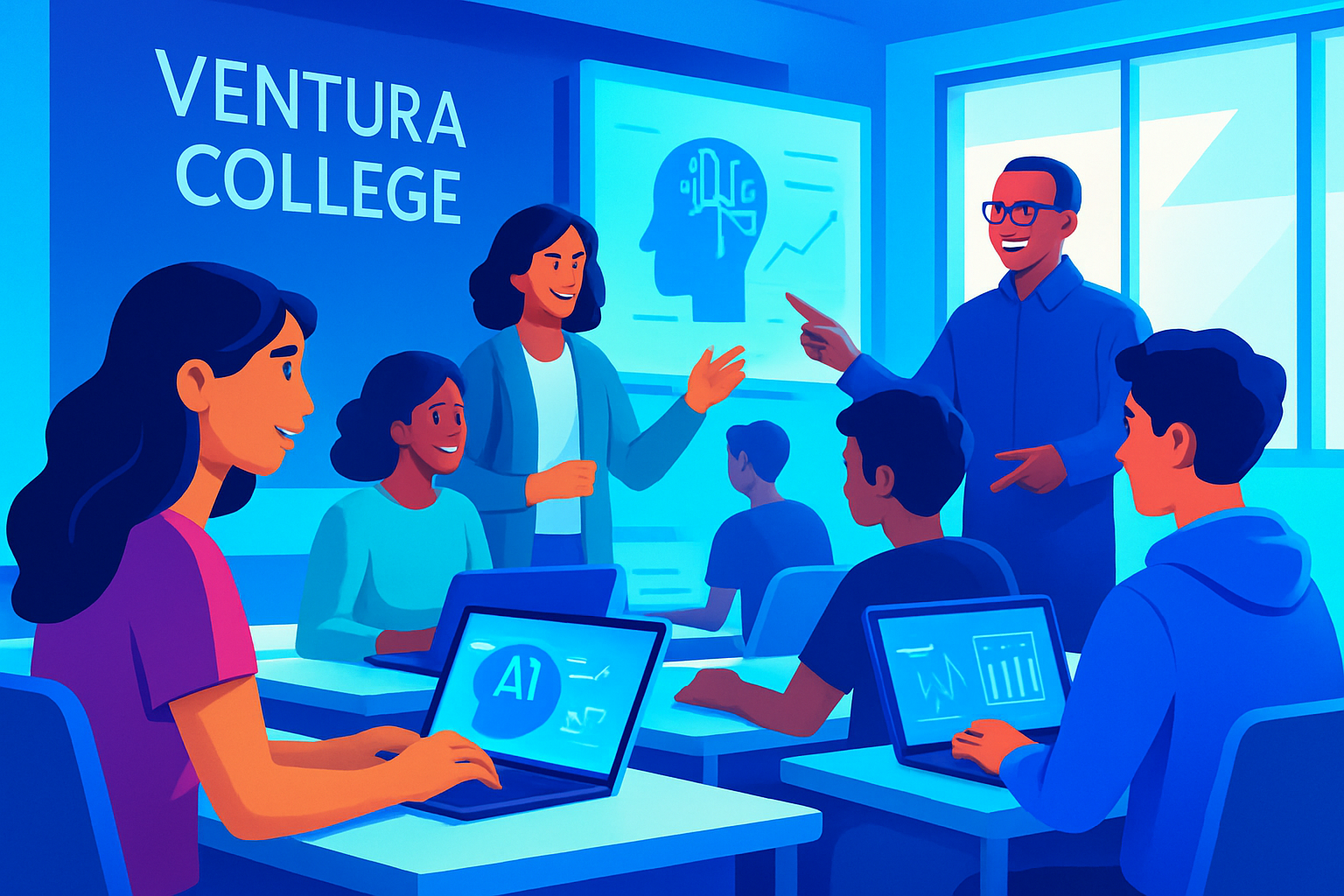
The introduction of artificial intelligence in higher education promises significant gains for faculty, particularly in terms of increased efficiency and improved learning outcomes. However, to fully leverage these technologies, educators must first familiarize themselves with them. While many are experimenting independently, some institutions are taking steps to accelerate this learning. At Ventura College, a community college in California, leaders have recently established communities of practice (CoP) around the use of AI. A CoP brings together individuals who share a common interest in a subject or technology; in this case, AI. The group then collaborates to deepen its knowledge on the topic or to use the technology more effectively. “Teachers need time to familiarize themselves with the technology — to meet, discuss, and experiment with it,” says Eric Martinsen, head of the English department and trainer within the program.
Establishing a Community of Practice
Students are already using AI on their own initiative, which can be a good sign. “With guidance, structured use of AI can lead to real improvements in student learning and deeper engagement,” explains Martinsen. But to be effective as instructors, teachers must understand how these tools work and what they can accomplish. With this in mind, Jennifer Garner, a biology professor at Ventura College and chair of the academic senate, attended a statewide training session in the spring of 2025 and returned with the idea of developing CoPs at Ventura. To implement this, the academic center's leadership helped create a training program for trainers. “We put out a call for a leadership team developer, who turned out to be Jennifer, as she had just completed the training,” explains Martinsen. Next, a call was made for five teachers interested in leading AI-focused CoPs. These educators concentrated on different aspects of AI adoption. Martinsen, for example, is already using an AI assistant compliant with the Family Educational Rights and Privacy Act (FERPA), “and the goal of my community of practice was to determine how to use a tool like this to interact with students or perhaps do our own work,” he says.
Bringing the Community of Practice to Life
The five trainers spent the fall semester meeting several times a week, preparing and developing their training materials. Then, the CoPs were opened to participants. To encourage participation, the school offered financial incentives. Teachers received a stipend of $1,250 for participating in the CoPs. Each trainer took charge of a group of 10 participants; the planning team received about 80 applications for 50 available spots. The format of the CoPs varied, with some meeting in person and others on Zoom. “Some of the trainers organized their sessions a bit like a seminar course, where everyone has a viewpoint,” explains Martinsen. “Others were more leader-directed.” Technology was essential to make these learning sessions effective. Trainers used platforms such as Canvas and Google Docs to publish resources and facilitate exchanges among participants. It was also important to establish measurable outcomes to demonstrate the impact of the effort. Each trainer defined outcomes that could be assessed at the end of the training. Within each CoP, “there was an expectation that work would be accomplished,” clarifies Martinsen. In his case, he asked teachers to use AI platforms to develop bots or applications, and others did the same within their CoPs.
Le brief IA que les pros lisent chaque soir
Les 7 actus IA du jour, décryptées en 5 min. Gratuit.
Inclus dès l'inscription : notre sélection des meilleurs guides & comparatifs IA.
Choisissez votre rythme
Gratuit · Pas de spam · Désabonnement en 1 clic
Lessons Learned from Developing Communities of Practice
Other colleges and universities can draw key lessons from Ventura's experience. First, this type of effort requires strong leadership. In Ventura's case, leaders shared a common vision and commitment to making the project work, explains Martinsen. Persistence also pays off. “We actually went through several vice presidents of academic affairs during the setup of this project, and I give a lot of credit to Jennifer for managing all those transitions. She was able to say: ‘Your predecessor approved this, here’s where we are in the process, we need to move to the next step.’ And that was iterated several times,” adds Martinsen. The IT team can play a key role in providing the infrastructure that supports an AI-focused CoP. “We definitely relied heavily on Zoom and other collaborative platforms,” says Martinsen. And there are also the AI tools themselves, with their respective licenses. IT can support the availability of these tools, ensuring that the right licenses are in place and that teachers know how to access the platforms they need. As the impact of the CoPs spreads, IT can help ensure equity at the student level. “It’s a huge advantage for students facing financial difficulties to have free or institutional access to a professional-grade AI tool,” concludes Martinsen. With trained teachers and the right tools in hand to support AI communities of practice, students can engage with the technology in both effective and responsible ways.
Brief IA — L'actualité IA en français
L'essentiel de l'actualité de l'intelligence artificielle, décrypté et expliqué chaque jour.