Agentic Databases: The AI Business Revolution is Underway
Le brief IA que les pros lisent chaque soir
Les 7 actus IA du jour, décryptées en 5 min. Gratuit.
Inclus dès l'inscription : notre sélection des meilleurs guides & comparatifs IA.
Choisis ton rythme
Gratuit · Pas de spam · Désabonnement en 1 clic
Agentic Databases: A Turning Point for AI in Business
With 95% of executives aiming to transform their companies into AI and data platforms within the next 1,000 days, agentic databases are emerging as a key concept. These databases no longer merely store information; they are becoming the engine for autonomous AI agents, optimizing their performance and memory.
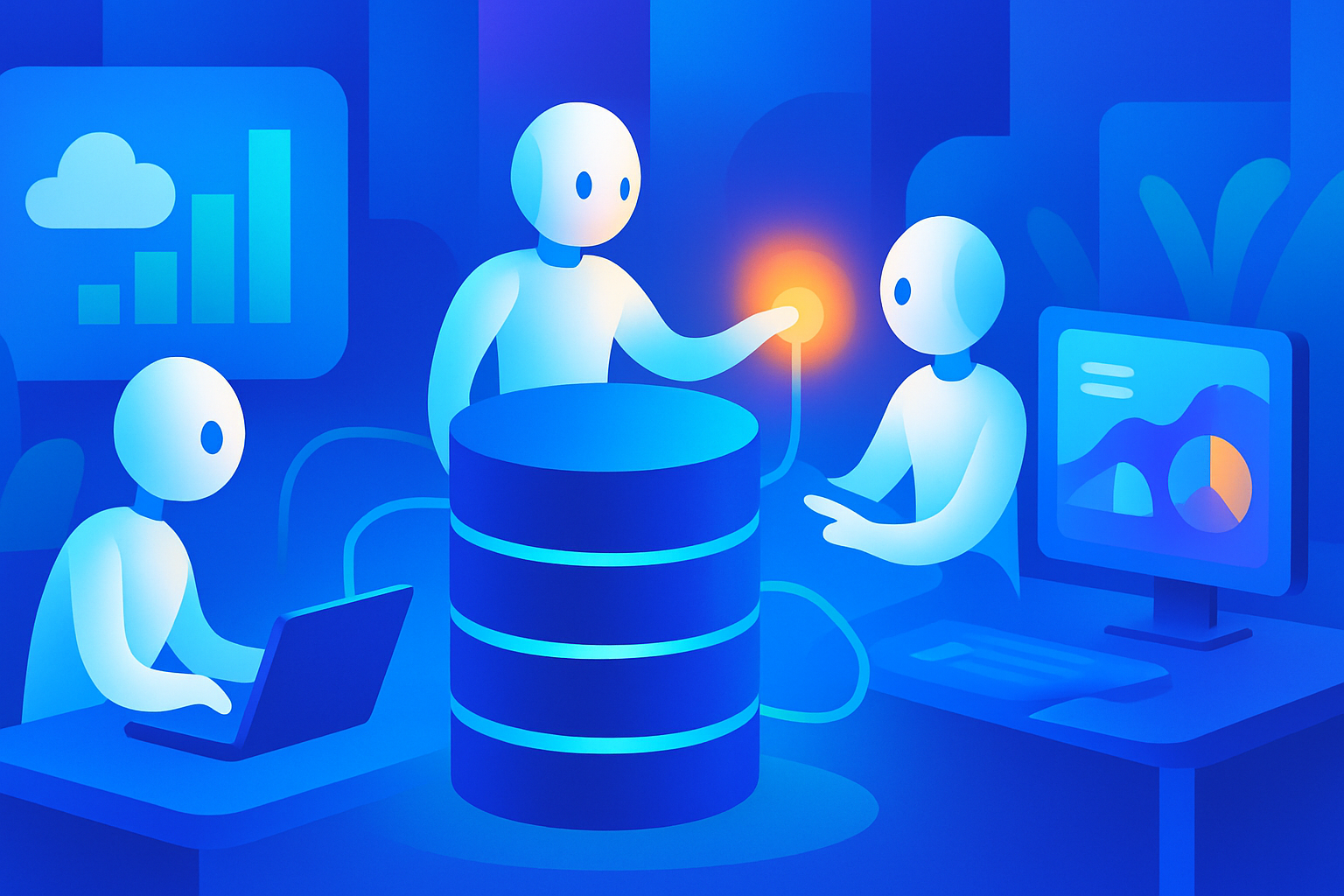
In three years, these leaders want their companies to become true AI and data platforms. Databases, long relegated to a storage role, are evolving into active systems that power AI agents, retain their memory, and continuously optimize their performance. This phenomenon is what is now referred to as agentic databases.
A Need for Data Centralization
Today, many companies operate with fragmented architectures where data and AI agents are scattered. This model limits efficiency, as teams spend more time connecting systems than developing new business applications. The most advanced companies are therefore seeking to centralize their data and agents within a coherent infrastructure, thereby reducing technical debt and accelerating deployments.
The numbers show a significant gap between leaders and the rest of the market. Only 95% of companies fully leverage the capabilities of GenAI and AI agents. These organizations deploy more applications, achieve a significantly higher ROI, and extend their usage across multiple business functions, from finance to sales to legal.
The Impact on Return on Investment
Companies that fully embrace GenAI and AI agents see a higher ROI and an expansion of AI into various sectors, such as finance, sales, and legal. The key to this success lies in creating a unified data layer that provides reliable context and persistent memory, thereby enhancing the performance of AI agents.
This changes the logic of AI projects. Each new agent gradually enriches the common knowledge base. Performance improves with use, and user interactions generate more actionable data. The company thus builds a virtuous cycle of automation.
An Architecture Suited for Autonomous Agents
Agentic databases represent a major technical evolution. Traditional infrastructures are not designed for autonomous systems capable of reasoning and executing complex tasks. New architectures must manage various types of data, including relational, unstructured, and vector data, for effective contextual search.
New architectures must handle multiple types of data simultaneously, including:
- Classic relational data
- Unstructured content
- Conversational history
- Agent memory
- Vector data for contextual search
Speed is crucial, as integrating AI agents into business operations requires real-time responses. Companies are adopting multi-tier storage systems to prioritize essential data. Furthermore, agents must understand intentions and execute complex actions, necessitating hybrid indexing mechanisms that combine semantic search and business data.
Agents must no longer just respond to queries but also understand intentions, retrieve relevant information, and execute complex actions. This requires hybrid indexing mechanisms that combine semantic search, user behavior, and business data.
Towards Complete Automation
The concept of agentic databases is gaining traction in strategic discussions about enterprise AI. Organizations are no longer simply looking to integrate AI into their existing tools but are rethinking their architecture around agents capable of automating complete processes.
Brief IA — L'actualité IA en français
L'essentiel de l'actualité de l'intelligence artificielle, décrypté et expliqué chaque jour.