DeepHealth: FDA Approves Its Breast Risk Tool
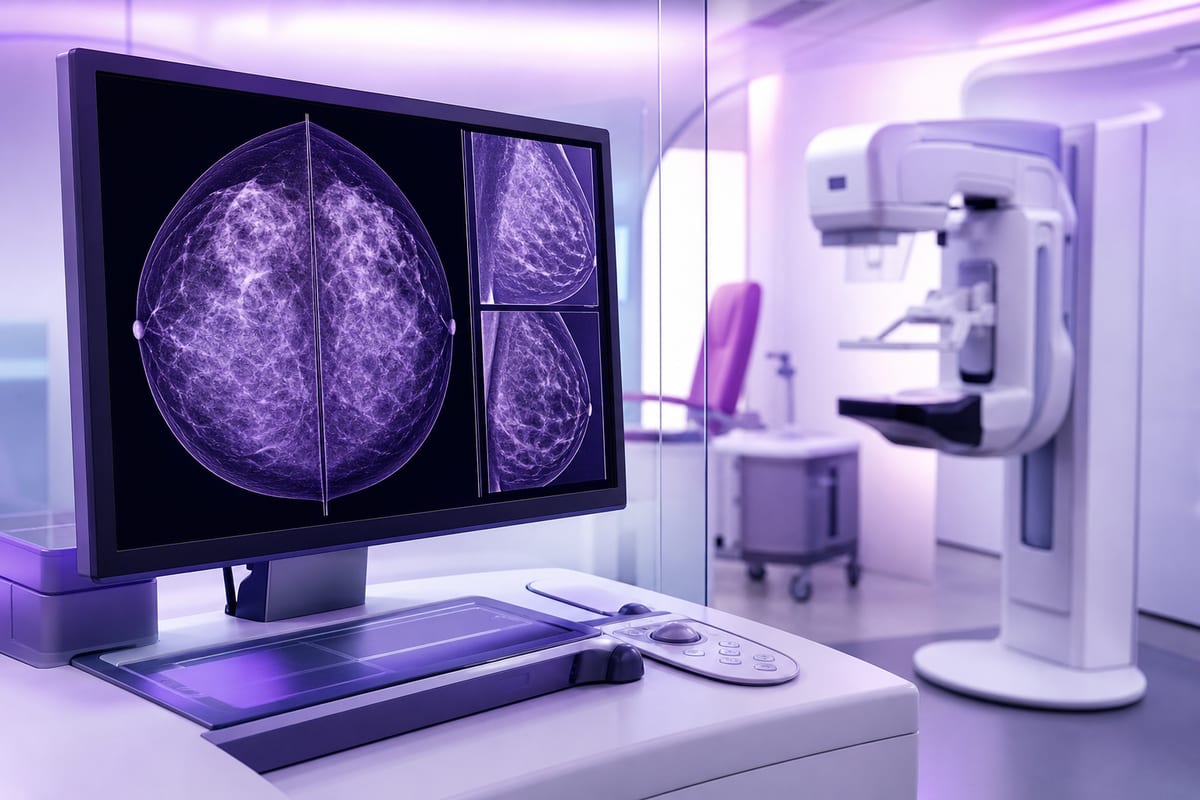
The FDA has authorized Mammo Risk, the AI from DeepHealth that estimates the risk of breast cancer over three, four, or five years. The RadNet subsidiary announced this decision on Tuesday, dated November 23 according to them. The tool utilizes a standard 3D mammogram without requiring any additional examination for its calculation.
DeepHealth presents results without specific accuracy figures
More than 65,000 mammograms performed for screening, from 10 clinical sites in the United States, were used for a multicenter independent evaluation. DeepHealth describes the predictive capabilities of Mammo Risk as strong but does not provide any accuracy figures when referring to the FDA file K262709. The company reports consistent results across subgroups, particularly for Black women and women with dense breasts. It notes that these populations have historically experienced less favorable outcomes and that traditional estimation methods were less accurate for them.
Mammo Risk is derived from a previous model, limited to a two-year horizon, which has already been marketed in Europe with CE marking. Researchers from the Karolinska Institute led its evaluation, published in 2022 in Science Translational Medicine, based on data from over 154,000 American women who underwent a 3D mammogram. In the group of the top 12% at highest risk, they measured a sensitivity approximately 2.4 times that of Tyrer-Cuzick, a traditional model.
Mammo Risk targets cancer-free examinations
The goal is not to detect an existing tumor: Mammo Risk is aimed at women whose mammogram shows no cancer but who may have a high future risk. Care providers can tailor their screening, including additional imaging exams. To detect cancer, DeepHealth offers another product, Mammo Dx.
Le brief IA que les pros lisent chaque soir
Les 7 actus IA du jour, décryptées en 5 min. Gratuit.
Inclus dès l'inscription : notre sélection des meilleurs guides & comparatifs IA.
Choisissez votre rythme
Gratuit · Pas de spam · Désabonnement en 1 clic
Traditional estimation methods rely on detailed questionnaires and clinical information. The AI of Mammo Risk, trained on 220,000 studies, derives its assessment from the mammogram itself. Niccolò Stefani, head of business and products for clinical AI at DeepHealth, presents this approach as a transition from detection to preventive pathways.
Victoria Smart, senior vice president of mission at the Susan G. Komen foundation, criticizes a one-size-fits-all approach despite biological differences and individual risk levels. She believes that better approaches have been long overdue. The American Cancer Society estimates about 321,910 cases of invasive breast cancer in the United States this year.
Commercialization, deployment, and billing
American healthcare providers can already purchase the software, which is compatible with systems from several vendors as well as with pathways combining 3D and 2D images. DeepHealth claims the first FDA authorization for a tool predicting this risk from 3D mammograms. According to the FDA, this imaging technique is available in more than 90% of U.S. facilities performing mammography.
RadNet plans to introduce Mammo Risk into its own screening programs over the coming months. DeepHealth also intends to showcase it in Chicago during the RSNA meeting, held from November 29 to December 2. A presentation scheduled for December 2 will focus on a study of its model using only the image.
Additionally, the American Medical Association has established a Category III billing code for tools assessing breast risk from images, set to take effect on January 1, 2027. According to DeepHealth, this code will be used to track their utilization. The data collected could contribute to future payment decisions.
Brief IA — L'actualité IA en français
L'essentiel de l'actualité de l'intelligence artificielle, décrypté et expliqué chaque jour.