DeepMind: AGI as a Social System of Agents and Humans
Le brief IA que les pros lisent chaque soir
Les 7 actus IA du jour, décryptées en 5 min. Gratuit.
Inclus dès l'inscription : notre sélection des meilleurs guides & comparatifs IA.
Choisis ton rythme
Gratuit · Pas de spam · Désabonnement en 1 clic
Three figures affiliated with Google advocate for an AGI envisioned as an ecosystem of coordinated agents working alongside humans. The core of the issue becomes organization, rules, and orchestration, rather than the pursuit of a single model. This thesis is based on recent work and proposes rethinking alignment, interfaces, and competencies.
Institutions and orchestration take precedence over a single model
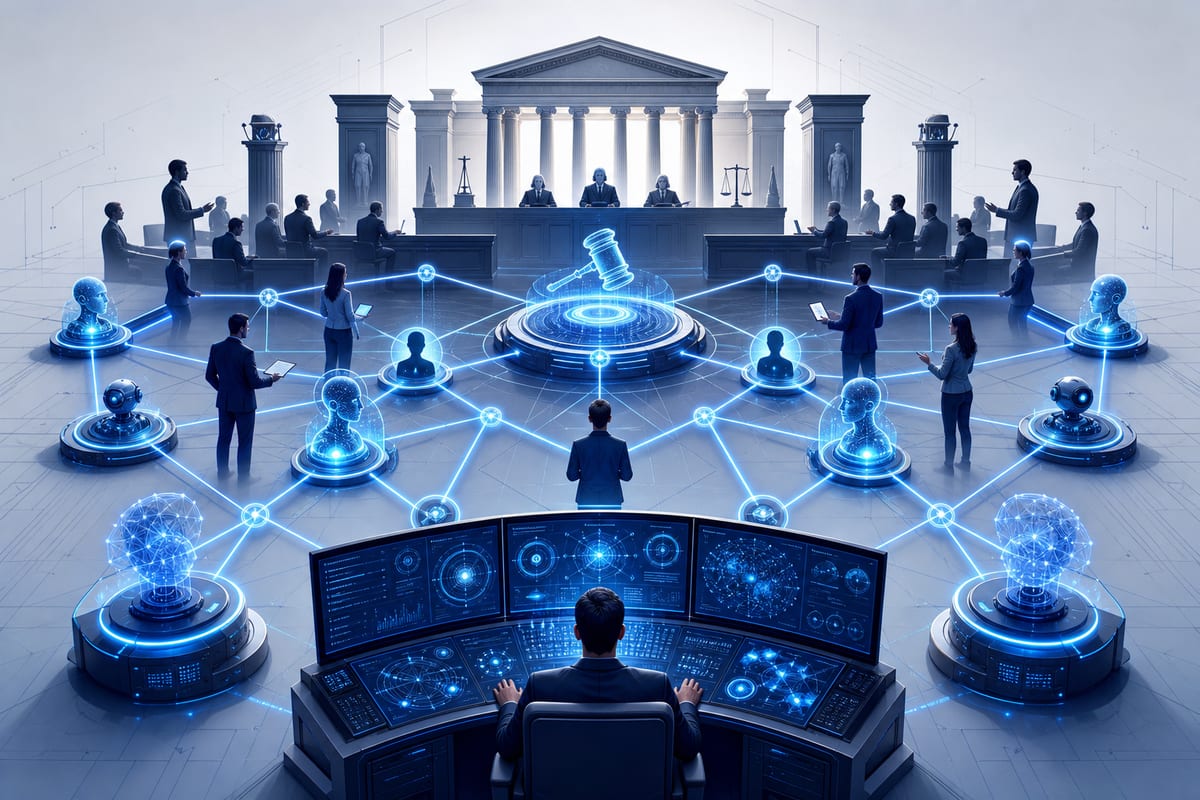
The determining question is to establish rules for collaboration between humans and multiple agents. Better models and smoother interfaces would not be sufficient. The market would not cover all coordination, as concepts like guilt, illness, or virtue cannot be reduced to transactions. They therefore argue for institutions that clearly define the roles of human and machine participants. Similar to a court, where a judgment results from roles, rules, and orderly exchanges between parties, the value of such an institution in AI would lie in its rules, procedures, precedents, and feedback loops that structure the actions of agents. Signs of this approach already exist with orchestration systems coordinating multiple models, which regularly outperform individual models considered more intelligent. This redistribution of attention also changes the public debate: if AGI is a final product, research and regulation focus on the size of models and their control; if it is a social system, progress must be made simultaneously on models, interfaces, institutions, and governance, with a carefully designed architecture.
The formation of values through successive interactions is advocated.
Alignment is reformulated: attempting to impose a fixed corpus of values on models from above would be a dead end. They argue that values are formed through continuous contact between people, agents, and institutions, at varying adoption rates depending on the domains. The research challenge is to develop a framework that structures this negotiation. This approach contests the idea of an imminent singularity and suggests that the next "explosion of intelligence" would remain closely anchored in human norms and institutions.
Redefining the agent: a reversible assembly rather than a digital twin
According to this approach, an AI agent is not presented as a miniature person, but as a provisional composition of models, roles, memories, ethical principles, tools, and skills. This setup can be separated and reconfigured, even if the user frequently feels a constant identity. Unlike a person, whose brain ensures physical continuity, the agent has no anchoring, and its capacity to act is reassembled with each request based on context and demand. The assimilation to fixed-identity digital twins is deemed misleading, as it would underestimate the potential of swarms of coordinated agents. Already, systems distribute work among multiple models in teams. In this context, the research challenge becomes the coordination and governance of networks of agents and humans, with intelligence being viewed as a social phenomenon.
Individual exchanges give way to visible networks of agents
Interactions centered on a one-on-one conversation with a bot appear to be transitional. Interfaces could evolve into visual network diagrams, showing agents as nodes and providing an overview to manage them without speaking to each one individually. This shift would be accompanied by a change in skills: while traditional programming valued sustained focus, strict order, and low tolerance for ambiguity, coordinating swarms would require dealing with behaviors that are difficult to pin down, experimenting, and delegating more to machines.
Empirical clues of internal debate thinking
An empirical study conducted on reasoning models such as DeepSeek-R1 and QwQ-32B describes traces resembling internal debate, with shifts in perspective, objections, and reconciliations between approaches. This behavior would emerge during training, without explicit programming, and reinforcement learning aimed at reasoning accuracy would lead to multi-perspective conversational dynamics. These observations, stemming from previous research within the same circle, are transposed to the possible design of societies uniting agents and people, complemented by a theoretical analysis on "agentic intelligence" and its place in a potential explosion of intelligence.
A historical shift envisioned and an alternative to singularity
These developments are situated in a context where urbanization, specialization, and declining birth rates reduce populations in industrialized countries, while instances of AI agents multiply rapidly. The balance between biological and synthetic thinkers could shift at a pace that, viewed from history, would resemble a leap. By analogy with the Industrial Revolution, a threshold could be crossed when texts, code, and administrative tasks produced synthetically exceed the combined output of biological brains, with humans then playing a slower and more abstract layer of oversight. In response to the vision of an isolated superintelligence, they propose "Artificial Symbiotic Intelligence," an ecosystem where humans and machines co-shape and decide together, which reconfigures the public debate and extends the idea that major advancements, both in the living world and in culture, arise from social dynamics.
Brief IA — L'actualité IA en français
L'essentiel de l'actualité de l'intelligence artificielle, décrypté et expliqué chaque jour.