DeepMind Establishes AGI Institute and Proposes Evaluation Framework
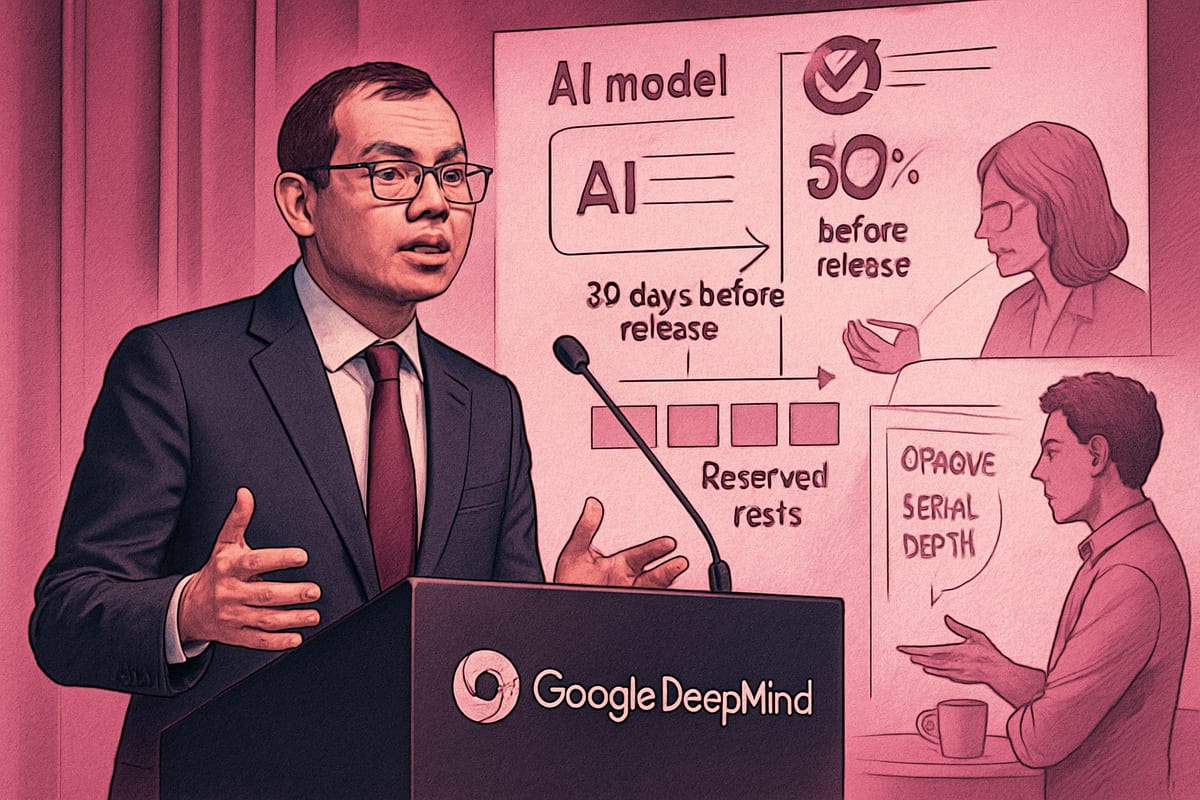
Google and Google DeepMind launch an institute dedicated to AGI and publish four essays proposing concrete governance options. On the agenda: a standards body led by the United States, "reserved" tests, and safeguards on transparency, as industry leaders support the idea of pacing developments.
Hassabis advocates for a US body, "reserved" tests, and potential tightening
Demis Hassabis proposes the creation of a standards organization to evaluate frontier AI models, led by the United States. In this framework, developers would voluntarily submit their systems up to 30 days before their release. If the effectiveness of this mechanism is demonstrated, passing these evaluations could become a condition for deploying frontier models in the United States. The organization would first design the evaluations in consultation with AI companies, then develop independent and undisclosed assessments, called "reserved tests," to prevent labs from tailoring their models to known tests. Hassabis notes that this framework could be strengthened if the severity of the situation requires it, potentially including a coordinated slowdown among developers. These proposals come as industry leaders support elements of Dario Amodei's call to "pace" the development of frontier AI, and the debate evolves towards mechanisms for disclosure, external oversight, and, if necessary, coordinated slowdowns.
Le brief IA que les pros lisent chaque soir
Les 7 actus IA du jour, décryptées en 5 min. Gratuit.
Inclus dès l'inscription : notre sélection des meilleurs guides & comparatifs IA.
Choisissez votre rythme
Gratuit · Pas de spam · Désabonnement en 1 clic
Transparency under constraint: researchers reject opacity by default
Rohin Shah and Anca Dragan argue that the loss of transparency in models is not inevitable, even if new architectures make the most powerful systems harder to monitor. They urge developers and regulators to confront the security trade-offs related to transparency head-on. Among the proposed avenues are limiting "opaque serial depth," meaning the amount of sequential computation performed without producing a readable reasoning trace, and requiring developers to demonstrate that less transparent systems remain monitorable.
A new institute to organize the debate and publish four thematic essays
The DeepMind Institute was launched on a Wednesday by researchers from Google and Google DeepMind to advance the discussion on AGI. The body is led by Shane Legg, James Manyika, and Demis Hassabis, with Legg serving as editor-in-chief. The stated goal is to clarify viewpoints that may diverge between Google, Google DeepMind, and the research community, with an acknowledged possibility of disagreements and changes as new data emerges. The first publication includes four essays: economic policies to manage potential AGI disruption, preserving human-readable reasoning in models, principles of human flourishing, and a framework for evaluating frontier AI models.
Brief IA — L'actualité IA en français
L'essentiel de l'actualité de l'intelligence artificielle, décrypté et expliqué chaque jour.