DeepMind and Agentic AI: Towards a Scientific Revolution
Le brief IA que les pros lisent chaque soir
Les 7 actus IA du jour, décryptées en 5 min. Gratuit.
Inclus dès l'inscription : notre sélection des meilleurs guides & comparatifs IA.
Choisis ton rythme
Gratuit · Pas de spam · Désabonnement en 1 clic
A New Era for Science with AI
Throughout history, certain voices have regularly proclaimed the end of science. In 1903, respected physicist Albert Michelson claimed that discoveries in physical science were complete. Later, in the 1980s, Stephen Hawking predicted the end of theoretical physics before the 21st century. Today, artificial intelligence (AI) is provoking similar reflections, especially after a Nobel Prize was awarded in this field.
In 2024, Demis Hassabis and John Jumper, affiliated with Google DeepMind, were awarded part of the Nobel Prize in Chemistry for their creation, AlphaFold. This neural network is capable of predicting the three-dimensional structures of proteins based on thousands of experimentally obtained shapes. This problem, which had resisted numerous attempts for decades, seemed solved by AlphaFold, generating immense interest in this approach. Hassabis and his team described AlphaFold as a model illustrating how AI could accelerate science at a digital pace. DeepMind's success has sparked a wave of startups in the fields of biology, chemistry, and materials discovery, raising billions of dollars. AlphaFold demonstrated that AI, when combined with sufficient data, could lead to revolutionary discoveries, even without fully understanding the underlying mechanisms.
The Limits of AlphaFold and the Need for a New Approach
Although AI promises major transformations in the scientific field, it is becoming increasingly evident that AlphaFold may not be the ideal model for this revolution. Despite its success, the conditions that allowed for the creation of models like AlphaFold are rare, and it will likely take decades to replicate them in other areas. The acceleration of science might instead come from another approach: AI agents.
The success of AlphaFold relies on the existence of the Protein Data Bank, a database containing approximately 170,000 experimentally validated protein structures, on which the DeepMind team was able to train its model. The creation of this database required 53 years of international scientific cooperation and about $21 billion in experimental work. Such efforts are difficult to fund, nearly impossible to coordinate, and extremely time-consuming to accomplish, which explains their frequent failures.
Even in fields with the necessary resources, another barrier persists: the scientific impossibility of generating comparable data. In the case of protein structures, protein crystallography is an exceptionally reliable experimental technique, having contributed to more than 25 Nobel Prizes. However, in most experimental sciences, results often vary. Cell lines evolve, chemicals contain contaminants, and laboratory humidity fluctuates. Creating datasets that are sufficiently consistent and accurate to train a modern neural network would require new measurement methods and standardized approaches, which will not be available anytime soon.
AI Agents: A New Path for Science
Certain fields, such as weather forecasting or some aspects of genomics, could benefit from breakthroughs similar to AlphaFold. However, for the majority of open scientific questions, another strategy is needed in the short term. Fortunately, a more discreet and modest approach is beginning to show its potential.
Scientists have always had to reason under uncertainty. Biologists searching for new drug targets have never had access to perfect datasets. Instead, they combine docking calculations, known structures, molecular dynamics, and binding assays, using their judgment to evaluate each method according to its strengths and weaknesses. Scientific skill lies in synthesizing results from many tools and revising conclusions as new evidence emerges. Until recently, no software could accomplish this.
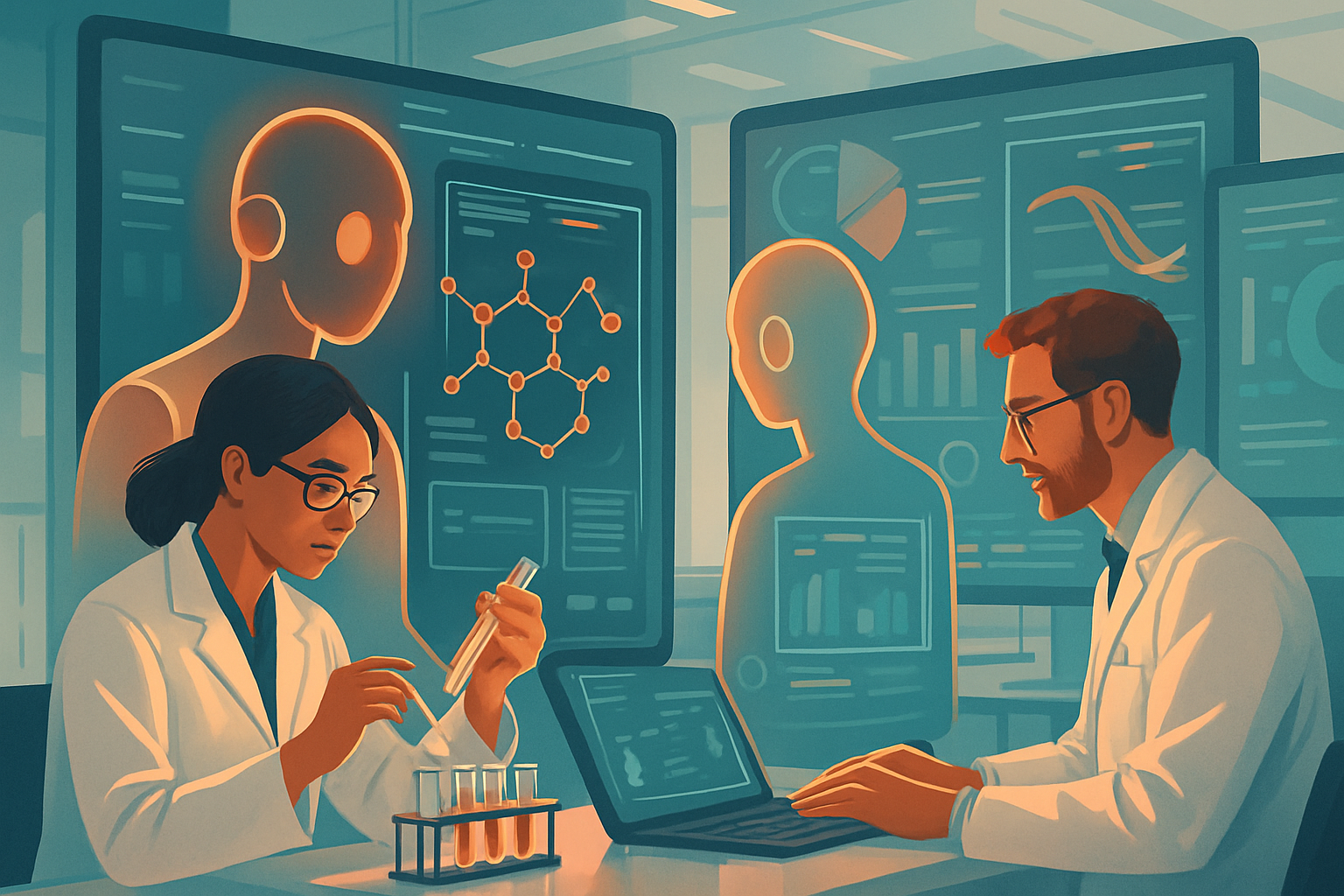
AI agents, however, are capable of doing so. In simple terms, an agent is an AI reasoning engine that can access and utilize digital or physical tools. In recent years, a fundamental architectural shift in AI has enabled the rapid proliferation of these programs, powered by large language models, significantly reducing the need for specialized datasets. For science, this advancement represents a fundamental change, allowing the creation of digital tools capable of replicating the iterative and contingent process of research. Unlike AlphaFold, which applies a powerful approach to a limited question, AI agents are generalists, digitally modeling the human process of discovery.
The Example of Google's Co-Scientist AI
Take, for example, Google's Co-Scientist AI, announced in May. Researchers provided it with a one-page brief and a goal: to understand how antibiotic resistance spreads between bacterial species, a key factor in drug-resistant infections. The system generated sub-agents. One formulated hypotheses from the literature, another reviewed them as a peer reviewer, a third organized tournaments to rank the strongest candidates, and a fourth refined the winning hypothesis. The agent concluded that resistance genes spread via bacterial viruses, using these viruses to reach new hosts. This hypothesis was correct. Researchers from Imperial College London had spent a decade reaching the same conclusion through meticulous laboratory work, and their paper was still under peer review.
The Challenges and Promises of AI Agents
Although agents like Co-Scientist are still new, and there are challenges to overcome before they become ubiquitous in the scientific process, these technical obstacles will eventually be surmounted. Currently, they can still hallucinate, their judgment is not always consistent, and they have memory and input limitations that restrict their autonomy. However, as these barriers fall, the cumulative effects of agents on the reliability, consistency, and speed of science will become evident.
Agents offer a structural solution to the "reproducibility crisis" in science, a widespread problem where researchers struggle to reproduce others' results. For decades, the scientific community has urged researchers to share their raw data and exact code to standardize experimental processes. But researchers have often resisted this tedious administrative work. Agents, on the other hand, automatically record every move, creating an accurate record of the method that led to their results, allowing for exact replication.
Towards an Amplified Scientific Memory and Accelerated Science
Another consequence of agents will be the amplification of scientific memory. Knowledge transfer between researchers is notoriously imprecise; without prolonged training and observation, graduate students often have to sift through disorganized lab notebooks to find crucial details. As agents become an integral part of the scientific process, the entire scientific history of a lab will be recorded in a centralized and standardized repository of institutional knowledge.
But the most significant impact of agents will be speed. In any field, when testing an idea takes less time than discussing it in a meeting, researchers stop debating and move directly to experimentation. An agent capable of reading a thousand articles in an hour, designing 500 molecules, and learning from its failures by morning will reduce the cost of experimentation and fundamentally change the pace of science. It will also enable researchers to pursue bold and unprecedented questions, opening doors to scientific avenues yet unexplored.
While the AlphaFold model is crucial for incredible discoveries, it will not lead to the end of science. On the contrary, the emergence of agentic AI represents a breakthrough of unprecedented scope, encompassing all scientific fields. Historically, such tools have only been introduced a few times, like calculus, statistical inference, spectroscopy, and the computer. Each has revealed a world of unexpected problems, redefining their respective fields. With agents, such a transformation is imminent.
Eric Schmidt, former CEO of Google, co-founded Schmidt Sciences in 2024 with his wife Wendy, a philanthropic initiative to fund unconventional explorations in science and technology. Suhas Mahesh leads the AI for science work at the Schmidt Sciences AI Center, specializing in materials discovery. Maya Levin, partner and head of science at Eric Schmidt's office, contributed to this research.
Brief IA — L'actualité IA en français
L'essentiel de l'actualité de l'intelligence artificielle, décrypté et expliqué chaque jour.