Internal Safeguards to Curb Overly Verbose AI Texts
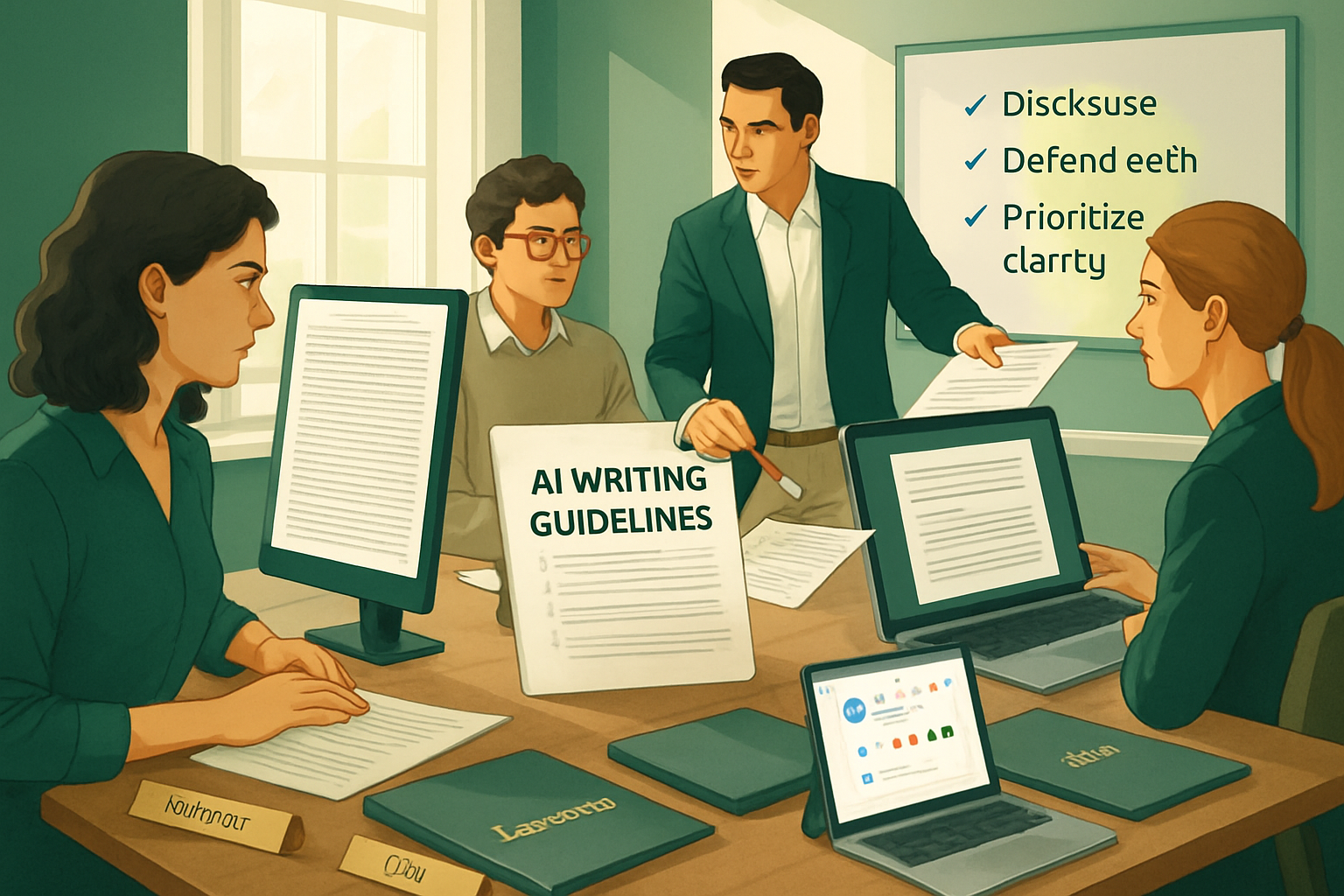
AI usage policies are spreading in companies like Polarsteps, Leapsome, and Clay. The stated goal: to stop the sending of long and confusing documents generated by AI, without banning the tool, by imposing clarity, accountability, and disclosure.
Visible Effects and Quantified Public Response
As of September 3, a LinkedIn post by the CEO of Clay regarding the new policy garnered nearly 10,000 reactions and over 700 shares. The message, published the previous month, circulated widely. Leaders who have implemented similar rules report that feedback from teams is mostly positive. At Polarsteps, Clare Jones now observes an influx of content written by humans.
Time Cost Described by a Survey and Managers
By the end of 2025, 40% of the 1,150 full-time office employees surveyed in the United States reported having received AI-generated content from a colleague the previous month, with each case taking nearly two hours to process according to respondents. Internally, managers also describe a reading overload: during a recent meeting, Jessica Zwaan noted that she spent more time reading preparatory documents than in the meeting itself. Leaders emphasize that length does not guarantee quality.
Polarsteps Imposes Disclosure and Critical Thinking
Founded in 2015 in Amsterdam, Polarsteps established principles for internal writing with AI earlier this year for around 100 employees. Clare Jones explains that a policy provides a shared reference point. Texts intended for users remain written by internal professional authors. The rules require disclosing the use of AI and delivering a result that reflects the reasoning and voice of the author. AI is allowed for brainstorming and drafts, provided critical thinking is applied before any sharing.
Le brief IA que les pros lisent chaque soir
Les 7 actus IA du jour, décryptées en 5 min. Gratuit.
Inclus dès l'inscription : notre sélection des meilleurs guides & comparatifs IA.
Choisissez votre rythme
Gratuit · Pas de spam · Désabonnement en 1 clic
Leapsome Targets Clarity and Document Length
In mid-August, Leapsome asked its 130 employees in Berlin and New York to defend their statements, aim for clarity, and manage length. The policy specifies that if a short prompt produces a long document, it is not useful to read, for the same reason it was not useful to write. For Jessica Zwaan, productivity is primarily about clarity rather than volume.
At Clay, Defending Every Sentence and Reducing Reader Cost
Sophie Alpert, a principal engineer at Clay, drafted the internal policy, initially shared in mid-June with about 100 engineers, then extended to all 550 employees in early August. The rules require that every idea and sentence can be defended and that the writing is worth reading. The policy emphasizes that the additional time imposed on readers has a multiplicative cost for the team, while the effort for clarity made by the author is a one-time cost that benefits everyone. Alpert says she acted after receiving five clearly AI-generated documents in one week and responses inviting her to "ignore" confusing passages.
No Ban on AI, But the End of Unverified Outputs
The policies at Polarsteps, Leapsome, and Clay do not ban AI. They aim to prevent unverified outputs from being passed off as personal reflection and to avoid burdening colleagues. The phenomenon even has its nickname, "meat proxies," popularized by German developer Niklas Gruhn in a post on August 3. The rise in usage follows the launch of ChatGPT at the end of 2022. At Leapsome, some employees have called for further restrictions on AI in internal messages and marketing content. In several companies, policies are now formalizing where reasonable use ends, in response to documents deemed confusing and time-consuming.
Brief IA — L'actualité IA en français
L'essentiel de l'actualité de l'intelligence artificielle, décrypté et expliqué chaque jour.