AI Text Detectors: The Impossible Quest for Reliability
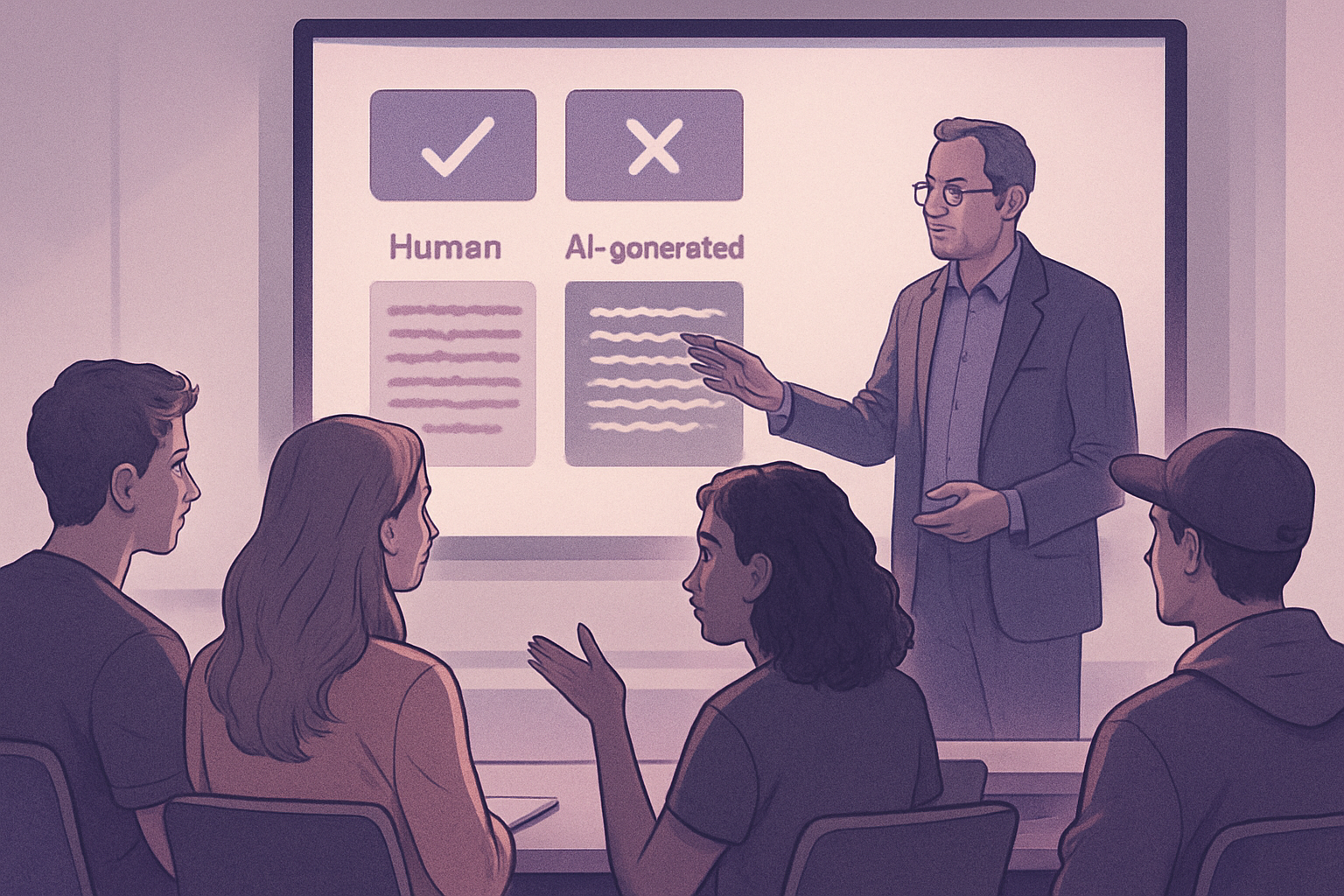
Since artificial intelligence gained the ability to autonomously write complex texts at the end of 2022, the need for a reliable tool to detect AI-generated texts has intensified. Schools, universities, and other institutions have expressed a growing demand for such detectors to preserve academic and professional integrity.
Current AI text detectors rely on several approaches. Initially, predictability metrics such as perplexity were used. More recently, transformer-based classifiers have been developed. These map the text into an embedding space and calculate a probability indicating whether the text is generated by AI or by a human. However, even these advanced models fail to establish an infallible detection rule.
Le brief IA que les pros lisent chaque soir
Les 7 actus IA du jour, décryptées en 5 min. Gratuit.
Inclus dès l'inscription : notre sélection des meilleurs guides & comparatifs IA.
Choisissez votre rythme
Gratuit · Pas de spam · Désabonnement en 1 clic
The performance of these detectors is often influenced by reference choices and training strategies, which can introduce biases and shortcuts. Additionally, real-world conditions, as well as adversarial attacks such as paraphrasing and detector-guided rewriting, continue to pose major challenges to the reliability of these tools.
An important theoretical result highlights that reliable detection is fundamentally limited by the increasing similarity between human and AI text distributions. As AI-generated texts become more fluent, detectors risk turning into tools for random guessing.
Practical tests conducted with a commercial detector revealed surprising false positives, even on purely human texts, as well as errors on mixed texts that were nonetheless obvious. Institutions should therefore consider detector scores as weak signals rather than irrefutable evidence, as the problem of reliable detection appears to be fundamentally unsolvable.
Brief IA — L'actualité IA en français
L'essentiel de l'actualité de l'intelligence artificielle, décrypté et expliqué chaque jour.