Discovered Materials: AI Enhancing Chip Performance
Le brief IA que les pros lisent chaque soir
Les 7 actus IA du jour, décryptées en 5 min. Gratuit.
Inclus dès l'inscription : notre sélection des meilleurs guides & comparatifs IA.
Choisis ton rythme
Gratuit · Pas de spam · Désabonnement en 1 clic
AI to Solve the Energy Challenges of Data Centers
Computer chips, essential for artificial intelligence workloads, generate a significant amount of heat. This phenomenon contributes to the enormous energy consumption of data centers, which require sophisticated cooling systems to operate efficiently. Faced with this challenge, entrepreneurs are turning to AI to find solutions to the problems it has helped create.
Discovered Materials and Its Innovative Strategy
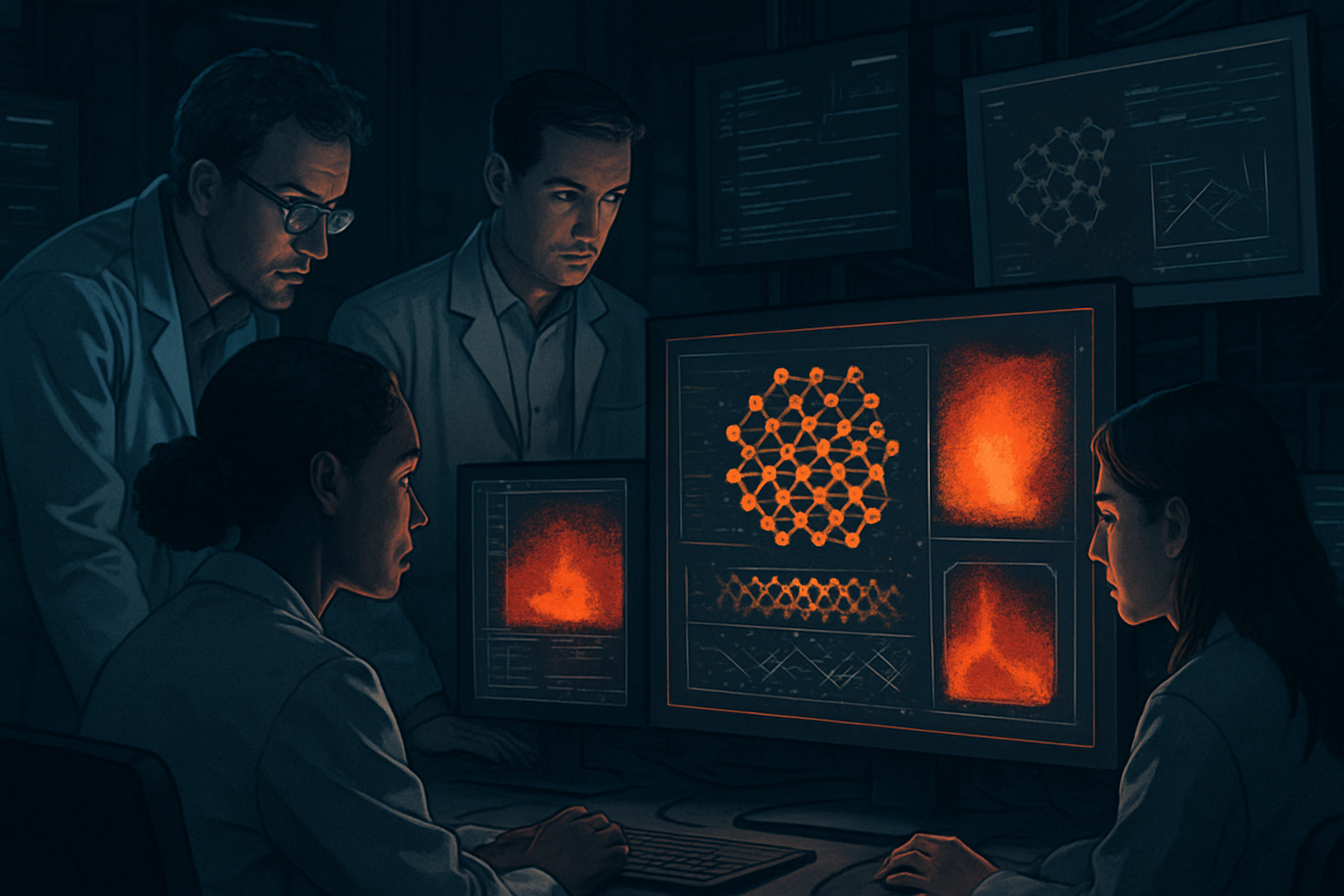
Discovered Materials is the latest company to embark on this path, using swarms of AI agents to identify new materials capable of improving the efficiency of integrated circuits. The startup recently raised $9 million in a funding round led by Lightspeed India Partners, after emerging from the Y Combinator accelerator. Among the investors are Peak XV Partners and notable figures such as Paul Graham, Gokul Rajaram, and Thariq Shihipar.
The Founders and Their Expertise
Advaith Sridhar and Akash Ramdas joined forces to found Discovered Materials. Ramdas, who holds a Ph.D. in materials science from Stanford, brings his academic expertise, while Sridhar draws on his experience with AI agents at Persona AI and Luma Labs. Together, they developed a software pipeline that utilizes Anthropic models in a custom framework to generate material leads. These leads are then tested using fundamental physics models they have trained themselves.
A Large-Scale Approach
According to Sridhar, Ramdas formulated about 20 hypotheses per day during his Ph.D. Today, thanks to AI automation, the company can generate thousands of hypotheses daily, operating continuously in the cloud to explore new research directions.
Promising Discoveries
Discovered Materials has published examples of hundreds of new materials, as well as a tool called "Material Discovery Bench" to track the advancements of cutting-edge models. Other companies, such as MatNex, SandboxAQ, and CuspAI, have also undertaken similar initiatives. However, Discovered Materials is focusing on a targeted approach to the thermal issues of semiconductor materials to stand out.
The Challenges of Materials Engineering
One of the main challenges lies in balancing the properties of materials. A material that reduces heat may be difficult to manufacture or have insufficient electrical properties. Hemant Mohapatra, a partner at Lightspeed, compares this research to a game of "whack-a-mole" with atomic structures, emphasizing that the utility of a material depends on the convergence of several factors.
The Future of Material Prediction
Mohapatra anticipates a commoditization of the new substance prediction sector as models improve. Discovered Materials stands out due to Ramdas's experience and its ability to quickly experiment and validate candidate materials. The company plans to patent the use of these materials in GPUs and license them to chip manufacturers.
The Challenges of Commercialization
Despite the excitement surrounding AI, no material or drug discovered through this technology has yet had a significant commercial impact. Renterosib from Insilico Medicine, an AI drug in phase II clinical trials, is one of the few examples close to commercialization. In the materials field, promising candidates like MatNex's rare-earth-free permanent magnets have not yet been deployed at scale.
Synthesis and Validation: Crucial Steps
Mohapatra emphasizes that the real hurdle is not the discovery of new materials, but their filtering and synthesis. Sridhar acknowledges that, despite the data and expertise of Discovered Materials, the process requires laboratory experimentation, an aspect that cannot be accelerated by AI.
Brief IA — L'actualité IA en français
L'essentiel de l'actualité de l'intelligence artificielle, décrypté et expliqué chaque jour.