Dust and Multiplayer AI: Towards a Collaborative Revolution
The Rise of Multiplayer AI in the Professional World
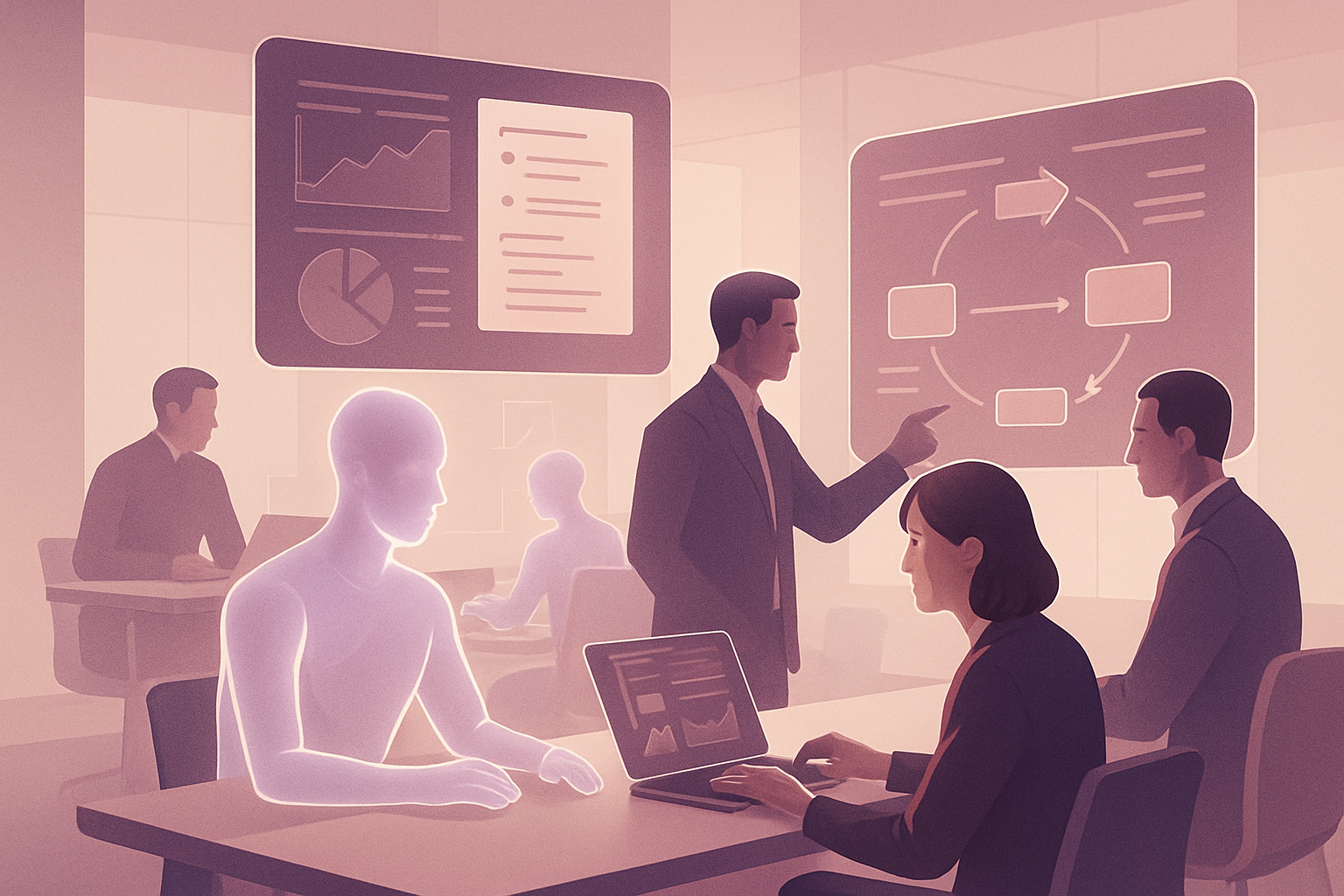
Artificial intelligence has rapidly transformed the work landscape by automating repetitive tasks that once occupied a significant portion of employees' days. However, according to Gabriel Hubert, CEO and co-founder of Dust, a company specializing in AI, a new era is emerging with the advent of multiplayer AI. This innovative concept is changing the way AI tools are used in businesses, shifting from individual use to a collaborative approach where agents become shared resources across different departments. By learning from internal data, these agents enable teams to automate processes and pool workflows.
In an interview with Sifted, Hubert details how companies can evolve from individual-centered AI to multiplayer AI, where collaboration within teams becomes the main driver of productivity. He explains that this transition requires a complete overhaul of how businesses envision the use of AI, moving from an approach where value is created by individuals to one where it is generated collectively.
Transition to Multiplayer AI
Traditionally, AI in the workplace often boiled down to an employee using a chatbot to accomplish a specific task: they provided context, sent a request, received a response, and used that information to move forward with their work. While this model can enhance individual productivity, it has its limitations. Hubert emphasizes that although one person may become more efficient, this improvement does not necessarily diffuse across the organization. "One person learns a better way to do something, but that improvement doesn't necessarily spread," he says. "The individual becomes faster, while the company continues to operate pretty much the same way."
In the context of multiplayer AI, AI agents begin to integrate into the same workflows as humans and other agents. They can transfer tasks, reuse knowledge acquired by other teams, and contribute to a shared system, thus avoiding starting from scratch each time. These agents act as "digital teammates," where users can mention an agent in a collaborative space to execute a task and then move on to another agent.
A concrete example is that of a "blog writer" agent that generates an article and then hands it off to a "LinkedIn" agent to create social content based on the same context. In the sales domain, this approach is also effective. Traditionally, a sales representative would spend a lot of time researching information and updating the CRM. With multiplayer AI, an agent can automate these tasks, ensuring a uniform process accessible to the entire team. "Traditionally, a sales representative spends 30 minutes searching for information, deciding if a prospect is relevant, and updating a CRM," explains Hubert. "Different representatives will inevitably do it differently."
Le brief IA que les pros lisent chaque soir
Les 7 actus IA du jour, décryptées en 5 min. Gratuit.
Inclus dès l'inscription : notre sélection des meilleurs guides & comparatifs IA.
Choisissez votre rythme
Gratuit · Pas de spam · Désabonnement en 1 clic
Governance and Security in Multiplayer AI
The transition to multiplayer AI requires a reevaluation of IT governance models. In Europe, while 55% of large companies use AI, only a quarter of them believe their governance models are suited to this new reality, according to Smarsh. This can lead to situations of "shadow AI," where AI tools are used without central authorization. For example, if an agent has access to a company's Google Drive, it could accidentally reveal confidential information.
At Dust, administrators manage agent access, determining which data is connected and how it is organized. Some spaces are open to the entire company, while others are restricted to specific teams. "Some spaces are open to the entire company while others are restricted to specific teams or individuals. Employees can create and use agents based on the spaces they have access to," Hubert clarifies.
Dust ensures that if a user does not have access to certain data, the agent cannot disclose it. Hubert insists that a company's knowledge should belong to the company and not be locked within applications or model providers. "The context and operational knowledge of a company should belong to the company. They should not be trapped inside a model provider, an individual conversation, or a series of disconnected applications," he adds.
The Importance of Humans in the Loop
One of the major challenges of adopting AI in the workplace is that employees are often ready to use it before their organizations are. A study by Microsoft reveals that organizational support, such as that from managers and talent practices, has a more significant impact on AI than individual effort.
At Dust, the adoption of multiplayer AI relies on "AI operators," a crucial role within the company. These operators rethink work processes, asking whether a task should still exist in the age of AI. They manage an "anti-task list," seeking to eliminate repetitive tasks. "The best operators manage an ‘anti-task list,’ asking after every tedious task, ‘how can I never have to do this again?’"
By 2027, Hubert hopes that companies will no longer question whether they should use agents but rather how to manage a workforce of agents. With numerous agents integrated into workflows, it is essential to understand their actions, determine who is responsible for them, and ensure the reliability of their decisions. "Once a company has many agents participating in workflows, it needs to understand what they are doing, who is responsible for them, and whether their decisions remain reliable," he says. The real asset lies in the interaction between agents, the company's context, and the people who continuously enhance these elements.
Brief IA — L'actualité IA en français
L'essentiel de l'actualité de l'intelligence artificielle, décrypté et expliqué chaque jour.