WATER: Anticipated Decision-Making Frameworks for AI Agents
Le brief IA que les pros lisent chaque soir
Les 7 actus IA du jour, décryptées en 5 min. Gratuit.
Inclus dès l'inscription : notre sélection des meilleurs guides & comparatifs IA.
Choisis ton rythme
Gratuit · Pas de spam · Désabonnement en 1 clic
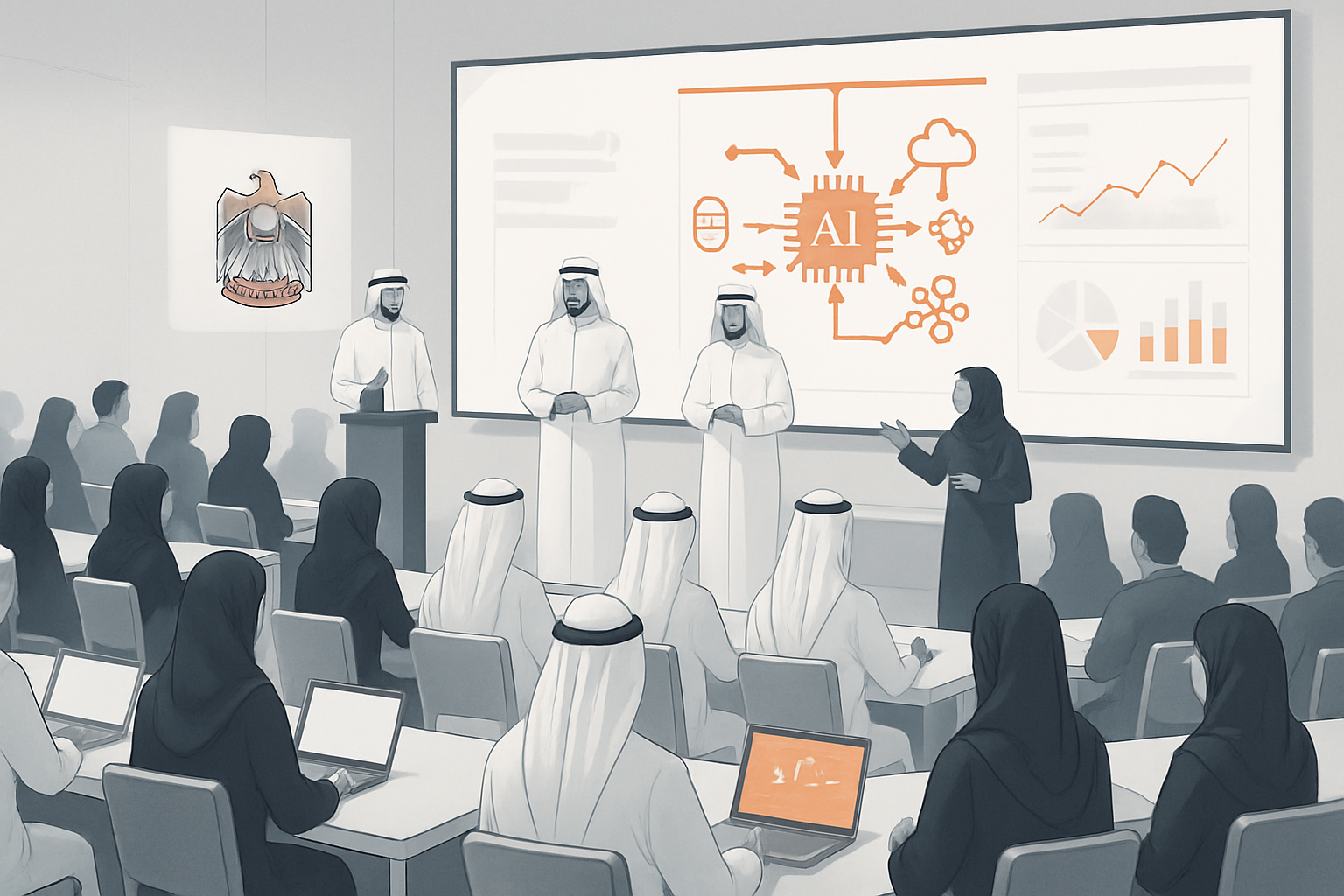
Abu Dhabi accelerates the adoption of autonomous agents in administration, aiming to transition half of federal tasks within two years. The chain of responsibility and the rules specifying what a machine can decide are yet to be published, while the training of 80,000 agents and the governance of the program are already confirmed.
Responsibility and Rules Still to be Clarified
Official documents outline the pillars, training, indicators, and governance, but do not specify what a citizen should do if an autonomous system makes a mistake regarding their file. They also do not clarify where responsibility lies in the event of an error. At this stage, no state has publicly provided a defensible method to draw the line between what a system can do independently and what it can only recommend, and none have yet resolved the issue of accountability as they have not been confronted with it. The United Arab Emirates will need to address this on a large scale within two years.
Political Oversight, Cabinet Decisions, and Skill Development
The program is under the supervision of Sheikh Mansour bin Zayed Al Nahyan, with a working group chaired by Mohammad Al Gergawi. In May, the Cabinet approved an initial batch of services to be equipped with agent-based AI tools and the largest training plan in the country’s administrative history, covering 80,000 agents, from ministers to newcomers. The same session adopted a national AI policy for health and frameworks that make digital files the official source of essential data, with unique collection and secure sharing between entities. In June, a training session in Dubai brought together over 300 participants from 50 institutions, aiming to identify use cases within 90 days, while another workshop, organized by the Presidential Court and the Ministry of Cabinet Affairs, trained 600 agents. This scaling up relies on existing capabilities, including a proactive AI-driven performance system that tracks over 150 million data points per month.
Operational Goals, Timeline, and Implementation Principles
The national program aims to convert half of federal operations, services, and tasks into agent-based AI models within two years. More than 100 officials paved the way during a workshop organized by the National Committee for the project, which set priorities and milestones and initiated the construction of task classification frameworks. The stated working principle is clear: humans lead, AI enables. During the announcement of the framework, Sheikh Mohammed bin Rashid Al Maktoum expressed the ambition for a broad deployment of agents capable of managing operations and executing actions without human intervention. Officials describe the operational launch, structured around seven pillars, with the definition of indicators and a focus on avoiding duplication between entities. The testing phase began this month.
Accumulated Capabilities and the UAE's AI Agenda History
The United Arab Emirates adopted a national AI strategy as early as October 2017, quickly followed by the establishment of a dedicated ministerial portfolio. At the age of 27, Omar Sultan Al Olama was appointed Minister of State for AI, marking a global first. Subsequently, the country implemented a digital identity, a sovereign cloud, and data-sharing infrastructures, elements that many other governments have yet to unify. This journey is presented as an asset built over nine years of investment in AI.
A Bet Observed Beyond the Gulf, with a Two-Year Deadline
In Asia and Europe, many governments approach the subject from a blank slate, often equipped with a strategy and a national body, but without quantified objectives. The United Arab Emirates, on the other hand, has set a figure and a date: in two years, public elements are expected regarding the impact of agent-based AI on services, workforce, and error rates. Other states do not have to conduct this experiment immediately but will need to decide how to leverage the results, or even whether to act before they are available. The task classification frameworks, when they appear, will represent the first sustained attempt by a state to define which decisions it delegates to machines.
Brief IA — L'actualité IA en français
L'essentiel de l'actualité de l'intelligence artificielle, décrypté et expliqué chaque jour.