Eka Robotics Raises $150 Million and Aims for $1.45 Billion in Robotics
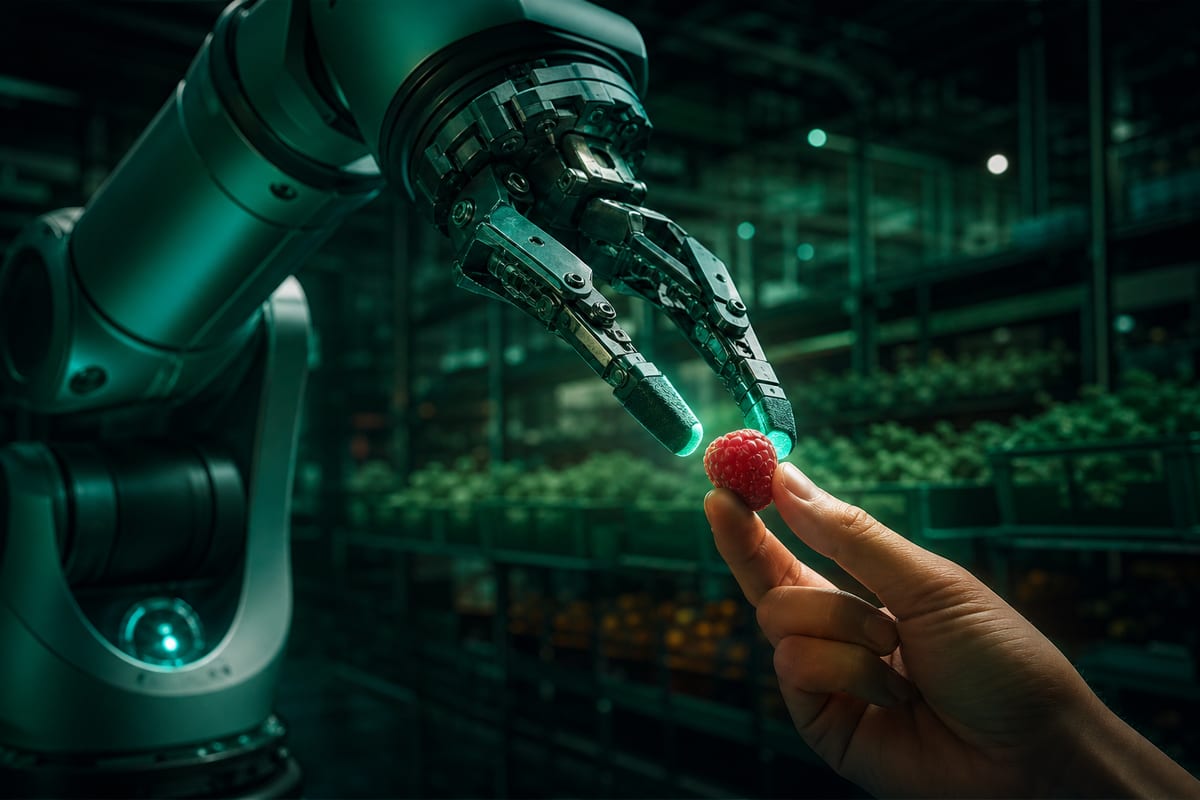
Eka Robotics, founded by Pulkit Agrawal and Tuomas Haarnoja, has raised $150 million at a valuation of $1.45 billion. Its vision-force-action manipulation model and sensitive gripper are attracting roboticists, boasting claimed speeds and reliability. Industrial pilot projects are underway, while the company announces sustainability and scalability goals yet to be validated on production lines.
Pilots and Reliability on the Line: The Yearly Challenge Continues
Eka is conducting confidential pilots with several industrial clients focused on picking and handling wires. For Kris Hauser, a key challenge will be to operate these systems with integrators on real assembly lines without breakage for an entire year. The transition from the lab to production is presented as nearly as challenging as the gap between simulation and reality, and the company still needs to confirm its results under industrial conditions. Hauser also highlights an open question: how far do these techniques extend beyond pick-and-place, as many high-value tasks require more.
Gripper Cost and Announced Cycle Goals
Pulkit Agrawal specifies that the gripper developed by Eka is priced under $1,000 with an estimated lifespan of 5 million cycles. The mentioned goal is to increase this figure to 20 million cycles, which aligns with the level of traditional industrial arms. Agrawal further states that the company designs entire workflows, with an initial focus on two verticals—picking, arranging, and placing on one side, and wire handling on the other—that it aims to transform into successes. According to him, the scope of the approach will expand once these initial points are validated.
Speed and Accuracy: 1,500 Picks/Hour and Over 95% Success Rate
Eka's robot is presented as capable of picking around 1,500 objects per hour, weighing up to 1 kg, while a human handles about 600 in the same timeframe. The company claims a reliability rate exceeding 95% during these picks. A lab observer reports that the arm is powerful enough to cause injury when moving at high speed, which he believes reflects a strong confidence in the algorithm to avoid damage, while questioning potential harm during development. The same witness describes a raspberry test where the robot approached a human arm quickly before slowing down for a very gentle contact.
Technical Choices: From Touch to Physical Simulator
Eka focuses on a vision-force-action architecture rather than a vision-language-action one, emphasizing, according to its leaders, the force signals and their connection to action. Pulkit Agrawal states that vision is used to estimate the pose, but the actual grasping occurs through contact forces. To achieve this, the team has designed a more flexible and highly instrumented gripper that is responsive to touch. The device is trained at scale using a physical simulator that models the multiple forces encountered, creating a reinforcement learning environment; Eka claims it can produce thousands of hours of experience in just a few minutes. Kris Hauser believes this approach goes beyond the limits of mere human demonstrations and appreciates not being constrained by the presented training data. However, the founders remain discreet about certain details. Critics, such as Rodney Brooks, deem the consideration of touch essential; Eka's results are presented as moving in this direction.
Le brief IA que les pros lisent chaque soir
Les 7 actus IA du jour, décryptées en 5 min. Gratuit.
Inclus dès l'inscription : notre sélection des meilleurs guides & comparatifs IA.
Choisissez votre rythme
Gratuit · Pas de spam · Désabonnement en 1 clic
Financial Announcements and Expert Reactions
Eka has completed a $150 million Series A round, with a valuation of $1.45 billion, in a round led by a16z and F-Prime and co-led by Raghu Raguram. The latter claims that some tasks would already exceed superhuman levels and anticipates the emergence of similar performances in many delicate manipulations in the coming months. From the academic side, Kris Hauser mentions a strong element of surprise, an ability to adapt to various objects without retraining, and the robot's persistence. Another specialist, who wishes to remain anonymous, describes an emotional experience comparable to the recent beginnings of reliable locomotion on legs. The company, founded by Pulkit Agrawal and Tuomas Haarnoja—two researchers from Berkeley and recognized as authorities in reinforcement learning applied to control—thus advances its technical strengths and support.
Between Generality and Performance: Where Does Eka Stand?
Pulkit Agrawal argues that Eka seeks to bridge the gap between generality and performance in modern robotics. The most general physical AI models currently lack efficiency, while hyper-specialized models do not always guarantee economic interest. The promise of generative AI is to quickly learn multiple tasks, including novel ones. Systems like Astra, presented as the latest LLM from ChatGPT, can already pilot a robot in an unknown environment, but slowly and at a high cost; in this context, a model like Eka's would handle physicality, while a more general model would decide on the action plan, for example, knowing where to place plates when Eka's robot allows them to be grasped without breaking. Eka also asserts its choice to industrialize reinforcement learning through simulation, deemed crucial for more complex interaction tasks than mere avoidance, and Tuomas Haarnoja contrasts his bottom-up approach with the traditional top-down planning emphasis. In the background, manipulation remains a challenge that the industry is still striving to overcome despite massive investments.
Brief IA — L'actualité IA en français
L'essentiel de l'actualité de l'intelligence artificielle, décrypté et expliqué chaque jour.