Emerald AI Unites AEMA to Optimize Data Center Network Access
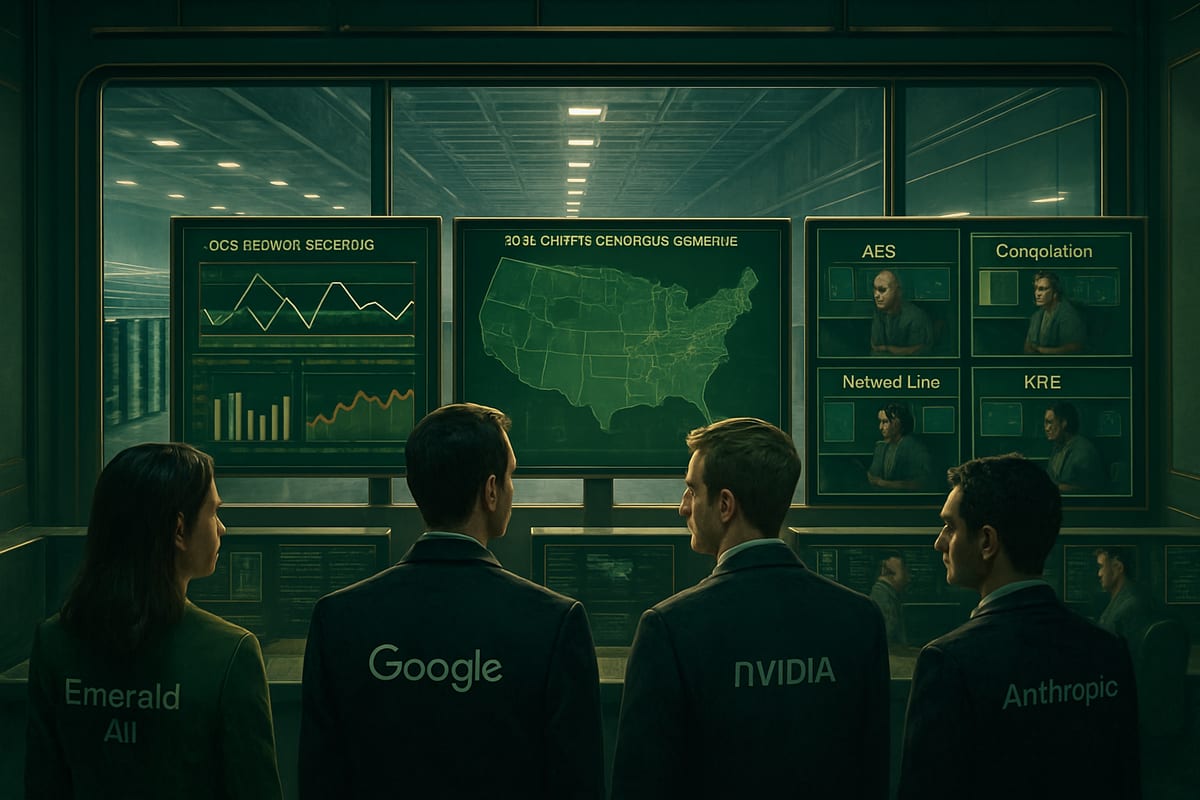
An alliance led by Emerald AI promises to mobilize demand response to connect more data centers to saturated networks. Advanced estimates suggest potential capacities of up to 100 GW, with other scenarios indicating 76 GW, but proponents acknowledge that this measure alone will not suffice. Google, Nvidia, and Anthropic are stakeholders, while Emerald AI is aligning $150 million to scale up.
Measured Gains and Limited Scope, According to Proponents
The mentioned capacity potential is significant. According to a study conducted by Goldman Sachs, limiting network usage to a maximum of 90% for a few hours could yield 76 gigawatts. For its part, the AEMA states that by suspending certain non-critical tasks and shifting computational loads, it would be possible to connect an additional 100 gigawatts of data centers to the grid. Ayse Coskun, who serves as Chief Scientist at Emerald AI, however, expresses caution regarding the extent of this method. According to her, the technology proposed by the company would reduce the need for new energy production capacity in the sector, but would not eliminate it entirely.
A Coalition Structured Around Demand Response
Emerald AI has formed the AI Energy Management Alliance (AEMA) with Google and Nvidia to mobilize its technology to free up space on the grid for new data centers. The stated goal is to integrate demand response from the design and development phases of sites. Anthropic has joined the founding trio, along with several energy companies, including AES, Constellation, National Grid, and NRG Energy. Specializing in energy management software, Emerald AI also indicates that the coalition will help tech companies and utilities identify new locations for data centers.
Le brief IA que les pros lisent chaque soir
Les 7 actus IA du jour, décryptées en 5 min. Gratuit.
Inclus dès l'inscription : notre sélection des meilleurs guides & comparatifs IA.
Choisissez votre rythme
Gratuit · Pas de spam · Désabonnement en 1 clic
How It Works: Managing Loads Instead of Starting Diesel
Demand response, practiced for decades, is based on a simple observation: networks are sized for peak demand, while most of the time, demand is below the maximum capacity. Historically, large consumers like factories would agree to reduce their consumption during peaks by suspending production or switching to backup generators in exchange for compensation. Data centers are now participating as well, often by activating generators. Emerald AI offers a software alternative to diesel generators: its system directly connects utility demands with data centers, which can then suspend non-critical tasks or transfer loads to other sites with available network capacity. This direct connection is presented as enabling rapid responses, comparable to battery behavior.
Competing Tools and Financial Means to Scale Up
Other technological solutions are being explored. Google is developing its own devices, while Enel X proposes using uninterruptible power supply systems from data centers to mitigate consumption peaks. In this context, Emerald AI recently secured $150 million in a Series A funding round led by Energize Capital and DCVC, which will allow for the expansion of its technology implementation. The flexibility of AI computational loads and the operational adaptability of data centers are presented as advantages for this type of regulation, but establishing new sites remains complex for both tech companies and utility providers.
Brief IA — L'actualité IA en français
L'essentiel de l'actualité de l'intelligence artificielle, décrypté et expliqué chaque jour.