In 2025, $184 Billion Lost in Supply Chains
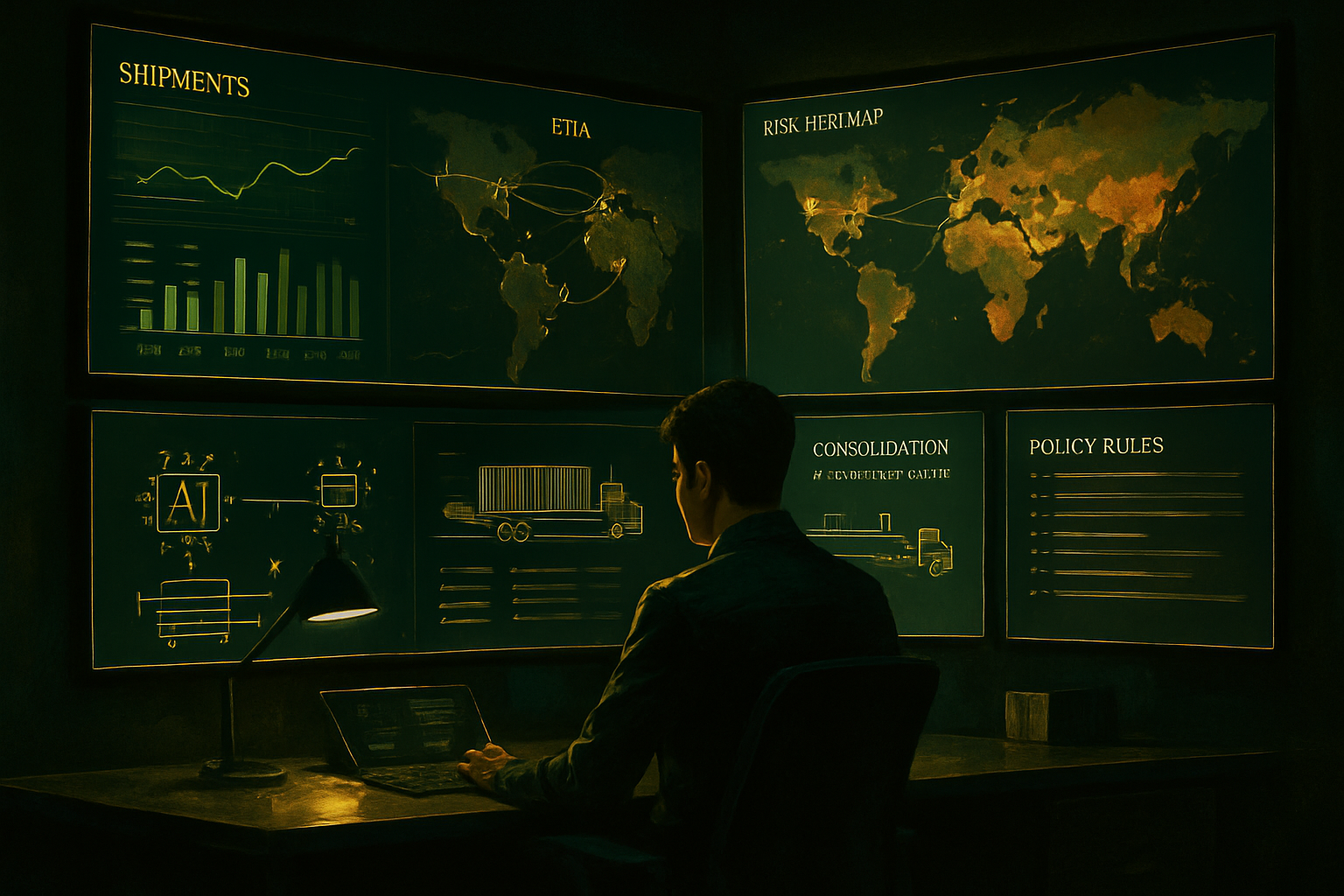
Some companies remain stuck at the alert stage, while performance gaps will be determined by the speed of execution. In 2025, disruptions cost $184 billion, and autonomous AI remains in the minority. Limited actions, framed by policies and accepted by execution systems, represent the next step.
Competitive advantage will hinge on action, not alertness
For some time, there will still be two methods that, on the surface, will appear similar, each relying on AI and a control tower. What will distinguish these approaches is the time between the detection phase and the implementation of a business action, and subsequently, the quality of service provided and the associated costs. Detection-focused structures will simply receive an earlier alert about a storm. For those that allow for controlled intervention, tenders will have already been reissued, flows consolidated, and critical items moved even before an incident is officially reported. Uncertainties such as delivery delays for essential components, rapid trend fluctuations, and multi-level complexity will continue to be structural elements. What is not imposed is to make the reaction dependent on the opening of a human queue. The product that maintains the delay is information lacking the authority to act; the one that removes it is an agent authorized to incur limited expenditure within a predefined framework, before any manual validation.
Today, AI remains confined to alerts and tickets
Most deployments are organized around a standardized sequence: a recommendation becomes an alert, the alert becomes a ticket, and the ticket waits for an already-busy planner to take action. At this stage, options have often been reduced, due to the disappearance of alternative capacity, the closing of consolidation windows, and the reassignment of factory slots. This model is not a discreet springboard to autonomy; it corresponds to the product sold: information, easier to demonstrate and govern, when action involves budgets, contracts, service levels, and responsibilities. In 2025, FourKites and ABI Research indicate that 27% of organizations allow AI to act autonomously, while 52% limit it to decision support. Adding a dashboard does not change the decision cycle or, in general, EBITDA; it merely adorns it. Meanwhile, a 2026 Knosc survey reports that 28% of time is spent responding to disruptions, primarily to seek causes rather than modify the trajectory. The strategic interest in AI is real: Capgemini identifies a next-generation supply chain among the top three trends for 70% of executives in large companies in 2025. However, measurable financial impact remains rare, and according to Gartner, only 23% of organizations have a formal AI strategy. Budgets continue to focus on forecasting and visibility—demand sensing, ETA, supplier risks, inventory, and networks—areas where reducing errors and anticipating delays are tangible. The core of the cost lies in the post-signal area, where repeatable but framed decisions wait behind a human inbox.
Le brief IA que les pros lisent chaque soir
Les 7 actus IA du jour, décryptées en 5 min. Gratuit.
Inclus dès l'inscription : notre sélection des meilleurs guides & comparatifs IA.
Choisissez votre rythme
Gratuit · Pas de spam · Désabonnement en 1 clic
Companies delegate specific tasks to AI agents
Companies ready to capture market share pre-authorize a narrow class of movements and delegate their execution to agents as long as the exception remains low-cost. This includes, for example, reissuing a tender if the carrier's ETA exceeds a threshold and a qualified alternative falls within the validated price range, consolidating outgoing waves if the cost/schedule equation is favorable, switching from sea to air for predefined SKUs if the differential is less than the cost of a missed retail window, or reallocating safety stock between two sites when forecasting and transport converge. These rules are written in terms of conditions, action, spending cap, and traceability, with human intervention if the case falls outside the framework. This is not a fully automated supply chain but rather a management approach akin to machine control: the agent acts within an interlock and escalates beyond it. Here, the interlock is a policy—category, supplier level, mode, cap, and service class—rather than an industrial robot.
Three operational prerequisites for scaling up
The first prerequisite: convert "business rules" into explicit policies. A guideline such as "pay for air freight for item A after 48 hours of maritime delay" cannot remain in someone's head if we want an agent to execute it. The next two years will be less about training models and more about designing decisions: identifying what is reversible, what is capped, and what is pre-approved.
The second prerequisite: open execution systems to machine-initiated transactions. An agent that can generate an RFQ without the ability to transmit it remains a detection tool. TMS, WMS, procurement suites, and carrier APIs must consider a limited agent as a junior buyer: identified, tracked, capable of canceling its actions, and subject to a cap.
The third prerequisite: align responsibility with action. If a follow-up within the framework fails, the analysis must focus on the policy, data, and framework, rather than on a person presumed to "verify." As long as this culture does not evolve, agents will be designed to wait, as waiting protects careers.
A massive cost for reactions that are still too slow
In 2025, disruptions amounted to approximately $184 billion, a sum largely directed towards detection capabilities. Organizations frequently have solutions that allow them to identify an incident several hours or days in advance, but taking action still depends on opening a ticket, real-time discussions, and manual entry into various tools. Over the past decade, we have seen a proliferation of visibility platforms, control towers, risk assessment systems, digital models, and exception dashboards, which have helped shorten the alert time. However, the reduction in the time between awareness of a problem and business response has remained more limited, even though this is now where performance gaps are determined.
Brief IA — L'actualité IA en français
L'essentiel de l'actualité de l'intelligence artificielle, décrypté et expliqué chaque jour.