Enterprise AI: Budgets Surge and Moratoriums in Texas
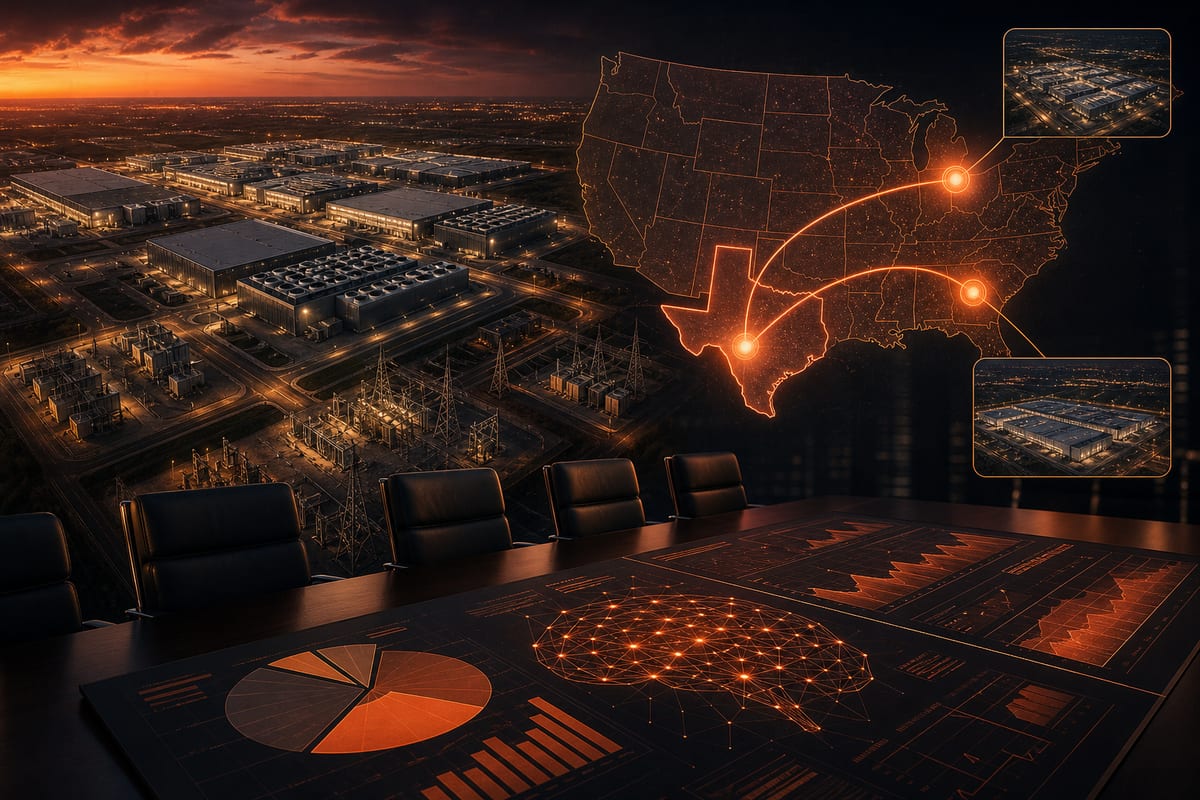
Spending dedicated to the deployment of generative AI in businesses skyrocketed to $176.8 billion by September 2026, while key states for data centers, including Texas, are shifting towards pause policies. At the heart of this landscape, Anthropic relies on investments from Amazon and Alphabet and its coding models to target the high-end market.
Moratoriums and Elections Redraw the Data Center Map
Several key U.S. states for data centers, including Texas, Georgia, and Ohio, have come under Democratic governance with pause or conditional freeze policies on new projects. In Texas, about a quarter of the expected national capacity by 2030 is affected, and Jefferies estimates that around 13.3 gigawatts of announced projects could be challenged under a moratorium led by Gina Hinojosa. The midterm elections have extended moratoriums and delayed projects due to bottlenecks. Texas is also portrayed as the capital of AI data centers, a theme highlighted by James Talarico during his campaign. The scenario of a "blue tsunami" includes the possibility of investigations and hearings in Congress regarding Elon Musk, Starlink, and other players, along with increased regulatory scrutiny.
Corporate AI Budgets: From $1.7 to $176.8 Billion in Three Years
Spending on the deployment of generative AI in businesses rose from $1.7 billion in 2023 to $8.5 billion in 2024, then to $33 billion in 2025. It is projected to reach $176.8 billion by September 2026, representing a 5.4-fold increase year-over-year. In this context, AI labs capture 69% of every dollar invested by businesses. A problem of concentration of AI infrastructure in the United States and a backlash from voters are mentioned, while sentiment around AI has reportedly declined significantly over the past 18 months.
Le brief IA que les pros lisent chaque soir
Les 7 actus IA du jour, décryptées en 5 min. Gratuit.
Inclus dès l'inscription : notre sélection des meilleurs guides & comparatifs IA.
Choisissez votre rythme
Gratuit · Pas de spam · Désabonnement en 1 clic
What Underpins Anthropic's Position: Capital, Cloud, and Coding
Anthropic maintains close ties with Amazon and Alphabet, which hold significant stakes, along with Cloud partnerships and diverse financial support. Founded about five years ago, the company aims for high-end applications through dominant AI coding models and competent agency capabilities. Menlo, an early investor, recently published a report on enterprise AI. In a growing market during the 2020s, Anthropic is presented as the main beneficiary of the concentration of enterprise AI, with favorable dynamics for leaders.
American Duopoly and Shifting Competitive Hierarchy
The American AI sector is described as a duopoly between Anthropic and OpenAI. By 2026, Google and OpenAI are portrayed as struggling to keep up, while Anthropic's LLMs are deemed significantly ahead. Since 2023, the concentration of talent and their retention have been cited as advantageous factors for Anthropic. This hierarchy is linked to a regular supply of cutting-edge models and the ability to attract and retain highly compensated researchers.
Recursive Self-Improvement, Marketing, and Real Reach: A Conditional Debate
The theme of recursive self-improvement (RSI) is downplayed in relation to the capital raised and the support Anthropic receives. The S-1 and management statements mention the prospect of a model aiming for RSI, while true RSI is defined as general, cross-sectoral, and autonomous. Generative AI is presented as absent from observable productivity gains, and swarms of agents, in 2026, as sources of cybersecurity risks and pressures on employment. Marketing around RSI is deemed aggressive and should be monitored if growth slows. The pillars of talent, capital, and hyperscalers are put forward as potential safeguards, without guaranteeing that Anthropic will be the definitive solution.
Brief IA — L'actualité IA en français
L'essentiel de l'actualité de l'intelligence artificielle, décrypté et expliqué chaque jour.