Companies and AI: Pilots, Chatbots, and Legacy Tools
Three years after the widespread availability of Copilot, ChatGPT, or Claude, actual usage remains concentrated among a minority, while management teams conduct pilots, about half of which succeed. AI does not eliminate the need for tool selection; it primarily creates new choices, brings the chatbot to the forefront as a workspace, and shifts the balance between improvised solutions and institutionalized processes.
AI Pilots: About Half Succeed, Far from Widespread Adoption
To transform structural processes, companies launch pilots utilizing AI capabilities, whether through purchased products or internally developed solutions. Approximately half of these experiments are successful, which is considered normal for a pilot. This framing remains the classic one from an IT department: use cases, flagship projects, champions, quick wins, and measurable results. Meanwhile, executive teams question scalability when only five to ten experiments are conducted across hundreds of workflows.
Actual Use of Assistants: An Intensive Minority, Many Inactive Users
Large companies have widely distributed Copilot, ChatGPT, or Claude over the past three years. A small portion of employees uses them intensively and has sometimes increased their productivity, a larger number connect a few times a week, and many do not really use them at all. The situation is reminiscent of the widespread adoption of PCs and Lotus 123 in 1983 or web access in 1997, which had no direct and automatic effect on processes like invoice processing or supply chains. Distributing a general tool to everyone is theoretically scalable, but the majority struggle to find concrete uses.
The Chatbot Becomes a New Ground for Improvisation Alongside Excel and Email
AI expands existing applications and encourages the emergence of new vertical solutions, while reinforcing improvisational spaces like Excel, Tableau, Google Sheets, or email. In this cycle, the chatbot emerges as an additional free space, capturing tasks from these platforms and also feeding into applications. A small company hiring ten graduates may stay longer on Google Sheets thanks to AI, use it as a data space for Gemini, hesitate between entrusting a creation to Claude or migrating to Notion, before discovering a targeted SaaS offering that meets this need and other unanticipated ones.
Le brief IA que les pros lisent chaque soir
Les 7 actus IA du jour, décryptées en 5 min. Gratuit.
Inclus dès l'inscription : notre sélection des meilleurs guides & comparatifs IA.
Choisissez votre rythme
Gratuit · Pas de spam · Désabonnement en 1 clic
Improvised vs. Institutionalized: Where AI Shifts the Thresholds
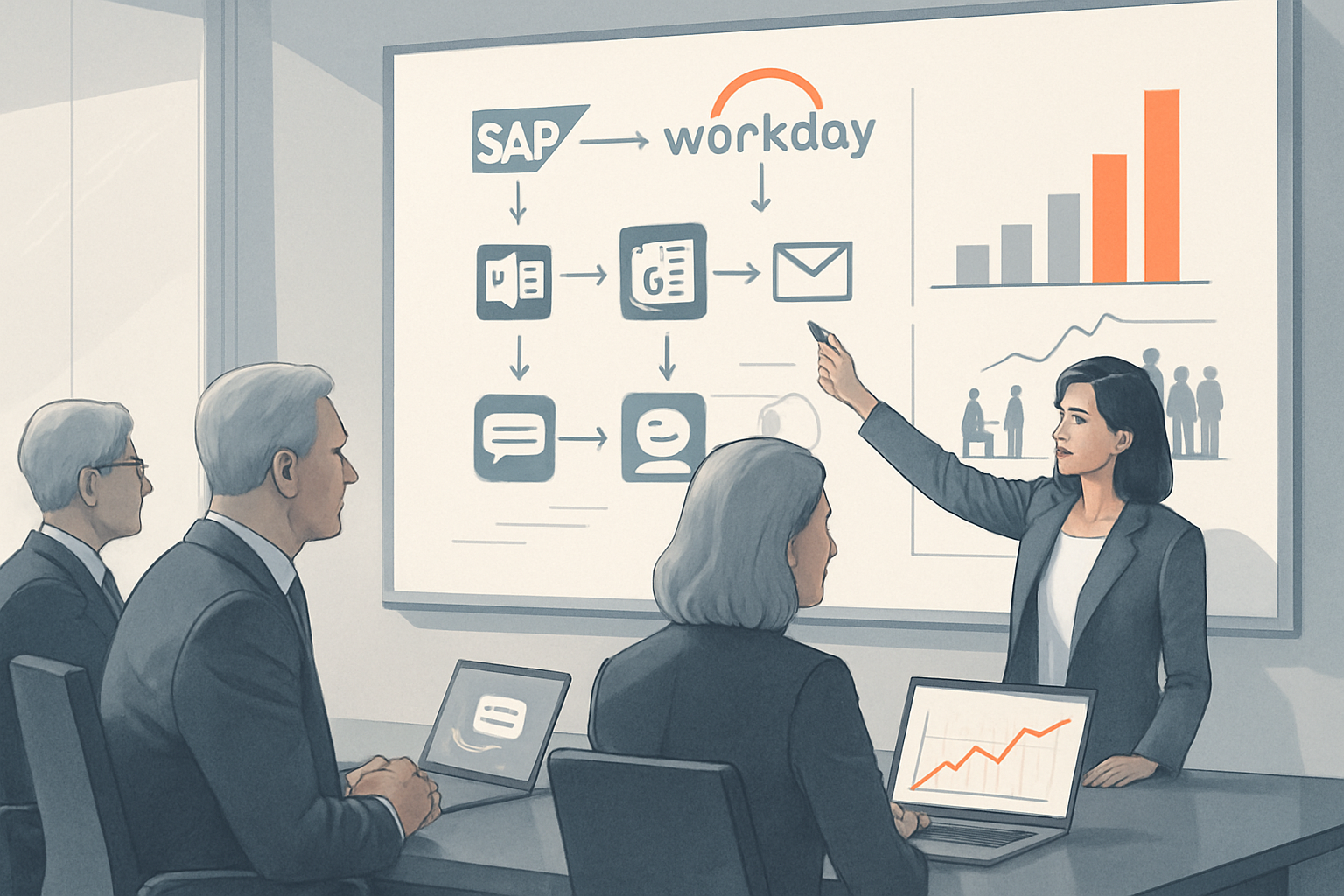
Enterprise tooling evolves between institutionalized solutions and improvised practices. Routine tasks are performed using specialized tools such as SAP, Carta, or Rippling, following standardized procedures. Exceptions are managed through makeshift means like Excel, email, shared folders, Tableau, PowerPoint, CSV files, screenshots, PDF files, or conference calls. When an operation becomes regular, standardized, and presents significant stakes, it needs to be structured to meet audit, security, maintenance, and accountability requirements. Organizations may overlook recurring workflows where hundreds of people lose an hour a day; this cycle of improvisation followed by normalization explains the proliferation of applications. AI does not eliminate this balancing act but shifts the points of equilibrium.
Adoption Constraints: Broad Scope and Long Decision Cycles
Making coding simpler does not resolve the difficulty of identifying the right need and the correct specifications for a tool, then achieving adoption. The processes to be automated often involve 50 to 500 people, five departments, three management systems, and four regulatory regimes. Even a compelling idea, for instance in accounts payable, does not impose immediate large-scale change: it must go through a purchasing decision and a sales cycle estimated at 18 months.
Lessons from SaaS: More Tools, Faster, and Constant Back-and-Forth
The shift to SaaS has exponentially increased the volume of software, with a new operational model and pace of evolution that have challenged historical players, an episode described as the SaaSpocalypse. Functions continuously cluster and de-cluster: SaaS applications perform tasks that could also be done in SAP, Excel, or email; Carta is presented as a $4 billion company managing a spreadsheet for the CFO; consulting missions alternate equally between migrating from Excel to a database and back to Excel. Practices vary by scale: PwC, with 3,000 to 4,000 annual hires, relies on dedicated software, while a small organization hiring five to ten people organizes via email, shared folders, and Google Sheets, with the option to later switch to Notion or an HR SaaS for SMEs. Even in a large group, a small team may prefer Google Sheets if Workday is deemed too rigid.
What AI Promises… and What It Does Not Solve
AI fuels the hope of handling repetitive tasks, allowing for the creation of a tool in five minutes, or even executing the task directly, making software more dynamic and generative to automate more with fewer applications. However, the majority of professionals are not tool designers and do not spontaneously rethink their work. Identifying the right problems is neither obvious nor straightforward: they are often hidden and require redefinition. Even recognized publishers have faced half a dozen failures before finding the right approach. AI does not inherently resolve the discovery of needs or the precise definition of the tool.
Brief IA — L'actualité IA en français
L'essentiel de l'actualité de l'intelligence artificielle, décrypté et expliqué chaque jour.