AI Interviews: A 7-Step Framework and Key Figures
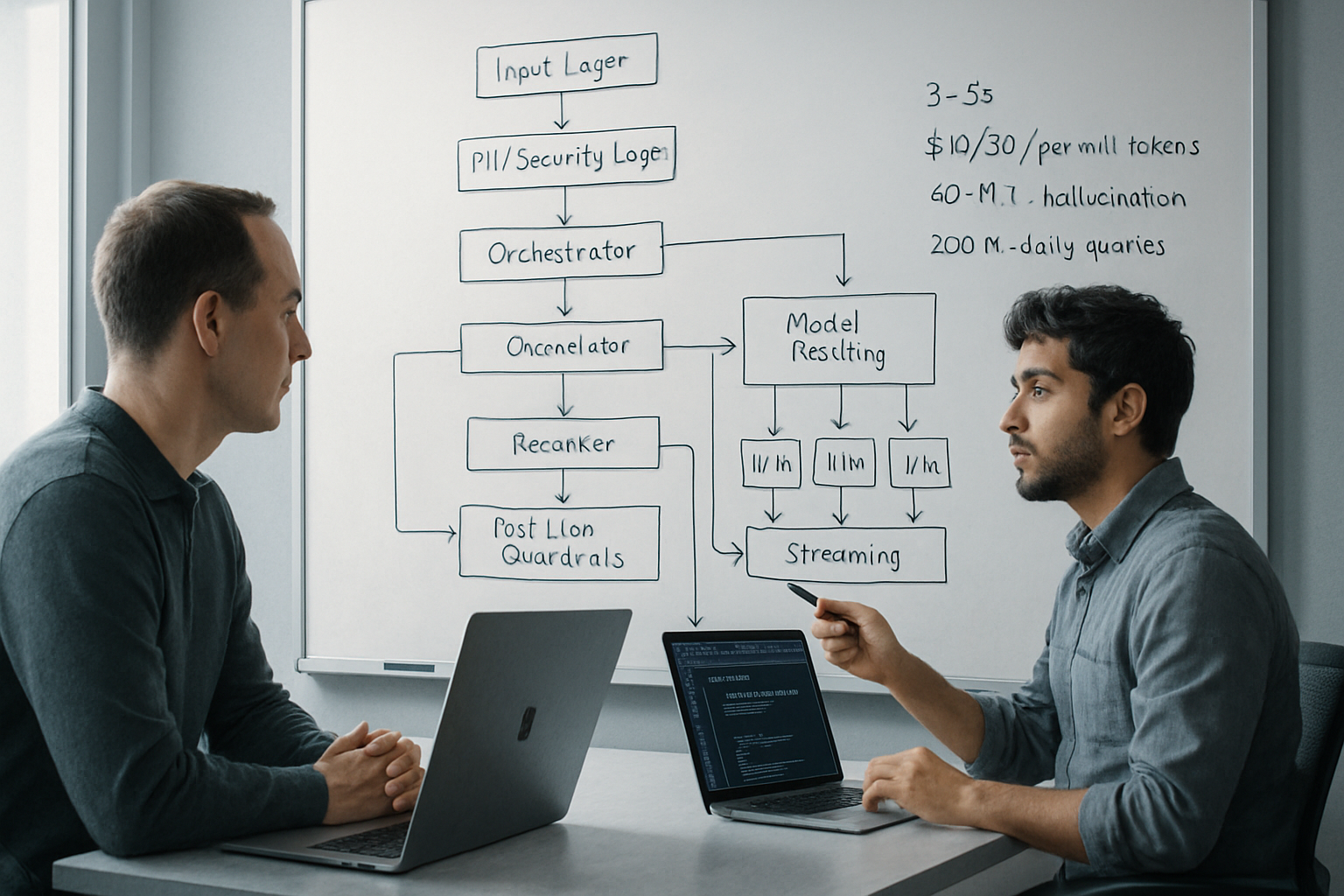
Technical evaluations in AI no longer require drawing Uber, but rather thinking about ChatGPT, a support agent, or a Copilot in real-world conditions. Cost per token, latency, and safeguards have become central. Here’s what recruiters are looking for, the pitfalls identified, and the expected operational framework, illustrated by architectures in production.
What Still Disqualifies: Rushing, Ignoring Costs, Past Failures
The most cited reason for failure is proposing a solution without clarifying objectives, constraints, and success criteria. The first minutes should be dedicated to this alignment. Recruiters also note plans where components align without justification: a vector database or a reranker are worthless if it’s not explained what breaks when they are removed. Another pitfall is neglecting the issue of cost and latency, as it is a major requirement to obtain responses within 3 to 5 seconds. Furthermore, failing to address types of failures—hallucinations, prompt injection, provider outages, multi-tenant isolation—along with detection methods is highly detrimental. When numerical data on the reduction of hallucinations is presented, recruiters expect ranges, as published results vary by source and context.
What Interviews Measure: Trade-offs of a Probabilistic System
Current evaluations target the ability to reason about probabilistic systems under constraints of cost, latency, quality, and security. Convincing candidates connect each layer to its function, explicitly detailing the failures induced if it disappears. At the senior level, discussions delve into 3 to 5 themes, focusing on past failures and their fixes, rather than a superficial overview. Experience in production and delivered examples make a difference.
Responding Methodically: A 7-Step Framework to Follow
A guiding thread in seven steps structures a good response. First, clarify data, privacy, latency budget, error tolerance, scale, freshness, and API or self-hosting dependencies. Next, estimate tokens per second, context size, volume of embeddings, cost per call, and QPS. Outline a typical flow with input, security and PII, orchestrator, retrieval via vector database and reranker, model routing, post-LLM safeguards, streaming, and observability. Deepen one or two components like RAG, prompts, exact or semantic caches, and model prioritization. Explicitly state trade-offs regarding latency, quality, RAG versus fine-tuning, cost ceilings, and fallback models. Present the different types of possible failures as well as the indicators for their detection. Finally, detail the evolution steps: A/B testing of prompts, feedback loops, evaluation mechanisms before production, and gradual migration of models.
Le brief IA que les pros lisent chaque soir
Les 7 actus IA du jour, décryptées en 5 min. Gratuit.
Inclus dès l'inscription : notre sélection des meilleurs guides & comparatifs IA.
Choisis ton rythme
Gratuit · Pas de spam · Désabonnement en 1 clic
Expected Technical Components, with Orders of Magnitude
Five elements recur in most architectures. On the RAG side, a query encoder, a retriever that ranks documents, and a generator conditioned by the query and context form the core; in production, chunking, embedding pipelines, vector retrieval, caches, evaluation logging, and access limits are added. RAG often reduces hallucinations by 40 to 71%. Regarding model routing, GPT-4 level models are around $10 per million tokens in input and $30 in output, with latencies of 3 to 5 seconds; an agent handling 10,000 daily conversations of 5,000 tokens exceeds $7,500 per month with a single provider. Routing routine requests to economical models, when 60 to 80% of requests are of this nature, typically allows for 40 to 70% savings. Safeguards are implemented before and after the LLM: validation, removal of PII, and anti-injection defense upstream; schemas, refusal policies, and fact-checking downstream. Layered approaches can reduce the risk of hallucination from 71 to 89% relative to a baseline rate of 3 to 20%, to be presented in ranges. Finally, evaluation and observability require tracking versions, retrieval, tools, security decisions, latency, and cost via prompt hashes; combine calibrated offline LLM-judge and online metrics such as fidelity, context recall, and relevance. For agentic loops, clearly separate reasoning from the LLM, control by the orchestrator, governance by the policy engine, and execution in a sandbox.
Production References to Cite During the Exchange
Anchoring the discussion in real systems enhances credibility. GitHub Copilot builds its prompts from the IDE, considering the code surrounding the cursor and contextual signals; the Fill-in-the-Middle schema aggregates neighborhood and paths, filters on the backend, and routes to a model on Azure, with about a 10% relative increase in acceptance rate compared to a simple prefix. A separate model then evaluates quality and security in offline, pre-production, and production modes. Other benchmarks include Uber's GenAI gateway with a PII writer covering over 60 use cases; Airbnb's conversational AI with chain of thought and safeguards; Perplexity handling 200 million queries daily on Vespa.ai; a stateless RAG at Slack with isolated models in VPC; and a multi-agent search engine at Anthropic driven by Opus with sub-agents Sonnet.
AI Recruitment Increases by 143% and Changes Interviews
The surge in AI recruitment is pushing interviews towards LLM-centered products. The role of AI engineer has been ranked at the top of growth in the United States for two consecutive years, with a 143% annual increase projected for 2025, and 75,000 new job postings between 2023 and 2025 according to LinkedIn, while the share of AI/ML jobs has risen from 10% to 50%. Exercises now focus on integrating large models into products, designing agents, retrieval, and cost management, rather than on internal algorithmics. Typical requests—chatbot, RAG, code agent, voice assistant—are becoming similar once the framework is acquired, with variations mainly concerning inputs and constraints. The professional and academic ecosystem, from interview preparation platforms to practitioner-teachers, contributes to disseminating these practices.
Brief IA — L'actualité IA en français
L'essentiel de l'actualité de l'intelligence artificielle, décrypté et expliqué chaque jour.