United States: Patent Inventor Remains Human, Even for AI
Le brief IA que les pros lisent chaque soir
Les 7 actus IA du jour, décryptées en 5 min. Gratuit.
Inclus dès l'inscription : notre sélection des meilleurs guides & comparatifs IA.
Choisis ton rythme
Gratuit · Pas de spam · Désabonnement en 1 clic
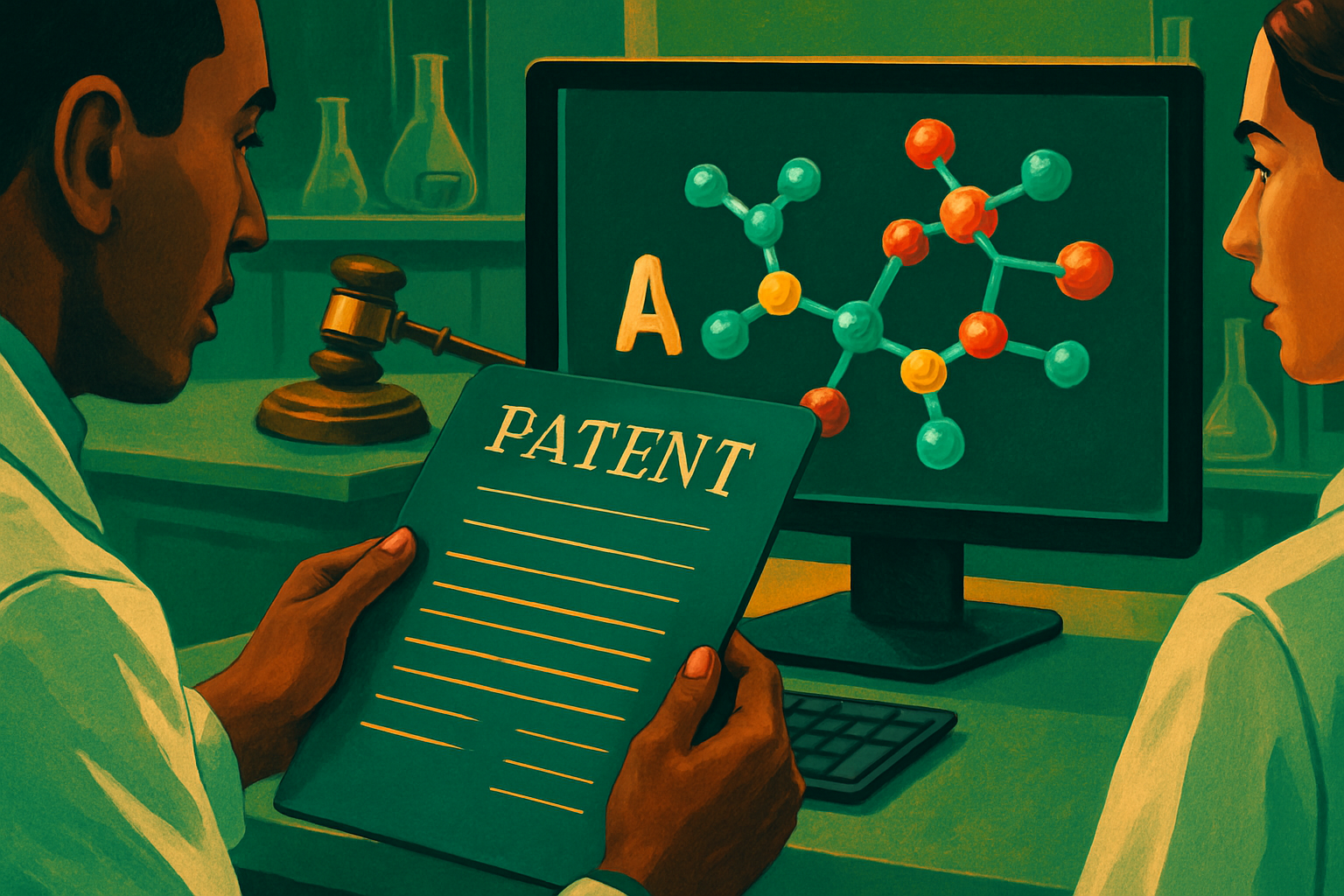
In the United States, only humans can be recognized as inventors on a patent, even when AI models generate novel molecules. The U.S. Patent and Trademark Office (USPTO) considers AI as a tool and does not require its mention, leading companies to designate individuals on their filings. The DABUS case law has confirmed this position, but legal experts anticipate disputes over the minimum required human contribution.
The USPTO Treats AI as a Tool and Does Not Require Its Mention
The U.S. Patent and Trademark Office currently adopts a "don't ask, don't tell" approach regarding the use of AI. Under the Biden administration, the agency published guidelines to help applicants determine if and when humans can be considered co-inventors of a discovery resulting from AI. After Trump took office, this position was reversed: AI is now regarded as a tool comparable to a calculator, and it is not necessary to mention it in patent filings.
What Level of Human Contribution is Needed to Be an Inventor: A Looming Legal Battle
The emerging question concerns the threshold of human contribution sufficient to claim inventor status. Ryan Abbott anticipates legal challenges regarding AI-generated drugs, reminding that a patent can be invalidated if incorrect inventors are listed. He believes that qualifying minimal acts, such as "pressing a button," will lead to future litigation, and finds it inappropriate to claim an invention if a simple request made to a system like Claude resulted in a major breakthrough. For now, pioneering companies are likely keeping humans involved and documenting their roles.
In the Labs, Human Tasks Still Key at Insilico
At Insilico Medicine, Alex Zhavoronkov explains that human chemists synthesize molecules, create variants, and test them on animals. According to him, it is these individuals who will be named on the patents. Even in a scenario of complete automation, someone will still need to initiate operations and allocate budgets.
The DABUS Case Law Locks in the Inventor as a Human Being
In 2022, a court of appeals in Washington, DC, ruled that philosophical questions about potential rights for AI were irrelevant. It held that U.S. laws define an inventor as an "individual," meaning a human being. This position stems from a pro bono case brought by attorney Ryan Abbott, a partner at Brown, Neri, Smith & Khan in Los Angeles, who designated the AI DABUS as the inventor of a food container with a complex geometric surface that facilitates heat transfer and stacking. Abbott argued that no human contributed to the design and that AI should be named as the inventor.
AI Patents Under Pressure and Echoes in Copyright Law
The U.S. Patent and Trademark Office acknowledges that an AI system can perform acts that, if carried out by a human, could meet the criteria for inventiveness. Ryan Abbott nonetheless expresses concern that disregarding results produced by AI could slow the development of new drug treatments. Furthermore, the Copyright Office does not grant copyright for images and texts generated by AI, a decision that alarms organizations such as the Motion Picture Association of America, some of whose members utilize these technologies. Abbott emphasizes that Article 1 of the U.S. Constitution assigns exclusive rights the mission of promoting the advancement of science and useful arts for a limited time.
At Insilico, AI "Discovers" but the Patent Lists Five People
Insilico Medicine, a biotechnology company, used models to propose a molecule for pulmonary fibrosis and presented its platform as having "discovered" this structure. The company is part of a group that uses AI to rapidly generate drug leads, with the potential to accelerate research, as models can propose atomic architectures as easily as ChatGPT writes a thank-you note. When filing the corresponding patent, there was no mention of AI: five humans are listed as inventors, including CEO Alex Zhavoronkov.
Brief IA — L'actualité IA en français
L'essentiel de l'actualité de l'intelligence artificielle, décrypté et expliqué chaque jour.