Fable 5.2 by Anthropic: Coded and Tested in Robotics
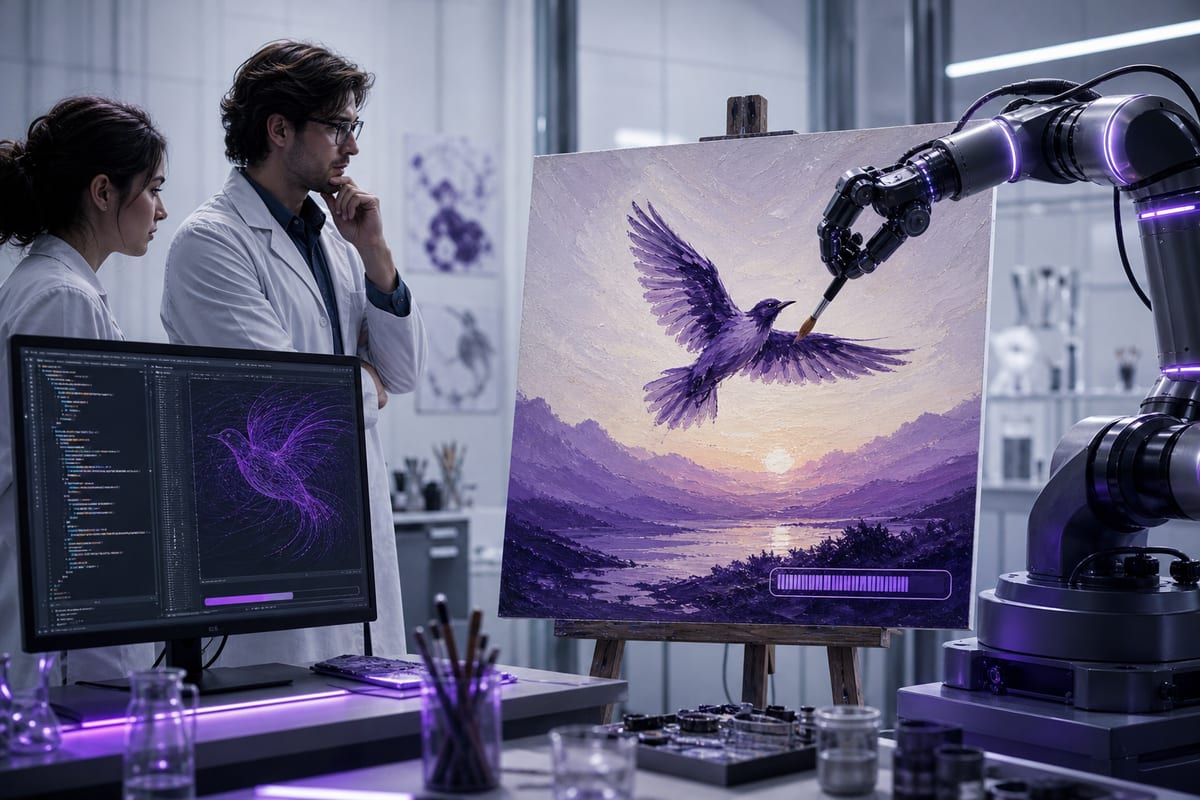
Anthropic highlights Fable 5.2, a language model that creates images by executing simulated brush strokes via Python. The company reports a score of 64.9% on its RoboDojo Sim benchmark compared to 29.8% for GPT-6 Astra, but tests on robotic arms reported by Aris Zhu show Astra to be faster and capable, at this stage, of balancing a domino. Public demonstrations detail execution without an external image model and iterative corrections, stroke by stroke.
Robots and Motor Challenges: Mixed Results Against GPT-6 Astra
Aris Zhu pitted Fable 5.2 against GPT-6 Astra in a painting exercise of The Starry Night using physical robotic arms. His comparison highlights the limitations of Fable 5.2 in fine motor control and a faster execution for Astra. To date, only OpenAI's model has managed to keep a domino standing by gradually loosening its gripper to rely on gravity as a pivot. In simulation, Anthropic reports 64.9% for Fable 5.2 on RoboDojo Sim against 29.8% for GPT-6 Astra, but these scores coexist with performance gaps in the physical trial.
A Model Designed for Long and Technical Tasks
Anthropic presents Fable 5.2 as suitable for demanding technical tasks and long-term projects, similar to Mythos 5.2, which targets researchers specializing in verified security and biology. In its internal evaluations, the company claims this model solved two unresolved questions in black hole physics and created three operational electronic devices in collaboration with the circuit board manufacturer Diode. Anthropic also notes that Fable 5.2 involved over 1,000 sub-agents to write the code for an operating system intended for a laptop within eight days.
Le brief IA que les pros lisent chaque soir
Les 7 actus IA du jour, décryptées en 5 min. Gratuit.
Inclus dès l'inscription : notre sélection des meilleurs guides & comparatifs IA.
Choisissez votre rythme
Gratuit · Pas de spam · Désabonnement en 1 clic
Painting by Program: Simulated Brush Strokes
Fable 5.2 does not generate an image from noise: it executes a Python program that lays down brush strokes on a virtual canvas by simulating the texture of bristles, wet paint, and the surface of the canvas. According to Jake Eaton, the model does not rely on an external image model or pre-rendered or traced sources, with each artwork consisting of 1,000 to 2,000 lines of code driving a painting engine. The approach resembles agentic editing, with tool choices and output evaluations, without an undo button: each stroke is a commitment, produced as a line of coordinates, in contrast to video generators like Flux 3.
Public Demonstrations: Cart and Bird, Stroke by Stroke
Jake Eaton showcased an image of a shopping cart in a parking lot, generated from about 700,000 simulated strokes, and a bird scene derived from 111 coordinate sequences, with post-corrections. Michael Graczyk streamed an experiment where Fable 5.2 painted a bird at sunrise: a 21-second video totaled 111 strokes applied to an initially blank canvas. The very first stroke used color #30346a, had a thickness of 90 pixels, and consisted of five trajectory segments with slight undulations; the model indicated it added a variation of about seven pixels to mimic the gesture of a human hand. Between each series of strokes, Fable 5.2 examined the canvas and made corrections to its own mistakes, such as thickening the back of the bird to transform scattered marks into feathers. In a second piece of 280 strokes, two people painting at dusk required repainting inadvertently spread objects and reversing the active hands so that the inner shoulders could touch, as requested.
After Criticism of Opus 5.5, a Dedicated Authorial Directive
Critics had targeted Opus 5.5 for allegedly imitating existing works. In response, Jake Eaton directed Fable 5.2 towards creating fictional artist personalities with coherent stories and styles. Each painting involving several thousand strokes, he intervenes with comments to redirect the model's progression.
Brief IA — L'actualité IA en français
L'essentiel de l'actualité de l'intelligence artificielle, décrypté et expliqué chaque jour.