Figma Focuses on Humanity at Config 2026 Despite External AI
Le brief IA que les pros lisent chaque soir
Les 7 actus IA du jour, décryptées en 5 min. Gratuit.
Inclus dès l'inscription : notre sélection des meilleurs guides & comparatifs IA.
Choisis ton rythme
Gratuit · Pas de spam · Désabonnement en 1 clic
Figma Focuses on Human Input at Config 2026 Despite External AI
Figma is expanding its design space beyond static layouts to include code, animations, and 3D effects, aiming to keep users on its platform as competitors like Anthropic and OpenAI increasingly offer tools that generate interfaces directly.
The company is introducing collaboration features that allow teams to share successful AI prompts, workflows, and custom plugins, thereby facilitating the enhancement of each other's outcomes.
High inference costs associated with using external AI models are squeezing Figma's profit margins, prompting the company to focus on a tighter integration between design and code to reduce token consumption and improve efficiency.
At Config 2026, Figma is betting on human judgment and smarter token usage rather than developing its own models. AI, a key growth engine for the company, is eroding margins and comes from providers like Anthropic, which are building competing products.
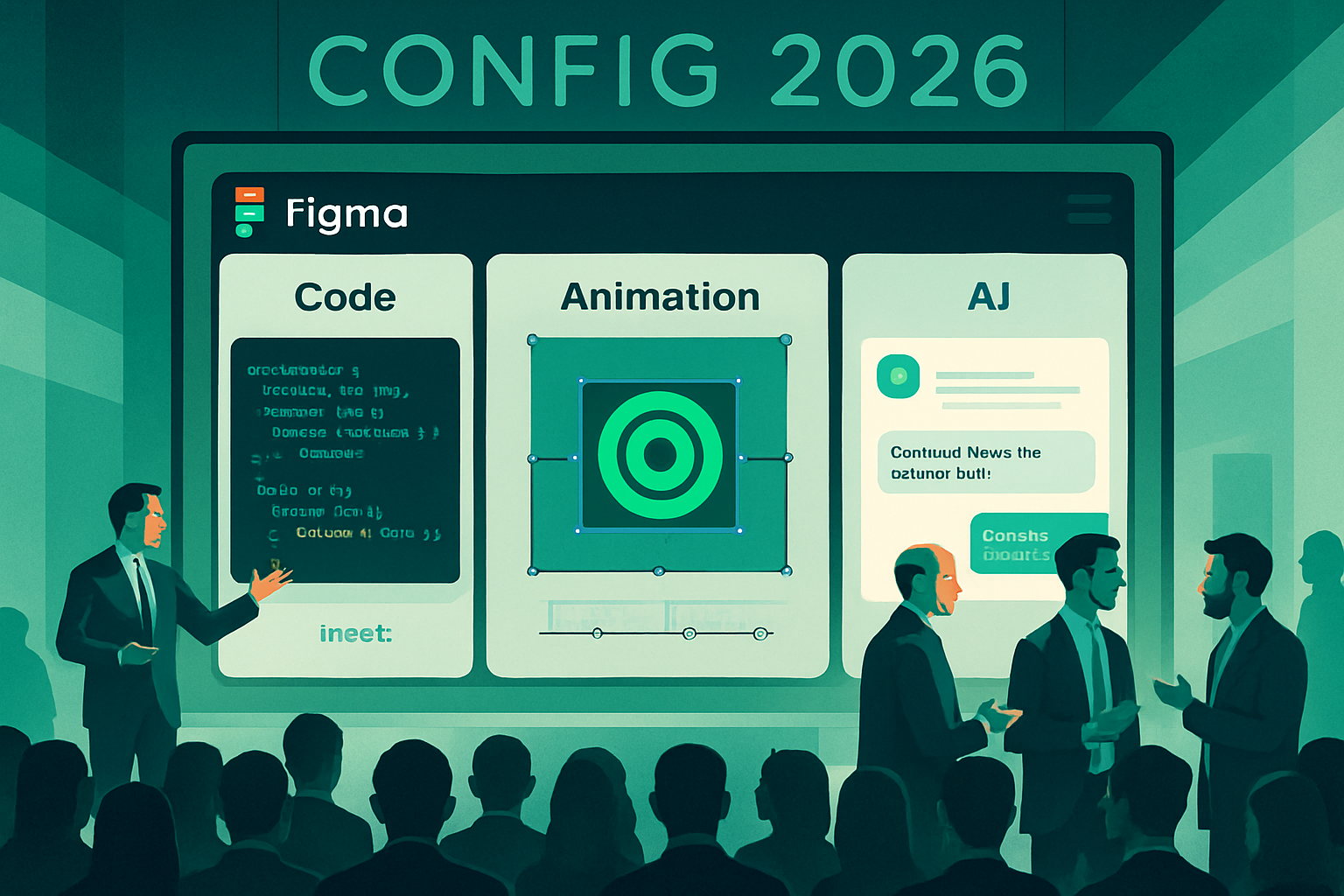
During its annual conference in San Francisco, Figma rolled out a series of updates transforming the design space into a workspace for code, movement, depth, surface effects, and AI agents. The company claims that 95% of Fortune 500 companies build their products in Figma.
Generating interfaces, text, and code with AI has become inexpensive. Human attention, the very thing that all this production competes for, has not increased. Standing out means going beyond what models trained on average internet content can produce. The new features provide designers with more tools for this without relinquishing control over the outcome, according to the company.
Code, Movement, Depth, and Shaders on a Single Canvas
It starts with code. Last year, Figma integrated code onto the canvas for the first time with Figma Make. Now, Make incorporates a team's production code and applies changes through branches, commits, and pull requests, all without a terminal. This feature is currently being rolled out in beta.
With the new Code Layers, design and code coexist in the same space. Users can generate code from a design, request it via an agent, or import a repository from GitHub. From a code layer, they can extract editable design layers, adjust them directly, and reconvert them into code. Figma asserts that the speed matches how designers already iterate through variations with design layers.
Movement is the second element arriving on the canvas. Animations, transitions, and timelines that previously required external tools are now part of the design system. They can be edited collaboratively, generated via an agent, and pushed to production through Dev Mode and MCP.
Additionally, Figma is adding a layer of depth with 3D transformations. Until now, spatial depth in interfaces was primarily simulated with stacked shadows. Now, designers can shape perspective directly.
The new shader feature uses WebGPU for effects like dithering, pixelation, and various types of blur, as well as surfaces resembling frosted glass or polished chrome. This previously required knowledge of graphic programming. Now, users describe the desired effect, and an agent generates it with adjustable controls.
The idea behind all these features is the same. AI should not just produce a finished result that you have to accept or re-request. It should provide you with a tool that you can continue to adjust. The results can be shared within the team.
Finally, Figma integrates Weave, the workflow system acquired last year, as what it calls an "AI material." Weave allows teams to combine multiple models and image sources into a cohesive design direction, for example, for a campaign.
Starting this week, more than 20 Weave tools are available on the canvas. Figma sees this as a first step. Full integration is expected later this year. The goal is to provide brand and product teams with a shared workspace.
Shared Prompts, Skills, and Custom Tools
The second half of the announcement focuses on collaboration. AI has made solo work easier but has complicated teamwork. Teams find themselves bogged down in revisions and lose sight of shared progress.
Figma's solution centers on the prompts themselves. Each interaction with an agent produces a workflow and a prompt technique. Users will be able to search through the work done by their teammates' agents and reuse it as a starting point. Found a good way to solve a problem? Share it with the team.
Agent Skills allow users to define custom commands like /contrast-improvements, share them with the team, and apply them across all designs.
Frequently used workflows can be saved as skills and deployed at the team level, such as checking a design's regulatory compliance. These skills are not new in agent products. They are essential. Agents can also pull in additional information via third-party connectors, web searches, and attachments.
Generative Plugins enable users to create their own reusable tools via prompts, without the need for a development environment. Figma cites the example of a fintech designer who regularly needs certain diagrams and can create a custom tool for that. The company claims to have used this feature internally for several months.
Rented Intelligence, Your Own Risk
This year's Config takes place at a tense moment. With Claude Design, Anthropic can generate a clickable and reasonably polished interface from a prompt in just minutes. Tools like "Vibecoding" challenge the fundamental principle of Figma's business model, which is that a digital product starts with a design file. And Claude Design comes from Anthropic, one of the model providers whose AI Figma uses in its own features. The provider is becoming a competitor.
The Code Layers, Motion, Shaders, and Weave workflows are Figma's response. They integrate AI generation onto the canvas so that it occurs within Figma rather than around it. If you're going to build your interface via prompts anyway, Figma wants to ensure you don't exclude it from the process.
The Provider Becomes a Competitor
This dependency comes at a cost. Figma's AI operates on rented models from OpenAI, Anthropic, and Google, which directly impacts margins. The gross margin has dropped from about 92% to 86% during 2025, with the decline linked to large-scale AI inference costs. Each new AI feature that drives engagement increases the bill.
One of these providers is also a competitor, which is now worrying shareholders. Activist investor Findell Capital has demanded a review of the governance of the board's ties with Anthropic following the launch of Claude Design. A few days before the release, Anthropic's product lead, Mike Krieger, had left Figma's board.
Internal Models? Sort of
The press conference featured CEO Dylan Field and design director Loredana Crisan, who transitioned from Meta to Figma in 2025. When THE DECODER asked whether Figma was training its own base models and how it viewed its reliance on API providers, Field sidestepped the question. The company had trained models at various times, he said, but most were small models designed to improve efficiency.
"We are in a position where we are ready to benefit from all the innovation in the market regarding models and to train our own," he stated.
Figma is not trying to replace cutting-edge models but to avoid being locked into a single provider. Weave, which chains any image model in sequence, is exactly that protection. Canva is taking the opposite approach, training its own models to free itself from API providers.
To combat margin pressure, Figma is betting on more efficient usage rather than ownership of models. CodeConnect links the design system to the corresponding code, so the AI has less to regenerate. In specific and measured cases, this reduces inference costs by about 30%.
Field also criticized the economics behind some of the AI hype. When someone boasts about an AI-generated design, he likes to ask how long it took and how many tokens it cost. Measured against human work time, the result is "sometimes completely irrational."
The Bet on Human Judgment
The machine makes creation cheap. The judgment about it should remain human. AI is a tool and a material, Crisan stated, but not the only way to bring an idea to life.
Field went further and highlighted the weaknesses of the very models Figma relies on. They solve high-level math and coding problems, he said, but they can't handle "div centered" and don't understand aesthetics, UX, or simple judgment calls. He was particularly frank about a downside of rapid adoption. In dialogue with AI, designers often received almost sycophantic praise, clung to a single idea, and quietly abandoned broader exploration.
Figma went public in the summer of 2025, and its stock soared to just under $143 on its first day of trading. Around the launch of Claude Design in April 2026, the stock fell to new annual lows. The 52-week low now stands at $16.60, about 88% below the all-time high. It is currently trading around $19.
The product continues to grow. Revenue recently increased by 46%, and during fiscal year 2025, Figma surpassed the billion-dollar mark. But the growth engine is eroding margins and comes from competing companies in the same market. At Config, Figma showcased a canvas capable of doing everything. The intelligence powering it simply does not belong to Figma.
Brief IA — L'actualité IA en français
L'essentiel de l'actualité de l'intelligence artificielle, décrypté et expliqué chaque jour.