Evaluation Flywheel: Revolutionizing Failure Management in AI
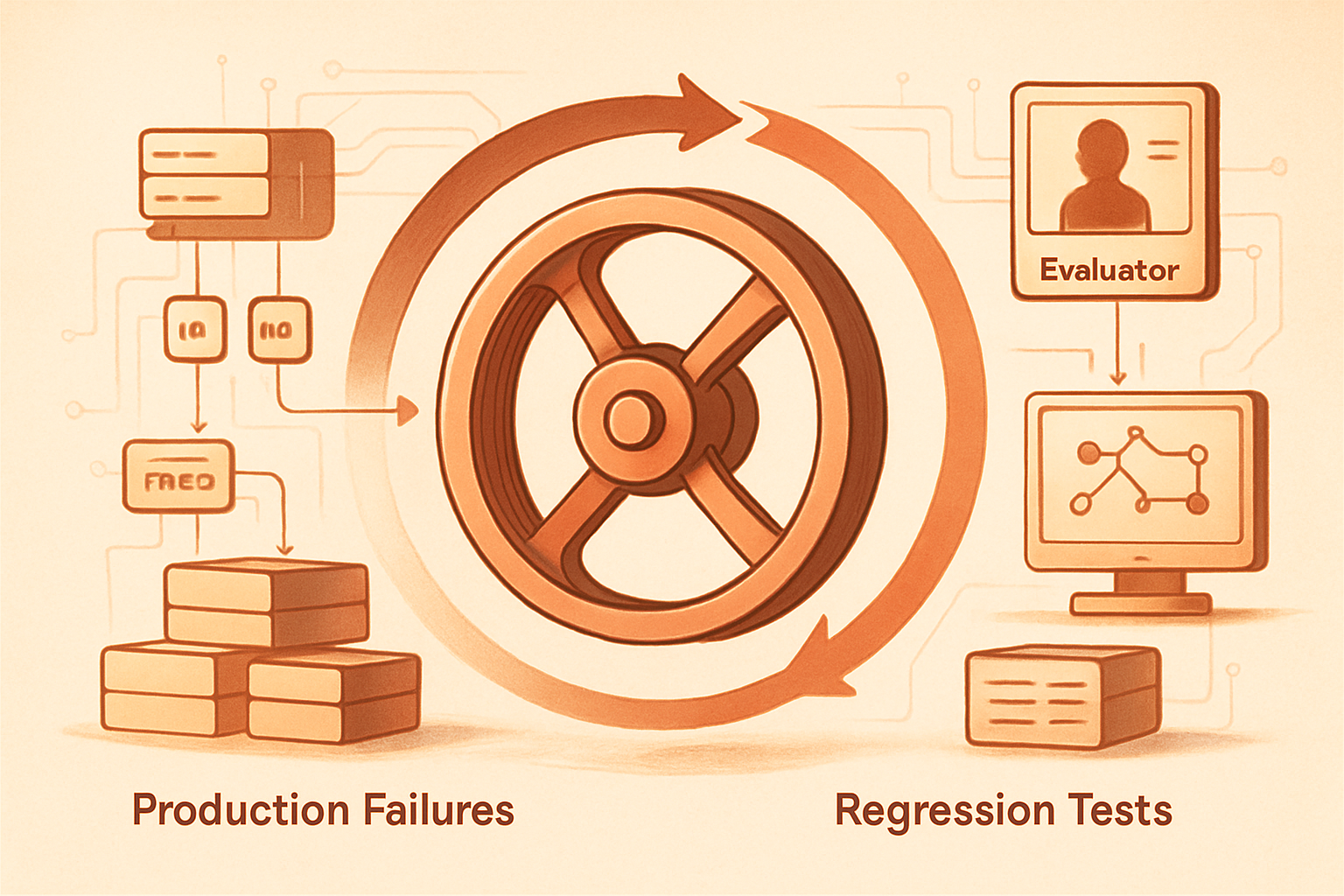
Revolutionizing AI Failure Handling with the Evaluation Flywheel
In traditional software development, a strict loop is followed to address bugs: reporting, reproducing, creating a failing test, fixing, passing the test, and then merging. This process ensures that the bug does not silently reappear. However, artificial intelligence systems require a different approach, known as the evaluation flywheel.
Turning Failures into Opportunities
The evaluation flywheel aims to convert every production failure into a regression test. Key steps in this process include recording failures using trace IDs, triaging and labeling failures, as well as minimizing failures during reproducible evaluations. An appropriate evaluator is chosen based on the type of issue: rules for structural problems, exact matching for fixed outputs, and language models to assess subjective quality.
Le brief IA que les pros lisent chaque soir
Les 7 actus IA du jour, décryptées en 5 min. Gratuit.
Inclus dès l'inscription : notre sélection des meilleurs guides & comparatifs IA.
Choisissez votre rythme
Gratuit · Pas de spam · Désabonnement en 1 clic
Continuous Integration and Regression Prevention
Automatically running the evaluation suite as part of continuous integration (CI) allows for blocking regressions with every change. This method is particularly crucial for agentic systems, where non-determinism and combinatorial failures can occur.
Challenges and Best Practices
Evaluation programs can encounter several common types of failures, such as bloat, unreliable judgments, a false sense of security, costs associated with non-determinism, outdated cases, and organizational incentives. To counter these challenges, it is recommended to maintain minimal cases, version in parallel with prompts and graphs, perform repeated sampling for non-deterministic cases, and conduct quarterly audits.
An Evolving Discipline
The evaluation flywheel is presented as a discipline that gradually strengthens AI systems. By integrating failures as learning opportunities, this approach enables the construction of more robust and resilient systems in the face of incidents.
Brief IA — L'actualité IA en français
L'essentiel de l'actualité de l'intelligence artificielle, décrypté et expliqué chaque jour.