Gates Foundation: $1 Billion for Useful AI Beyond English
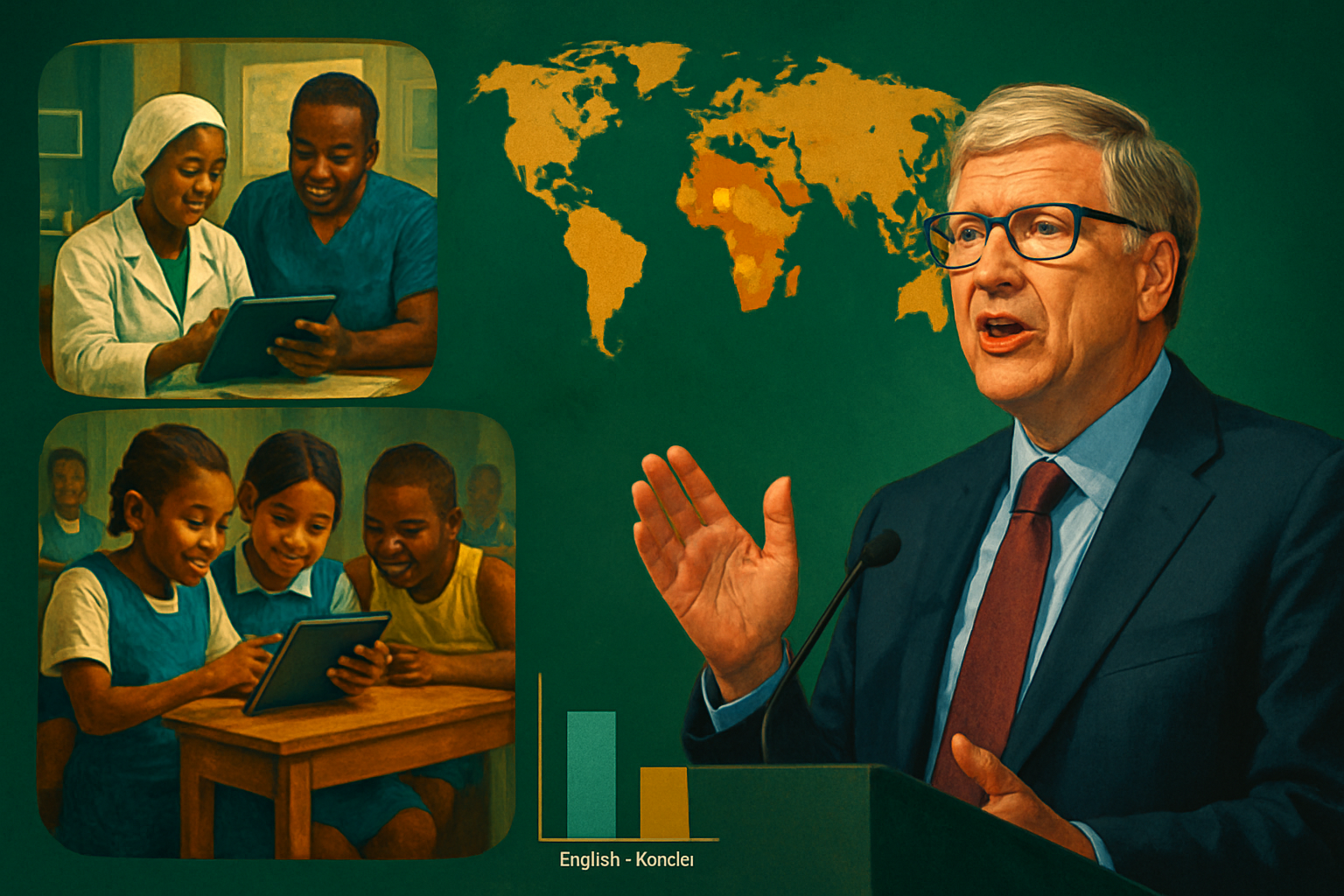
The Gates Foundation is allocating at least one billion dollars over two years for AI applications in health, education, and agriculture, with a portion dedicated to underrepresented languages. Experiments in Kenya, Sierra Leone, and India serve as proof of concept. Bill Gates emphasizes a window of 12 to 18 months to decide who will truly benefit from these systems, while also highlighting the risks he associates with AI.
Measured pilots and a financial target of $200 billion by 2045
Several projects are being put forward as demonstrators. In Kenya, at Penda Health clinics, an AI diagnostic and dosage assistant is credited with a 16-point increase in diagnostic accuracy. In Sierra Leone, an eight-week pilot with the Gemini Guided Learning tool produced up to 1.7 years of progress among participating students. In India, the MahaVISTAAR AI service already reaches over 740,000 farmers and costs less than 18 cents per person for public authorities. These initiatives fall within a broader financial framework: the Gates Foundation aims for approximately $200 billion in spending by its announced closure in 2045, which represents 99% of Bill Gates' remaining fortune.
Funding field tools and opening non-English data
The foundation plans to allocate at least one billion dollars over two years to tools for professionals in education, health, and agriculture. A portion of these resources will be dedicated to integrating non-English sources into large datasets, so developers can create and deploy in more languages. The funding will also cover concrete projects, such as diagnostic aids in Kenya, learning systems in Sierra Leone, and agricultural advisory services in India. Bill Gates believes the market will not bridge this linguistic gap on its own and that, without targeted intervention, the most effective solutions will first concentrate where users can pay.
Le brief IA que les pros lisent chaque soir
Les 7 actus IA du jour, décryptées en 5 min. Gratuit.
Inclus dès l'inscription : notre sélection des meilleurs guides & comparatifs IA.
Choisissez votre rythme
Gratuit · Pas de spam · Désabonnement en 1 clic
The linguistic gap: 90% of data in English and error rate disparities
The first generations of large language models were trained on over 90% of data from English. Bill Gates links this bias to the observed outcomes: the best speech recognition tools have an error rate of less than 6% for English, while an equivalent tool exceeds 60% failure in Yoruba. He argues that this underrepresentation particularly affects audiences that could benefit most from AI and notes that, for about one billion mostly English-speaking users, progress is steady, while for approximately seven billion others, the situation remains stagnant. He adds that a poor translation can be critical in a medical emergency context.
Twelve to eighteen months to decide who will benefit from AI
Bill Gates places the bulk of the decisions within the next 12 to 18 months regarding how AI is designed, funded, and deployed. According to him, these choices will determine whether the benefits will primarily go to those who already have the most or extend to those who have the least. He warns that, without dedicated initiatives, the gap will widen. He simultaneously presents AI as a substantial promise, provided that its benefits stem from public policies rather than chance.
A sustained warning about the risks associated with AI
Bill Gates recently published a lengthy essay accusing the tech industry of deliberately downplaying risks for financial reasons. He points out dangers such as lasting job losses, potential diversion towards biological weapons, and the psychological cost of omnipresent AI companions. At the same time, he asserts that AI can both reduce and exacerbate inequalities, reminding that the direction it takes is a "choice in the present" and that, if properly guided, it can expand access to solutions and knowledge.
Brief IA — L'actualité IA en français
L'essentiel de l'actualité de l'intelligence artificielle, décrypté et expliqué chaque jour.