For Tony Fadell, the winning AI agent will run on the device
Le brief IA que les pros lisent chaque soir
Les 7 actus IA du jour, décryptées en 5 min. Gratuit.
Inclus dès l'inscription : notre sélection des meilleurs guides & comparatifs IA.
Choisis ton rythme
Gratuit · Pas de spam · Désabonnement en 1 clic
Tony Fadell sees the failures of early AI gadgets as a problem of real need and trust. He advocates for an agent that operates entirely locally for reasons of privacy and efficiency, cites Apple for its hardware advantage but notes a lack of AI expertise, and uses Meta's Muse as an example to illustrate the demand for security.
Trust Tested with Muse and the Demand for Security
Meta launched Muse, a versatile AI assistant. A security researcher quickly identified a serious vulnerability shortly after its launch. According to 404 Media, Meta employees discovered security issues, and several teams worked urgently and overtime to fix them before release. For Tony Fadell, trust and security will be paramount for anything we entrust to an intelligence.
Focus on Local: The Technical Path Advocated by Fadell
Tony Fadell predicts that a successful AI agent will need to operate entirely on-device, citing reasons of privacy and efficiency. He does not believe in a future dominated by data centers and emphasizes the computing power now available on battery-powered devices. He adds that keeping sensitive data on the device has helped Apple gain user trust for biometric uses like Face ID.
Apple in a Strong Hardware Position, but Lacking a Leading In-House AI Model
Tony Fadell cites Apple as one of the few companies likely to succeed, believing that the company has the necessary hardware, chips, and other components. However, he argues that Apple does not have all the AI expertise. Apple lacks a world-class model, and the new AI assistant Siri relies on customized versions of Google’s Gemini. Apple is behind in proprietary AI but ahead in hardware. Tony Fadell also recalls having previously criticized Apple when he felt the company was making mistakes.
Why the First Wave Missed Its Target
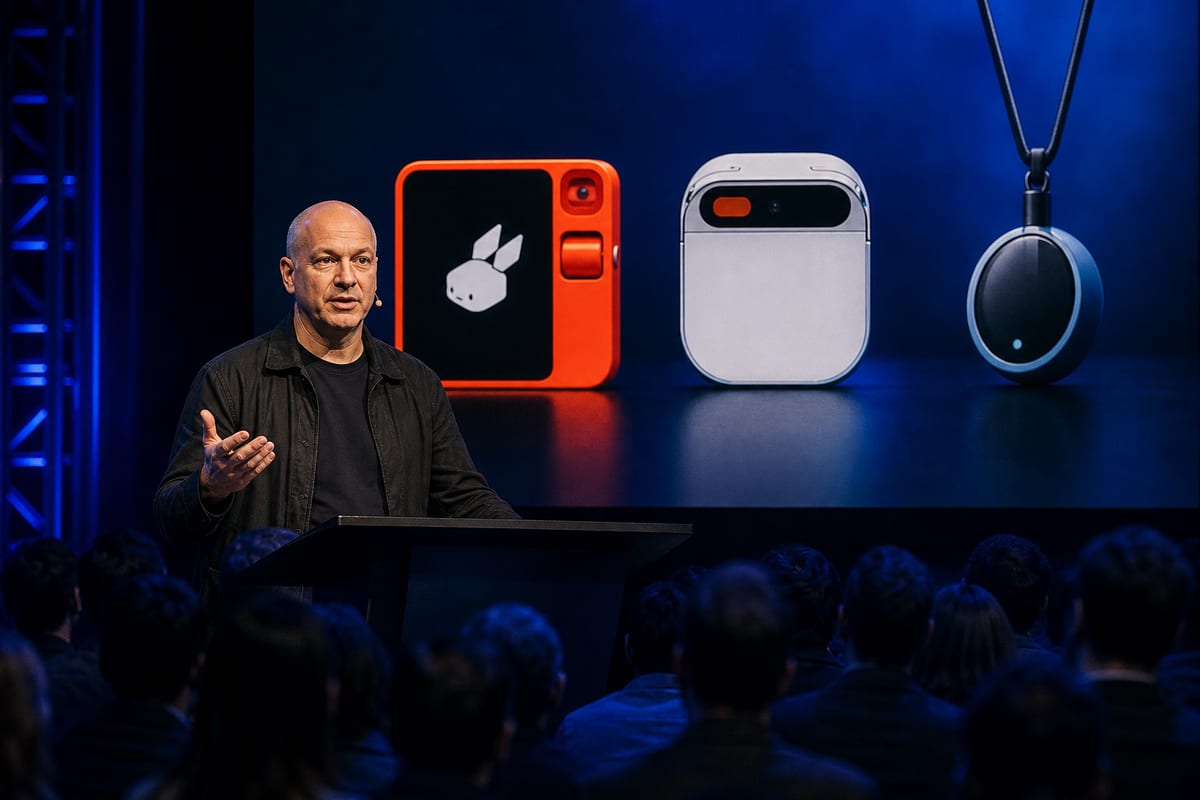
During his talk, Tony Fadell revisited the cases of the Rabbit R1, the Humane Ai Pin, and Limitless, first-generation devices that were abandoned. He believes they did not meet any real needs and were primarily technology for enthusiasts. These products promised the convenience of a personal assistant but did not work very well. Tony Fadell reminds us that less than 0.01% of the population has ever had a human assistant and that most consumers do not really understand what that entails. He explains that it took him years to learn how to better use an assistant, to entrust it with sensitive data, and to let it organize meetings or interact with his bank, and he considers that there are still many steps before widespread adoption by the general public and businesses.
Without a Device Ecosystem, Players Are Betting on Sensor Gadgets
Tony Fadell argues that companies like Meta and OpenAI are turning to gadgets because they do not have billions of devices in circulation like Apple. According to him, lacking access to phone sensors, they request video, audio, and GPS location, up to a list of 20 permissions or more, and then design a device without a screen that integrates these sensors. These devices connect via Bluetooth or Wi-Fi to the phone and then save data on the web or through a 5G network. Tony Fadell was speaking at MIT Future Fest. He indicated that companies had approached him and that he declined. A former executive credited as the father of the iPod, co-creator of the iPhone, and founder of Nest, which was acquired by Google, he also emphasizes that for a startup, a failure can be fatal and that it only has one chance, unlike Apple, which he cited with the Vision Pro.
Brief IA — L'actualité IA en français
L'essentiel de l'actualité de l'intelligence artificielle, décrypté et expliqué chaque jour.