From Steel Part to Toy: AI Moves to Physical Objects
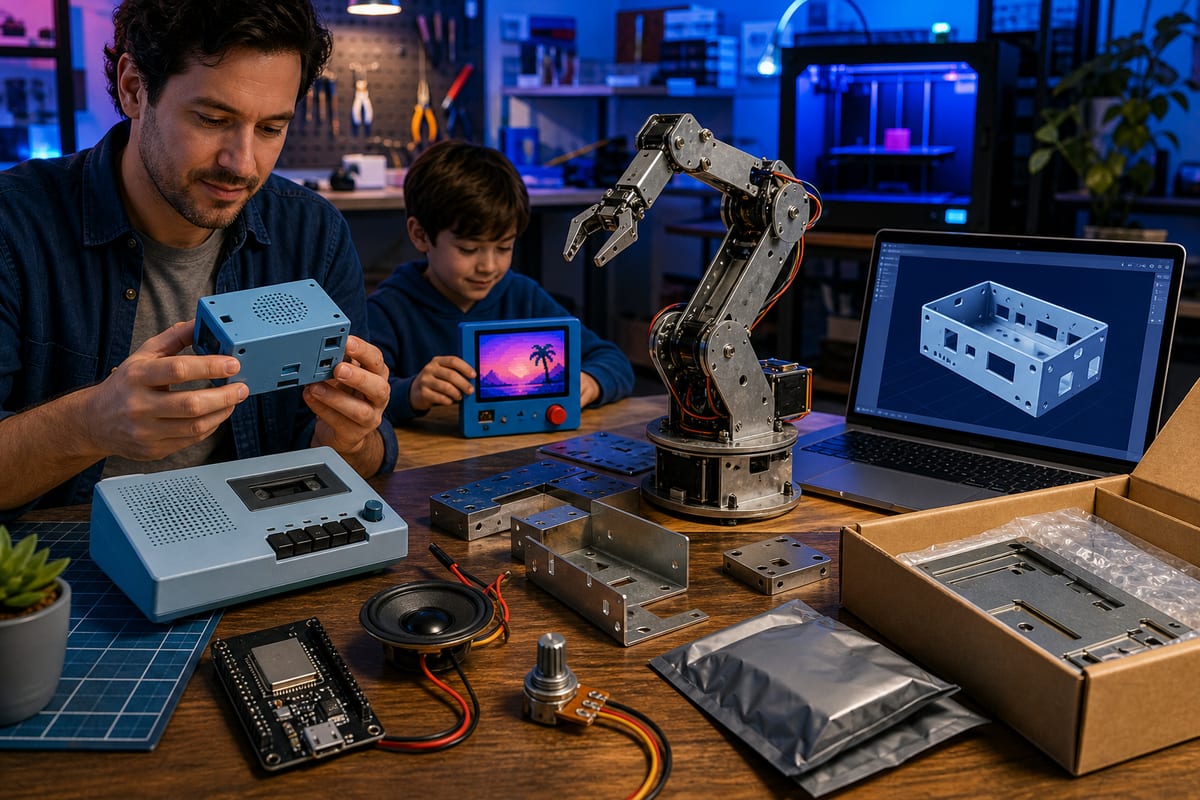
Amateurs and engineers alike are mobilizing chatbots to design, iterate, and order real parts. Prototypes in just a few minutes, a robotic arm for $200, a series of toys for €500: initial uses are taking hold, especially for simple objects aimed at children, while tools like text-to-CAD are racking up thousands of stars.
Delivered Objects, Adopted Toys, and €500 Series
The toy designed by Arthur Prince works and has won over its first tester, his daughter. After a consensus was reached among the chatbots on the design, he ordered 10 units from the Chinese manufacturer JLCPCB for about €500. David Plakon notes that his family messaging box is operational and that he hopes to market it one day. For now, he plans to set it up at the grandparents' house for Christmas and does not envision factory production. To achieve this, he printed around 15 versions of his model to improve the fit.
Iterations, Budgets, and Deadlines: The Reality of AI-Assisted Design
Several vibe manufacturers report multiple iteration cycles that weigh on their budgets. Jake Fitzgerald mentions having observed cumulative failures a few months ago, such as misaligned screw holes, which led him to spend about $2,000 on repeated orders for parts. David Plakon reminds us that while AI is useful, it is not perfect. Regarding timelines, Jeff Deehan received his part ten days after ordering and estimates he could design the prototype in about ten minutes, with the chatbot proposing an initial design in five minutes.
Tools and Community: text-to-CAD Surpasses 23,000 Stars
Amy Zhou and Jake Fitzgerald are developing text-to-CAD, an open-source tool dedicated to vibe manufacturing that has amassed over 23,000 stars on GitHub. Zhou, who worked on the iPhone case team at Apple and is now a design engineer at Vizcom, and Fitzgerald, who communicates with her between San Francisco and New York, aim to transform traditional CAD. Vibe manufacturers argue that a large language model simplifies tasks previously reserved for specialists.
Le brief IA que les pros lisent chaque soir
Les 7 actus IA du jour, décryptées en 5 min. Gratuit.
Inclus dès l'inscription : notre sélection des meilleurs guides & comparatifs IA.
Choisissez votre rythme
Gratuit · Pas de spam · Désabonnement en 1 clic
Use Cases: Robotic Arm, Jewelry, and Printed Brain
With text-to-CAD, 31-year-old Jake Fitzgerald designed a sheet metal robotic arm, commissioned from SendCutSend for about $200. The device, equipped with a motor and a camera, has a reach of 0.6 meters and is envisioned as an "edutainment" product to teach robotics. Amy Zhou creates jewelry with AI after a previous startup that converted photos into 3D wax-cast charms; she notably made a necklace for Roy Lee, CEO of Cluely, and continues occasionally for friends. In London, Sourish Sharma transformed MRI data into a printable model: after manual corrections with an open-source tool, he now uses GPT-6 Astra, which he finds superior for producing a more accurate brain, printed in full size and miniatures. He claims that AI completely replaces CAD engineering and believes that with GPT-6 Astra, cumulative failures are no longer an issue.
Children: Simpler Objects to Prototype Without the Internet
Vibe manufacturing is becoming more challenging with product complexity and does not allow for the prospect of making a car at home with ChatGPT anytime soon. Toys for children, being simpler and more accessible, form an initial ground. Near Paris, 34-year-old Arthur Prince says he modeled a toy with AI in a week that would have taken him months in CAD; the object generates stories and images from a voice prompt and was designed with GPT-6 Astra, then reviewed by Claude. In Austin, 39-year-old David Plakon, a long-time tinkerer and 3D printer user since 2015, chose with his wife to build an offline messaging machine for their children and grandparents. He provided design inspirations to GPT-6 Astra, required purchasable or printable parts, and followed recommendations for a potentiometer, a speaker, and an ESP32 chip, with assembly guidance.
Manufacturing Chain: Online Ordering and On-Demand Workshops
Tinkerers are now designing a variety of physical objects with AI, dubbing this movement vibe manufacturing in echo of vibe coding for software. Supporters are confident in its potential. The practice combines chatbot-assisted prototyping and outsourcing to manufacturers, fabrication workshops, and home 3D printers. In this flow, services like SendCutSend come into play after the models, exported in DXF, have been ordered and paid for online. Despite the success of some cases, dimensional discrepancies remain a possibility, where other players claim that AI allows for extending the gains already observed in programming to hardware.
Brief IA — L'actualité IA en français
L'essentiel de l'actualité de l'intelligence artificielle, décrypté et expliqué chaque jour.